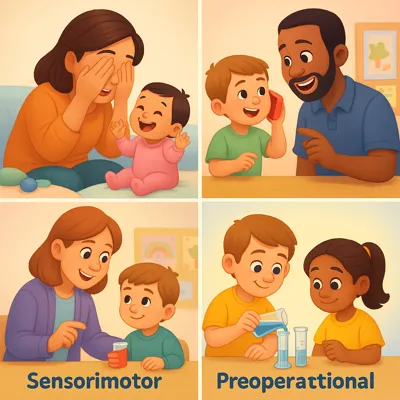
Jean Piaget: Cognitive Development Theory
Understanding how children construct knowledge through interaction and staged growth.
Swiss psychologist Jean Piaget (1896-1980) transformed our understanding of childhood. He argued that children aren't simply "less able" adults, but active thinkers who construct their own world through exploration.
His process-oriented view showed how thinking evolves in qualitatively different stages as children interact with their environments.

The Four Key Concepts
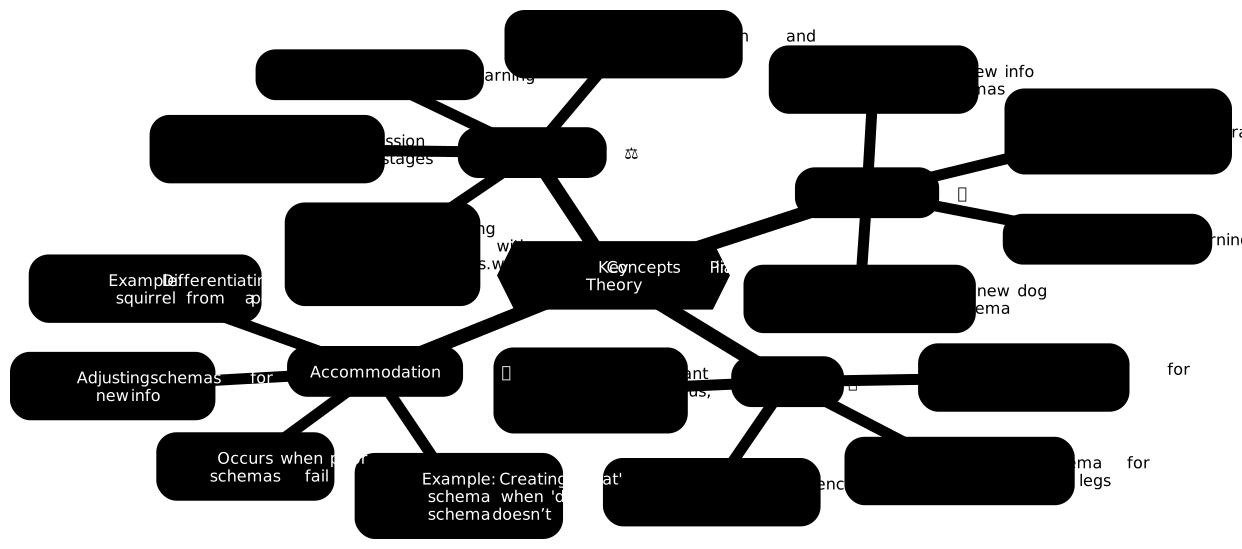
Schema Theory
Mental structures used to organise knowledge. As children grow, a simple "Dog" schema matures into a complex understanding of "Animals."
Assimilation
Fitting new information into existing schemas (e.g., seeing a new breed of cat and adding it to the "Cat" schema).
Accommodation
Adjusting or creating new schemas when information doesn't fit (e.g., realising a four-legged animal that barks is a "Dog," not a "Cat").
Equilibration
The force that moves development forward by striking a balance between assimilation and accommodation.
The Four Stages of Growth
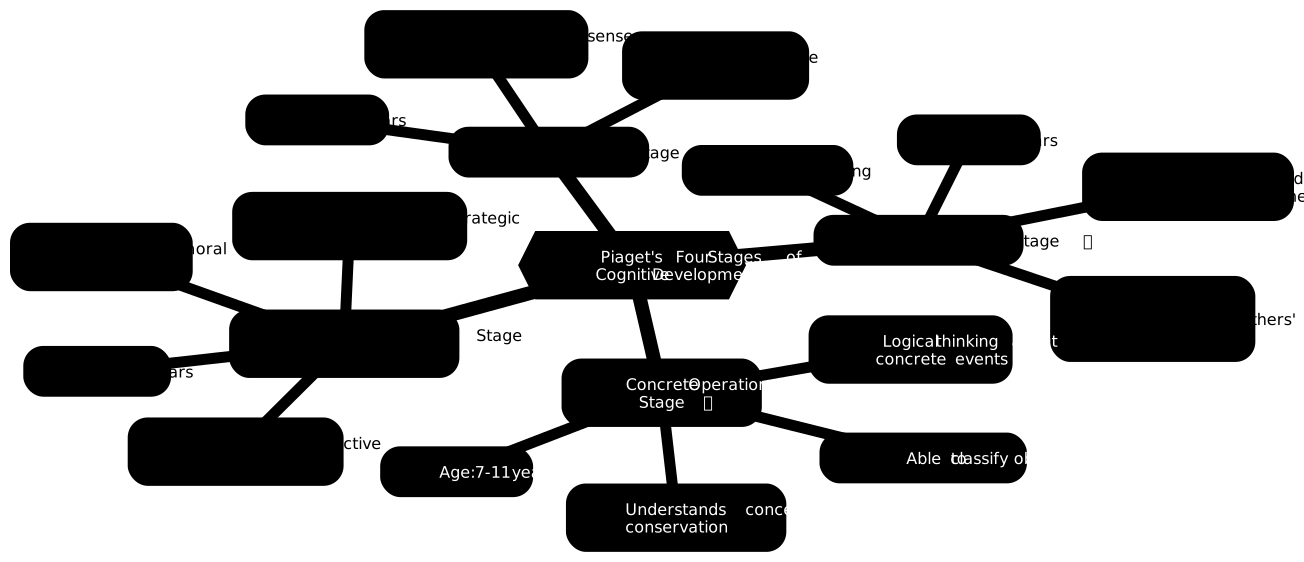
Sensorimotor Stage
Learning through senses and motor actions. Key milestone: Object Permanence—knowing things exist even when out of sight.

Preoperational Stage
Symbolic thinking and language develop. Thinking is Egocentric (struggling to see other perspectives) and lacks Conservation.

Concrete Operational
Logical thinking begins. Children understand Reversibility and classification. Egocentrism declines as empathy grows.

Formal Operational
The ability to think abstractly and hypothetically. Adolescents can use logical frameworks to predict outcomes and reason through moral or philosophical issues.
Educational Impact
Piaget's work underpins the modern focus on Learning through Play. Teachers act as facilitators, providing hands-on activities that allow children to discover concepts independently through trial and error.
Criticisms & Alternatives
Lev Vygotsky
"Social context is key."
Argued that children learn through the "Zone of Proximal Development" with others, rather than as solitary explorers.
Jerome Bruner
"Language and Scaffolding."
Felt Piaget underestimated how language and structured guidance (scaffolding) accelerate learning.
Martin Hughes
"Egocentrism Debated."
Demonstrated that children as young as three could understand other perspectives in real-world contexts.
Kurt Fischer
"Dynamic Skill Theory."
Proposed that cognitive skills develop in non-linear, dynamic ways rather than rigid stages.
Final Thought
While Piaget's theory has its critics, it remains a vital framework for understanding the qualitative shifts in how children think. By respecting developmental readiness, we can better support every child's intellectual journey.

Mark Else
My experience ranges from running playgroups for pre-schoolers to managing complex safeguarding caseloads within both mainstream and SEMH provisions. In addition to having worked within the education sector since 2018, I am currently studying for a Level 6 Youth Work degree.