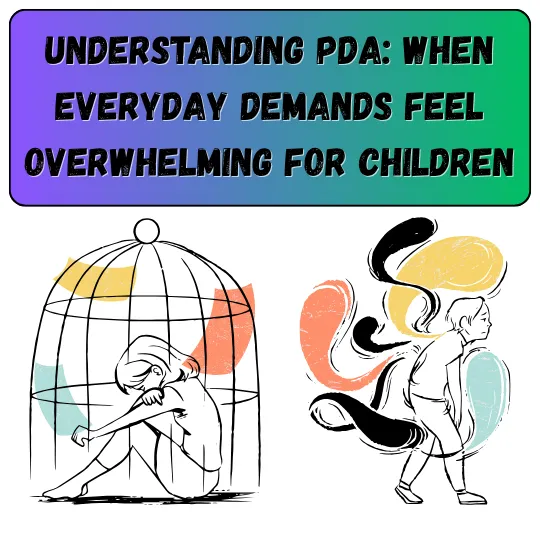
Understanding Pathological Demand Avoidance (PDA)
Reframing avoidance as an anxiety-driven need for autonomy and safety.
"It’s not that they won’t comply; it’s that their brain tells them they can’t."
For most, daily routines are simple tasks. For a child with PDA, a request like "put your shoes on" can trigger intense anxiety. To an outsider, this looks like defiance; in reality, it is a survival response to a perceived loss of control.
The PDA Profile
The Root Cause
PDA is driven by an intolerance of uncertainty and high levels of anxiety. The nervous system perceives demands as life-threatening, triggering a fight, flight, freeze, or fawn response.
Avoidance Strategies
Children may use distraction ("Look at that bird!"), excuses ("My legs are broken"), or fantasy roles to deflect the perceived pressure.
Social Capability
Unlike other autistic profiles, children with PDA often have high social awareness, which they may use to negotiate or navigate out of demands.
Pillars of Support
At Home
- • Gentle Invitations: Replace "Do this" with "I wonder if we could..."
- • Choices: Offer two options to restore a sense of agency.
- • Humour: Use playfulness to lower the "threat" level of a task.
In the Classroom
- • Indirect Language: "I'll just leave this worksheet here in case you want to look."
- • Collaborative Planning: Involve the pupil in setting their own schedule.
- • Safe Havens: Access to quiet zones when anxiety peaks.
The Failure of "Control"
Compliance vs. Connection
Traditional behaviour plans—sticker charts, time-outs, and sanctions—usually increase anxiety for a child with PDA. These methods reinforce the feeling of being controlled, pushing the child further into crisis.
"The more we pushed, the more distressed our child became. It was only when we stopped fighting for control that things began to change."
Summary of Support
- 1. Reduce Demands: Lower the pressure, not the expectation.
- 2. Prioritise Trust: A secure child is a more cooperative child.
- 3. Predictability: Use visual aids and advance warnings for transitions.
- 4. Manage Your Calm: Children with PDA mirror the emotions of the adults around them.
Hope and Flouring
Children with PDA are often creative, intuitive, and highly capable. When we reframe their avoidance as a matter of safety rather than "bad behaviour," we unlock their true potential.

Mark Else
My experience ranges from running playgroups for pre-schoolers to managing complex safeguarding caseloads within both mainstream and SEMH provisions. In addition to having worked within the education sector since 2018, I am currently studying for a Level 6 Youth Work degree.
References
- Birkett, K. et al. (2022) ‘Matching Level of Clinical Support to Patient Risk When Caring for Children With Behavioral Challenges’, Intellectual and Developmental Disabilities, 60(1), pp.32–41. American Association on Intellectual and Developmental Disabilities (AAIDD). Available at: https://doi.org/10.1352/1934-9556-60.1.32
- Gillberg, C. (2014) ‘Commentary: PDA – public display of affection or pathological demand avoidance? – reflections on O’Nions et al. (2014)’, Journal of Child Psychology and Psychiatry. Wiley. Available at: https://doi.org/10.1111/jcpp.12275
- Gore Langton, E. and Frederickson, N. (2016) ‘Parents’ experiences of professionals’ involvement for children with extreme demand avoidance’, International Journal of Developmental Disabilities. Informa UK Limited. Available at: https://doi.org/10.1080/20473869.2016.1204743
- Kildahl, A.N. et al. (2021) ‘Pathological demand avoidance in children and adolescents: A systematic review’, Autism. SAGE Publications. Available at: https://doi.org/10.1177/13623613211034382
- Newson, E. (2003) ‘Pathological demand avoidance syndrome: a necessary distinction within the pervasive developmental disorders’, Archives of Disease in Childhood. BMJ. Available at: https://doi.org/10.1136/adc.88.7.595
- O’Nions, E. et al. (2017) ‘Dimensions of difficulty in children reported to have an autism spectrum diagnosis and features of extreme/“pathological” demand avoidance’, Child and Adolescent Mental Health. Wiley. Available at: https://doi.org/10.1111/camh.12242
- Stuart, L. et al. (2019) ‘Intolerance of uncertainty and anxiety as explanatory frameworks for extreme demand avoidance in children and adolescents’, Child and Adolescent Mental Health. Wiley. Available at: https://doi.org/10.1111/camh.12336