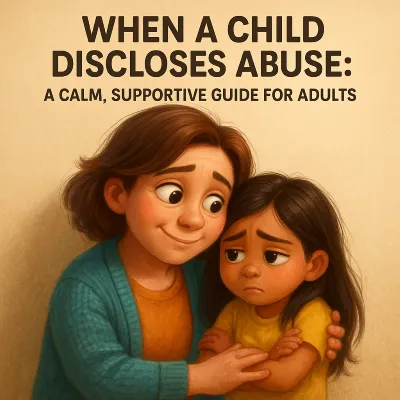
Responding to Child Abuse Disclosures
A professional guide on receiving, recording, and reporting disclosures with care and clarity.
The point at which children drop all of their barriers and trust in you enough to disclose abuse will be one that lives with you both forever.
Disclosures of abuse are among the most significant moments in a child’s life, and how adults respond can shape their healing journey (Allnock and Miller, 2013). Whether you’re a parent, teacher, youth worker, or another trusted adult, knowing how to respond is vital.
Understanding the Disclosure Process
Children may not always disclose abuse in a clear or direct way. It can come out in fragments, through behaviour, or in moments of quiet trust.

Immediate Response: The First Moments
What to Do
- ✅ Stay Calm: Maintain a steady, non-shocked presence.
- ✅ Listen: Use prompts like "I'm listening" without leading.
- ✅ Believe Them: Say clearly, "I believe you."
- ✅ Be Honest: Explain you must tell someone who can keep them safe.
What to Avoid
- ❌ No Leading Questions: Avoid "Did they do X?"
- ❌ No Promises of Secrecy: You must follow procedure.
- ❌ No Investigation: Do not interrogate or ask "Why?"
- ❌ No Panic: Emotional cues can lead to child shut-down.
Next Steps & Reporting
Accurate and Timely Recording
- Inform the Designated Safeguarding Lead (DSL) immediately.
- Use the child’s exact words and factual language.
- Record date, time, location, and everyone present.
- Note how the disclosure came about.
- Include any injuries seen using an official body map.
- Keep notes secure as per organizational policy.
Supporting the Child After
Maintain Familiarity
Keep daily life stable—school, hobbies, and predictable routines help. Avoid overwhelming changes.
Emotional Availability
Use gentle check-ins like "I'm here if you want to talk." Let the child guide the pace of conversation.
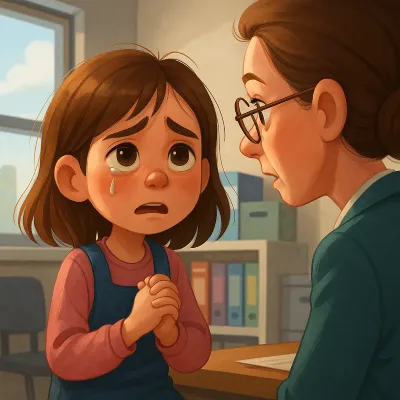
Supporting Yourself
Hearing a child disclose abuse can be emotional and heavy. You need support, too. It is normal to feel shock, anger, or helplessness.
Peer Support
Speak to your DSL or a trusted colleague.
Reflective Practice
Acknowledge thoughts without judgement.
Intention
Decompress via walking, journaling, or quiet reflection.
Key Resources
Emergency Services
999
Call if a child is at immediate risk.
NSPCC Helpline
0808 800 5000
Advice for adults with concerns.
Conclusion
Disclosures take immense courage. So does receiving them. When adults respond with safety and kindness, children are more likely to begin healing. You are already making a difference by listening and acting with compassion.

Mark Else
My experience ranges from running playgroups for pre-schoolers to managing complex safeguarding caseloads within both mainstream and SEMH provisions. In addition to having worked within the education sector since 2018, I am currently studying for a Level 6 Youth Work degree.
References
- Allnock, D. and Miller, P., 2013. No one noticed, no one heard: A study of disclosures of childhood abuse. London: NSPCC.
- Bath, H., 2008. The three pillars of trauma-informed care: Safety, connection and emotional regulation. Reclaiming Children and Youth, 17(3), pp.17–21.
- Beckett, H. et al., 2013. 'It’s wrong – but you get used to it': A qualitative study of gang-associated sexual violence towards, and exploitation of, young people in England. London: University of Bedfordshire.
- Cossar, J., Brandon, M. and Jordan, P., 2011. Don’t make assumptions: Children’s and young people’s views of the child protection system. London: Children’s Commissioner for England.
- Department for Education, 2023. Keeping children safe in education: Statutory guidance for schools and colleges. [online] Available at: <https://www.gov.uk/government/publications/keeping-children-safe-in-education> [Accessed 8 May 2025].
- HM Government, 2018. Working together to safeguard children: A guide to inter-agency working to safeguard and promote the welfare of children. [online] Available at: <https://www.gov.uk/government/publications/working-together-to-safeguard-children--2> [Accessed 8 May 2025].
- Ministry of Justice, 2011. Achieving best evidence in criminal proceedings: Guidance on interviewing victims and witnesses. [online] Available at: <https://www.cps.gov.uk/legal-guidance/achieving-best-evidence-criminal-proceedings> [Accessed 8 May 2025].
- NICE, 2018. Child abuse and neglect. NICE guideline [NG76]. [online] Available at: <https://www.nice.org.uk/guidance/ng76> [Accessed 8 May 2025].
- NSPCC Learning, n.d. Writing a safeguarding report. [online] Available at: <https://learning.nspcc.org.uk/safeguarding-child-protection/writing-records> [Accessed 8 May 2025].
- NSPCC, n.d. Reflective supervision in safeguarding. [online] Available at: <https://learning.nspcc.org.uk/supervision/reflective-supervision> [Accessed 8 May 2025].
- Ofsted, 2022. Inspecting safeguarding in early years, education and skills. [online] Available at: <https://www.gov.uk/government/publications/inspectingsafeguarding-in-early-years-education-and-skills> [Accessed 8 May 2025].
- United Nations, 1989. Convention on the Rights of the Child. [online] Available at: <https://www.unicef.org.uk/what-we-do/un-convention-child-rights/> [Accessed 8 May 2025].