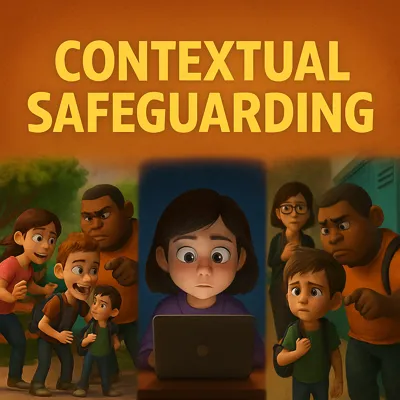
What is Contextual Safeguarding?
Broadening child protection to address risks and exploitation outside the home environment.
Pioneered by Dr Carlene Firmin, Contextual Safeguarding is a proactive approach focused on protecting children from extra-familial harm.
It recognises that as children grow, they are influenced by a complex network of relationships beyond their parents' control—including schools, peer groups, and online spaces.

Core Principles
Understanding the context of abuse is vital. The environment often shapes the exploitation:
Schools
Risks of bullying, peer pressure, and harmful relationships.
Online Spaces
Cyberbullying, grooming, and exposure to harmful content.
Communities
Vulnerability to serious youth violence and local crime.
Peer Groups
Susceptibility to negative influence and coercion.
Key Extra-Familial Risks
| Issue | Vulnerabilities & Context |
|---|---|
| County Lines | Criminal gangs exploit children to transport drugs. Vulnerabilities include school truancy, substance use, or missing episodes. |
| Online Grooming | Predators use chat rooms/social media. Children seeking love or belonging are at high risk. |
| Child-on-Child Abuse | Bullying and harassment. Children with SEN or those who witness domestic abuse are more susceptible. |
| Radicalisation | Extremist recruitment occurring online and in-person. Unsupervised internet access is a major factor. |
Contextual Safeguarding in Practice
Professionals must look beyond the immediate situation. If a child is found with drugs, we shouldn't simply label them a "dealer." We must investigate the community dynamics—are they being coerced?
Key Practice Tool: Mapping Exercises
Identify the environments influencing the child's life to find other potential victims or risk-takers.

The Paradigm Shift
Traditional Safeguarding
- ● Focus on harm within the home
- ● Parental ability to keep child safe
- ● Reactive (after harm occurs)
Contextual Safeguarding
- ● Focus on harm outside the home
- ● Peer, school, and community influence
- ● Proactive (intervention before harm)
Conclusion
Contextual safeguarding provides a framework to broaden our understanding of protection. By shifting focus from family members to peer relationships and community spaces, we enable a more holistic, community-based approach.

Mark Else
My experience ranges from running playgroups for pre-schoolers to managing complex safeguarding caseloads within both mainstream and SEMH provisions. In addition to having worked within the education sector since 2018, I am currently studying for a Level 6 Youth Work degree.
References
- Contextual Safeguarding Network
- References - Contextual Safeguarding - Cambridge University Press
- Contextual Safeguarding in Practice - CHSCP
- Contextual Safeguarding - Oxfordshire Safeguarding Children Board
- Contextual Safeguarding | BASW
- Contextual Safeguarding and Child Protection: Rewriting the Rules
- Contextual safeguarding | NSPCC Learning
- Contextual Safeguarding in Practice - CHSCP