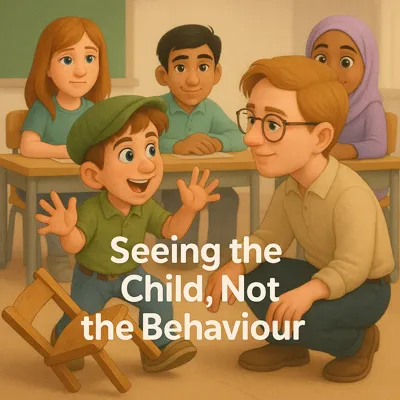
Understanding Behaviour as Communication
Shifting from managing behaviour to understanding the child behind it.
Building strong, trusting relationships is the secure foundation recommended in national guidance (DfE, 2018). When a child feels safe, valued, and understood, they are better able to regulate emotions and engage in learning.
For many children with SEMH needs, a consistent and compassionate adult presence is the turning point that helps them feel secure enough to grow.
Empathy and Curiosity
The PACE Model
Developed by Dan Hughes, the PACE model emphasises Playfulness, Acceptance, Curiosity, and Empathy as essentials for emotional safety.
Curiosity
Ask: "What is going on for this young person?" instead of jumping to conclusions about defiance.
Empathy
Recognise and validate feelings without judgement to build emotional trust and resilience.
Creating Emotional Safety
Consistency builds trust. When adults stay regulated—even when a young person is not—they send a message of safety: "I won’t be overwhelmed by your big feelings."
Micro-moments of Connection
Small, everyday moments—sharing a joke, noticing effort, or asking about interests—build relational currency. These aren't rewards for "good" behaviour; they are basic relational needs.

Regulation & Coaching
Co-Regulation
Becoming the child’s emotional anchor. Use tone of voice, body language, and attuned presence to help a child return to a regulated state.

Emotional Coaching
- 1. Naming: "It sounds like you're feeling really angry."
- 2. Validating: "I understand why that would make you cross."
- 3. Guiding: "Let's take a moment to breathe and figure out what's next."
Empower Their Voice
Shift the dynamic from doing things to young people to working with them. Involving them in support plans builds mutual trust and respect.
"I see you, and I care about you."
Work as a Team

Meaningful progress happens when adults—families, teachers, and therapists—work together to create a consistent circle of support.
Patient with the Process
Trust and emotional safety take time. Progress is rarely linear, but your steady, unwavering presence signals that the child is worth the wait. In short, patience is a powerful form of care.

Mark Else
My experience ranges from running playgroups for pre-schoolers to managing complex safeguarding caseloads within both mainstream and SEMH provisions. In addition to having worked within the education sector since 2018, I am currently studying for a Level 6 Youth Work degree.
References
- Bomber, L.M., 2007. Inside I’m Hurting: Practical Strategies for Supporting Children with Attachment Difficulties in Schools. London: Worth Publishing.
- Cooper, P. and Jacobs, B., 2011. From Inclusion to Engagement: Helping Students Engage with Schooling through Policy and Practice. Chichester: Wiley-Blackwell.
- Department for Education (DfE), 2018. Mental health and behaviour in schools: Departmental advice for school staff. [online] Available at: https://www.gov.uk/../mental-health-and-behaviour-in-schools--2 [Accessed 7 Apr. 2025].
- Hughes, D.A., 2009. Attachment-Focused Parenting: Effective Strategies to Care for Children. New York: W. W. Norton & Company.
- Rose, J. and Shevlin, M., 2020. Beating Bureaucracy in Special Educational Needs: Helping SENCOs Maintain a Focus on Learners. 3rd ed. London: Routledge.
- Treisman, K., 2021. A Therapeutic Treasure Box for Working with Developmental Trauma: Creative Techniques and Activities. London: Jessica Kingsley Publishers.