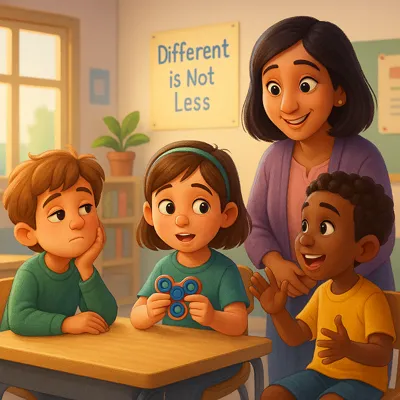
Introduction to ADHD
Understanding neurodiversity: Insights, challenges, and support strategies for children.
Attention Deficit Hyperactivity Disorder (ADHD) is a neurodevelopmental condition that affects a child’s ability to focus, control impulses, and manage hyperactive behaviour.
The National Institute for Health and Care Excellence (NICE) estimates that around 5% of children worldwide are affected by ADHD. In the UK, estimates are closer to 1-2% due to stricter criteria. While more commonly diagnosed in boys, ADHD is thought to be just as common in girls, who are more likely to display inattentive symptoms rather than hyperactive ones.
Traits of ADHD
ADHD symptoms are classified into three categories: Inattention, Hyperactivity, and Impulsivity.
| Hyperactivity | Inattention | Impulsivity |
|---|---|---|
| Fidgeting or tapping. | Hard to sustain attention. | Acts without thinking. |
| Struggles to stay seated. | Frequent detail mistakes. | Interrupts others. |
| Feels restless. | Poor organisation. | Hard to wait turn. |

Diagnosis Criteria
Assessment involves structured interviews and rating scales (e.g., Conner’s Scale). Symptoms must impair functioning in two or more settings (e.g., home and school) to meet criteria.

Impact on Daily Life
School & Social
Difficulty sustaining attention during lessons and struggling to understand social cues can lead to academic underachievement and peer isolation.
Family & Emotions
Frustration at inability to finish tasks can cause low self-esteem. Parents may experience burnout while managing symptoms.
Support & "Superpowers"
Strategies
- • Visual timetables & timers
- • Movement breaks
- • Positive reinforcement systems
- • Distraction-free seating
Positive Traits
- • Exceptional Creativity
- • High Energy & Enthusiasm
- • Hyperfocus on passion areas
- • Resilience & Empathy
Breaking the Stigma
Success stories demonstrate that ADHD is not just about challenges, but unique potential.
Parental Resources
Embracing Neurodiversity
ADHD should not be viewed solely as a challenge but as an opportunity. By dismantling stigma and celebrating unique strengths, we can create a future where every child with ADHD feels supported and understood.

Mark Else
My experience ranges from running playgroups for pre-schoolers to managing complex safeguarding caseloads within both mainstream and SEMH provisions. In addition to having worked within the education sector since 2018, I am currently studying for a Level 6 Youth Work degree.
References
- American Psychiatric Association. (2013). Diagnostic and Statistical Manual of Mental Disorders (5th ed.). Washington, DC: APA.
- Biederman, J., et al. (2004). Impact of ADHD on emotional well-being. Journal of Clinical Psychiatry, 65(3), 31–35.
- Fabiano, G. A., et al. (2009). Evidence-based behavioural interventions for children with ADHD. Clinical Child and Family Psychology Review, 12(3), 182–200.
- Hinshaw, S. P., & Blachman, D. R. (2005). ADHD in girls. Journal of Clinical Psychology, 61(5), 579–593.
- Hoza, B. (2007). Peer functioning in children with ADHD. Journal of Pediatric Psychology, 32(6), 655–663.
- Johnston, C., & Mash, E. J. (2001). Families of children with ADHD. Clinical Child and Family Psychology Review, 4(3), 183–207.
- Loe, I. M., & Feldman, H. M. (2007). Academic and educational outcomes of children with ADHD. Journal of Pediatric Psychology, 32(6), 643–654.
- NICE. (2018). Attention Deficit Hyperactivity Disorder: Diagnosis and Management (NG87). National Institute for Health and Care Excellence.
- Reiber, C., & McLaughlin, T. F. (2004). Classroom interventions for ADHD. Education and Treatment of Children, 27(3), 219–234.
- Sonuga-Barke, E. J., et al. (2013). Nonpharmacological interventions for ADHD. Journal of the American Academy of Child & Adolescent Psychiatry, 52(9), 863–875.