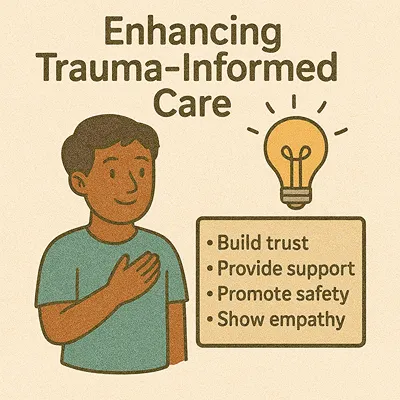
Being a Trauma-Informed Practitioner
Moving beyond understanding to intentional action, safety, and empowerment.
Being trauma-informed means recognising the profound impact trauma has on a child’s behaviour, emotions, and well-being. It involves intentionally creating environments that prioritise safety, support, and empowerment.
A Note on Self-Care
Delving into trauma is emotionally taxing. Prioritising self-care and seeking supervision ensures you can continue providing effective support (Bath, 2008).
Applying Trauma-Informed Frameworks
🔵 The PACE Model
Playfulness: Light-hearted, non-threatening atmosphere.
Acceptance: Unconditional value without judgement.
Curiosity: Understanding the child's internal world.
Empathy: Connecting deeply with the child's feelings.
🛡️ SAMHSA Principles
Prioritising Safety
Physical Safety
Use soft lighting and calm colours. Ensure easy access to exits and a space free from unexpected disruptions or loud noises, which can trigger hyper-vigilance (Perry, 2006).

Emotional Safety & Consistency
- Predictability: Inform the child of what to expect and discuss changes in advance.
- Boundaries: Agree on "stop" signals and limits for discussion.
- Validation: Use non-judgemental phrases like "It's understandable to feel upset."
- Choice: Empower the child to work at their own pace.
Empathy & Understanding
"What happened to you?" vs "What is wrong with you?"
Trauma rewires neural connections. A child might become dysregulated by a specific smell, sound, or style of clothing associated with past danger. Recognising these survival mechanisms allows for compassion instead of punishment.
Active Listening Tips
- • Remove all distractions.
- • Refrain from trying to "fix" it.
- • Join them in their experience.
Sensitive Language
- • Say: "Children who have experienced trauma."
- • Avoid: "Trauma victims."
- • Use: Open body posture & uncrossed arms.
Professional Development
A Continuous Commitment
Being trauma-informed is an ongoing effort. By fostering safe, supportive, and empowering environments, we create spaces where every interaction contributes to restoring a sense of safety and dignity for those who have experienced trauma.

Mark Else
My experience ranges from running playgroups for pre-schoolers to managing complex safeguarding caseloads within both mainstream and SEMH provisions. In addition to having worked within the education sector since 2018, I am currently studying for a Level 6 Youth Work degree.
References
- Bath, H. (2008). The three pillars of trauma-informed care. Reclaiming Children and Youth, 17(3), 17-21.
- Perry, B. D. (2006). Fear and learning: Trauma-related factors in the adult education process. New Directions for Adult and Continuing Education, 2006(110), 21-27.
- Hughes, D. A. (2015). Building the bonds of attachment: Awakening love in deeply troubled children (3rd ed.). Rowman & Littlefield.
- SAMHSA. (2014). SAMHSA’s Concept of Trauma and Guidance for a Trauma-Informed Approach. Substance Abuse and Mental Health Services Administration.
- van der Kolk, B. A. (2015). The Body Keeps the Score: Brain, Mind, and Body in the Healing of Trauma. Penguin Books.
- Bloom, S. L. (2013). Creating Sanctuary: Toward the Evolution of Sane Societies. Routledge.
- Perry, B. D., & Szalavitz, M. (2017). The Boy Who Was Raised as a Dog: And Other Stories from a Child Psychiatrist's Notebook. Basic Books.
- Rogers, C. R. (1951). Client-Centered Therapy: Its Current Practice, Implications, and Theory. Houghton Mifflin.
- Siegel, D. J., & Bryson, T. P. (2020). The Power of Showing Up: How Parental Presence Shapes Who Our Kids Become and How Their Brains Get Wired. Ballantine Books.
- Freire, P. (1970). Pedagogy of the Oppressed. Continuum.