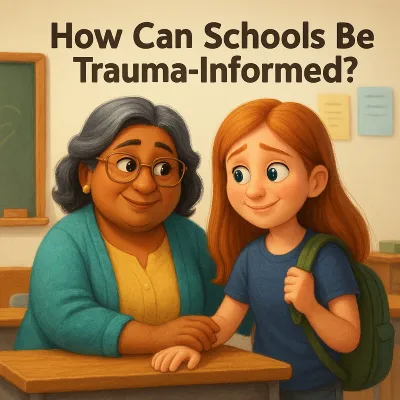
Introduction to Trauma-Informed Practice
Transforming school environments through safety, trust, and emotional support.
In this article, I look at trauma-informed schools and what can be done for schools that are looking to become more trauma-informed. Various aspects of the school environment are looked at, including classrooms, safe spaces and teaching strategies.
Schools can become more trauma-informed by adopting a holistic approach that recognises and responds to the impact of trauma on children. This involves creating environments that prioritise safety, trust, empowerment, and emotional support to help children thrive academically, socially, and emotionally (Craig, 2016).
Staff Training and Awareness
Effective staff training and awareness are crucial for creating trauma-informed school environments. When school staff understand the impact of trauma on children, they can respond with empathy.

Designing Safe and Calming Spaces
Classrooms should be calm, welcoming, and non-threatening. Dedicated self-regulation areas—"Calm Corners"—allow children to take breaks when overwhelmed.

Trauma-Informed Teaching Strategies
[Image of the Window of Tolerance diagram showing hyper-arousal, the optimal zone, and hypo-arousal]Structure & Support
Predictable routines, visual timetables, and movement breaks help children remain engaged. Discipline should be flexible, acknowledging that punitive approaches can worsen trauma responses.
Self-Regulation Tools
Integrating mindfulness, grounding techniques, and brain breaks helps children manage their internal states and stay emotionally balanced.
Restorative vs. Punitive
Replace punitive discipline with restorative practices focusing on understanding and repairing harm. Response to behaviour should start with curiosity.

Trusting Bonds
Daily check-ins and ensuring every child has at least one trusted adult they can turn to.
Voice & Choice
Providing control through child-led problem solving and classroom charters.
Asset-Based
Focusing on strengths, talents, and efforts rather than perceived deficits or outcomes.
From Awareness to Action
A trauma-informed school provides a safe, stable, and empowering environment. By embedding these principles into daily practice, schools create a healthier, more inclusive learning environment for all students.

Mark Else
My experience ranges from running playgroups for pre-schoolers to managing complex safeguarding caseloads within both mainstream and SEMH provisions. In addition to having worked within the education sector since 2018, I am currently studying for a Level 6 Youth Work degree.
References
- Anda, R. F., et al. (2006). The enduring effects of abuse and related adverse experiences.
- Barrett, P., et al. (2019). The impact of classroom design on learning.
- Blodgett, C., & Dorado, J. (2016). A selected review of trauma-informed school practice.
- Brunzell, T., Stokes, H., & Waters, L. (2016). Trauma-informed positive education.
- Cook, A., et al. (2005). Complex trauma in children and adolescents.
- Craig, S. E. (2016). Trauma-sensitive schools.
- Dweck, C. (2006). Mindset: The new psychology of success.
- Felitti, V. J., et al. (1998). Relationship of childhood abuse to later health.
- Felver, J. C., et al. (2016). The effects of mindfulness-based interventions.
- Herman, J. L., et al. (2016). Trauma and recovery.
- Hydon, S., et al. (2015). The role of teachers in trauma-informed education.
- Jennings, P. A., & Greenberg, M. T. (2009). The prosocial classroom.
- Perry, B. D. (2009). Examining child trauma.
- Porges, S. W. (2011). The polyvagal theory.
- Skiba, R. J., et al. (2014). The failure of zero tolerance.
- Souers, K., & Hall, P. (2016). Fostering resilient learners.
- Van der Kolk, B. (2014). The body keeps the score.
- Wachtel, T. (2016). Restorative justice in everyday life.