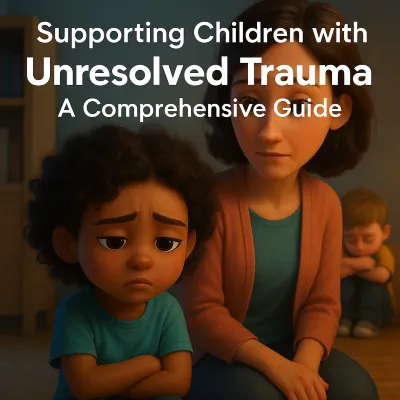
Supporting Children with Unresolved Trauma
A comprehensive guide to recognising the hidden wounds and fostering relational healing.
Unresolved trauma is a silent force, often hidden in plain sight. What may appear as defiance or avoidance is often the echo of past harm. This guide explores how we can recognise and support children affected by trauma, even when they cannot put their pain into words.
Unresolved trauma refers to adverse experiences that have not been processed or integrated. These experiences can leave a profound imprint on a child’s development, relationships, and learning potential.
The Impact on the Developing Brain
The Body Keeps the Score
Trauma leaves its imprint on the body and brain. The stress response system becomes hypersensitive, leading to a chronically activated fight-flight-freeze response and reduced activity in areas responsible for reflection and self-regulation.
Behaviour as Language
When words fail, behaviour speaks. Aggression, hiding, or shutting down are not signs of "badness," but survival strategies communicating internal distress.
Learning Barriers
Trauma impacts concentration, memory, and impulse control. Without understanding, these signs are often misdiagnosed as ADHD or conduct disorders.
The Pillars of Recovery
Relational Safety
Healing begins in relationships. Children need attuned, consistent adults to rebuild trust. Co-regulation—helping a child calm their nervous system through your presence—is the stepping stone to self-regulation.
The Polyvagal Lens
Understanding whether a child is in a state of safety, mobilisation (fight/flight), or collapse (freeze) helps adults respond with compassion rather than punishment.
Strategies for Support
Safety First
Predictable routines and low-arousal environments are essential. Children cannot learn or engage until they feel physically and emotionally safe.
Curiosity
Replace judgment with empathy. Ask: "What unmet need is driving this behaviour?" and "How can I create connection in this moment?"
Regulation
Incorporate movement, sensory tools, and creative outlets. Remember that self-regulation must be preceded by thousands of co-regulation experiences.
)
Trauma-Informed Environments
)
Supporting the Adults
Working with trauma-affected children is emotionally demanding. Supervision, reflective practice, and trauma-informed leadership are critical to prevent secondary traumatic stress and sustain this vital work.
Final Reflections
The question is not "What's wrong with this child?" but "What's happened to them—and how can I help?" Healing is possible and often begins with the smallest of things: a warm glance, a calm voice, and a safe space.

Mark Else
My experience ranges from running playgroups for pre-schoolers to managing complex safeguarding caseloads within both mainstream and SEMH provisions. In addition to having worked within the education sector since 2018, I am currently studying for a Level 6 Youth Work degree.
References
- Bath, H. (2008). The three pillars of trauma-informed care: Safety, connection, and emotional regulation. Reclaiming Children and Youth, 17(3), 17–21.
- Bloom, S. L. (1994). Creating Sanctuary: Toward the Evolution of Sane Societies. Routledge.
- Fava, C., Hemnani, K., & Manzi, S. (2024). Assessing ADHD when there is a history of trauma in children in care – a dimensional rather than categorical approach. Child & Family Clinical Psychology Review, 9(1), 42–47.
- Hughes, D. A. (2011). Attachment-Focused Family Therapy. Norton.
- Perry, B. D. (2006). The Boy Who Was Raised as a Dog. Basic Books.
- Perry, B. D., & Szalavitz, M. (2017). The Boy Who Was Raised as a Dog (2nd ed.). Basic Books.
- Porges, S. W. (2011). The Polyvagal Theory: Neurophysiological Foundations of Emotions, Attachment, Communication, and Self-regulation. Norton.
- Van der Hart, O., Nijenhuis, E. R. S., & Steele, K. (2006). The Haunted Self: Structural Dissociation and the Treatment of Chronic Traumatization. Norton.
- Van der Kolk, B. A. (2014). The Body Keeps the Score: Brain, Mind, and Body in the Healing of Trauma. Viking.