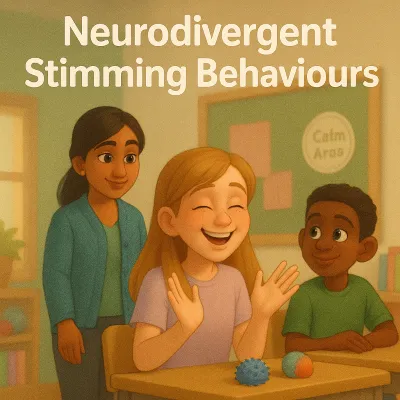
Understanding Stimming
Recognising self-stimulatory behaviour as a healthy tool for regulation and expression.
Stimming refers to repetitive actions, sounds, or movements used to regulate emotions, process sensory input, or express oneself.
While often associated with ADHD and autism, stimming is a universal behaviour observed in both neurodivergent and neurotypical individuals. It is a normal and healthy way for children to self-regulate, and should not be suppressed unless it becomes harmful.
Common Behaviours
For neurodivergent children, stimming reduces sensory overload or compensates for under-stimulation. Common examples include:

A Note on Safety
Rocking from distress can occasionally escalate into head-banging or skin-picking. If stimming becomes self-injurious, additional support and intervention may be required to address the source of the distress.
Functions of Stimming
| Function | Behaviours | Release |
|---|---|---|
| Sensory Overload | Rocking, covering ears, squeezing stress balls. | Filters overwhelming stimuli; regains calm. |
| Anxiety Coping | Tapping fingers, humming, rubbing fabric. | Predictable input lowers stress levels. |
| Excitement | Hand-flapping, spinning, clapping. | Channels positive physical energy. |
| Focus | Fidgeting, twirling pens, tapping. | Reduces distractions; enhances concentration. |
Common Misconceptions
"It's Attention-Seeking"
Truth: Stimming is a response to an internal sensory or emotional need, not a social performance.
"It's Unique to Autism"
Truth: While more prominent in autism, neurotypical children also stim to focus or soothe.
"It Should Be Fixed"
Truth: Suppressing stimming is often harmful. It is a functional behaviour that should be supported.
"It Means Distress"
Truth: Stims frequently express joy, excitement, or deep focus, not just distress.
Supporting Children Who Stim
Environment
Provide fidget toys, weighted blankets, or quiet spaces where stimming can happen freely without judgement.
Safety First
Replace harmful biting with chewable items or use noise-cancelling headphones to reduce overload.
Advocacy
Educate others on neurodiversity to reduce stigma. Respect the child’s right to stim in community spaces.
Individual Choice
Ask the child for their preferences—what helps them most when they feel overstimulated?
Conclusion
Ultimately, supporting children who stim is about building a society that respects and celebrates differences. By embracing stimming as a beneficial behaviour, we contribute to their emotional well-being and overall development.

Mark Else
My experience ranges from running playgroups for pre-schoolers to managing complex safeguarding caseloads within both mainstream and SEMH provisions. In addition to having worked within the education sector since 2018, I am currently studying for a Level 6 Youth Work degree.
References
- Leekam, S. R., Prior, M. R., & Uljarevic, M. (2011). Restricted and repetitive behaviors in autism spectrum disorders: A review of research in the last decade. Psychological Bulletin, 137(4), 562–593.
- Stereotypic movement disorders and their distinction from stimming: A systematic review. Journal of Neurodevelopmental Disorders.
- National Autistic Society: What is stimming?
- ADDitude Magazine: Understanding ADHD Stimming and Its Role in Self-Regulation.
- Silberman, S. (2015). NeuroTribes: The Legacy of Autism and the Future of Neurodiversity.
- Notbohm, E. (2005). Ten Things Every Child with Autism Wishes You Knew.
- Sinha, P. (2021). Stimming: A Neurodivergent Perspective.
- Department for Education. (2015). Special Educational Needs and Disability Code of Practice: 0 to 25 years.
- Prizant, B. M., & Fields-Meyer, T. (2015). Uniquely Human: A Different Way of Seeing Autism.
- Ayres, A. J. (2005). Sensory Integration and the Child.
- Dawson, G., & Watling, R. (2000). Interventions to Facilitate Auditory, Visual, and Motor Integration in Autism.