


Please Enter Your Email ID
Table of Contents
The challenge of children unable to access school presents one of the most pressing equity issues in contemporary education. Across the United Kingdom and internationally, hundreds of thousands of children are absent from formal classroom settings not out of defiance or truancy, but due to severe barriers including Emotionally Based School Avoidance (EBSA), undiagnosed or unmet Special Educational Needs and Disabilities (SEND), complex developmental trauma, and chronic physical or mental health conditions.
Historically, systemic responses have gravitated towards administrative enforcement, attendance prosecution, and behavioural compliance frameworks. However, contemporary educational psychology, relational youth work, and trauma-informed pedagogy demonstrate that attendance is not merely a behavioural choice—it is an outcome of safety, connection, and systemic accessibility. When a child cannot access school, interventions must shift from sanction-driven monitoring to holistic, relationship-centred, and multi-agency advocacy.
Deconstructing the Terminology: From Truancy to Severe Barriers
To develop effective interventions, practitioners must first dismantle the mixture between deliberate disengagement and non-attendance rooted in distress.
Emotionally Based School Avoidance (EBSA)
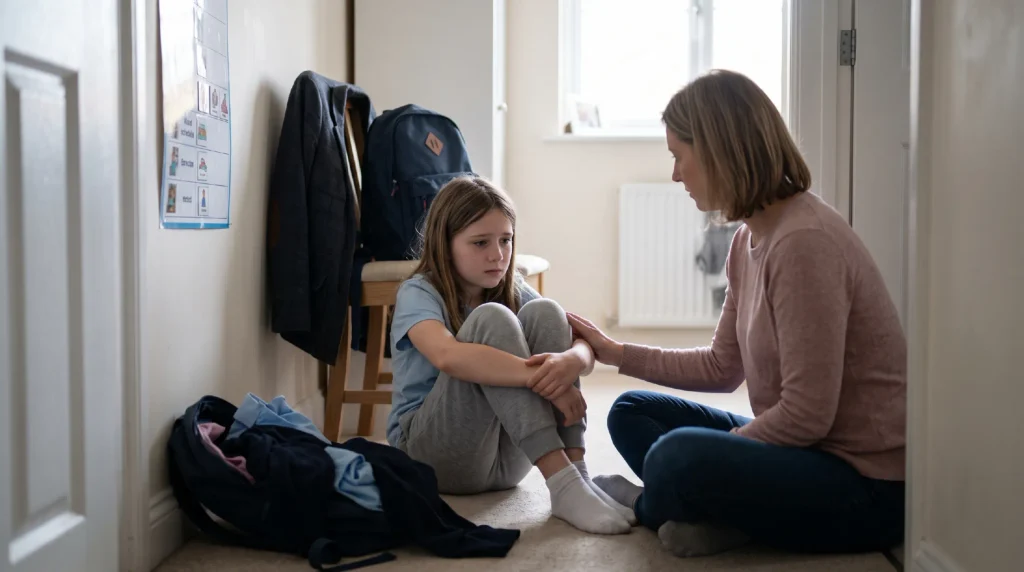
EBSA describes a pattern where a child experiences severe emotional distress—characterised by anxiety, panic, somatic complaints (such as nausea, headaches, and sleep disturbances), and depressive symptoms—associated with attending school. Unlike truancy, where the child is typically absent from both home and school without parental knowledge, a child experiencing EBSA remains at home with parental awareness, exhibiting intense apprehension rather than antisocial behaviour.
Neurodivergence and the Masking Dilemma
A substantial cohort of children unable to access school are autistic or possess profiles of Attention Deficit Hyperactivity Disorder (ADHD), Pathological Demand Avoidance (PDA), or sensory processing differences. For these young people, the conventional school environment is inherently dysregulating. Fluorescent lighting, acoustic chaos, social unpredictability, and rigid pedagogical demands place intolerable loads on cognitive and autonomic systems.
Many children—particularly girls—employ intense compensatory strategies known as “masking” to appear compliant and academically functional throughout the school day. When the threshold of sensory and nervous system endurance is crossed, they collapse into autistic burnout or chronic exhaustion, culminating in an inability to cross the physical threshold of the school building.
Complex Trauma and Attachment
Children with developmental trauma or disrupted attachment histories often experience the school environment through a lens of neuroception—the unconscious appraisal of risk and safety. For an infant or child raised in chaotic or emotionally volatile environments, vigilance is essential for survival. In a large, structured school environment where control is externalised and demands are non-negotiable, the autonomic nervous system perceives the routine demands of classroom life as existential threats, activating primitive fight, flight, or freeze mechanisms.
2. Theoretical Frameworks Underpinning Effective Practice
Effective support mechanisms must be anchored in robust, evidence-informed theoretical frameworks that illuminate why a child cannot engage and how their internal state dictates external accessibility.
Bronfenbrenner’s Bioecological Systems Theory
Urie Bronfenbrenner’s ecological model posits that human development occurs within complex systems of reciprocal relationships:
- Microsystem: The immediate settings in which the child interacts (the home, the classroom, the peer group).
- Mesosystem: The quality and cohesion of interactions between microsystems (the relationship between the school staff and the child’s parents).
- Exosystem: External environments affecting the child indirectly (local authority funding allocations, child and adolescent mental health service capacity, social care thresholds).
- Macrosystem: Overarching cultural ideologies, national statutory attendance targets, a nd societal paradigms regarding education and parental blame.
Interventions that treat school non-attendance purely as an individual deficit ignore the friction existing between these layers. When a school’s punitive attendance letters disrupt trust within the mesosystem, parental anxiety escalates, filtering directly into the microsystem and compounding the child’s distress.
Polyvagal Theory and the Autonomic Ladder
Developed by Dr Stephen Porges, Polyvagal Theory provides a physiological explanation for why children experiencing school-related distress cannot simply “try harder” or “show resilience”:
- Ventral Vagal Complex (Social Engagement): The state of physiological safety where social connection, receptive language, and abstract cognitive learning can take place.
- Sympathetic Nervous System (Mobilisation): The state of hyperarousal (fight or flight), presenting as panic, irritability, running away from gates, or outward verbal aggression.
- Dorsal Vagal Complex (Immobilisation): The evolutionary primitive shutdown state (freeze), presenting as mutism, catatonia, dissociation, or absolute physical inability to leave bed or the home.
Under this model, learning and compliance are physiologically impossible when a young person is trapped in sympathetic mobilisation or dorsal collapse. Re-engagement cannot commence through curriculum delivery; it can only occur through physiological co-regulation.
Relational Practice and Youth Work Principles in Action
When traditional school structures fail, practitioners must step away from authoritative pedagogical stances and adopt the foundational tenets of relational youth work and pastoral advocacy.
Unconditional Positive Regard and Voluntary Engagement
Youth work principles emphasise voluntary participation, equality of dignity, and building connections on the young person’s terms. When a professional engages with a child out of school, the dialogue must initially divorce itself from academic performance:
- Low-Demand Connection: Engaging in shared activities (gaming, art, animal care, walking) without requiring direct eye contact or intense verbal feedback.
- Predictability and Radical Transparency: Ensuring the young person understands exactly who is visiting, for how long, and what will happen, removing unexpected social demands.
- Validating Experience: Acknowledging the child’s pain as genuine and rational rather than an overreaction or manipulative tactic.
Digital Engagement and Hybrid Learning Pedagogies
For many young people locked out of physical school settings, digital interfaces serve as an indispensable bridge. Digital pastoral work and remote educational provision provide an initial arena for connection that bypasses intense sensory overload and social surveillance.
Lowering the Cognitive and Sensory Load
- Camera Autonomy: Allowing children to keep cameras off or use digital avatars during video calls reduces the cognitive tax of monitoring their own facial expressions and parsing micro-expressions from peers and educators.
- Asynchronous Learning Options: Enabling access to modular, prerecorded content empowers learners experiencing disrupted circadian rhythms or severe anxiety to engage during periods of regulated physiological stability.
- Text-Based and Chat-First Communication: For children experiencing situational mutism or selective silence in the presence of educators, chat boxes, shared digital whiteboards, and interactive forums preserve autonomy and voice without autonomic distress.
Digital Safeguarding and Relationship Building
Practitioners working digitally must maintain robust safeguarding vigilance while retaining warmth. Clear boundary setting, recorded channels, and monitored spaces ensure the young person’s safety without introducing bureaucratic coldness that repels an anxious student.
A Phased, Scaffolded Model of Re-Engagement
Re-entry into education—whether in the mainstream classroom, an alternative provision, or a hybrid setting—must be treated as an iterative, graded exposure intervention co-constructed with the young person.
Stage 1: Stabilisation and Environmental Calming
The immediate requirement is de-escalation. Practitioners and parents must establish a period of decompression where academic expectations are temporarily paused. Pushing an acutely dysregulated nervous system back into the triggering environment inevitably triggers severe crisis or developmental regression.
Stage 2: In-Home and Digital Relational Bridging
A single, consistent professional builds a consistent rhythm of contact. The focus is exclusively on rapport, mapping strengths, identifying specific sensory triggers, and determining what makes the young person feel safe.
Stage 3: Low-Stakes Environmental Exposure
The young person visits the school or alternate educational environment entirely outside operating hours. They explore the building when the corridors are silent, meet an approachable staff member in an informal space, test the seating, and map out discreet withdrawal points (“safe havens”) that they can access without requesting verbal permission.
Stage 4: Micro-Attendance and Bespoke Timetabling
The learner attends for an ultra-focused duration—often single lessons centred on their areas of special interest or strengths. Transitions are managed with precision: staggered start times prevent exposure to chaotic gate arrivals, and quiet study rooms replace crowded lunch halls.
Stage 5: Flexible Sustained Access
Full-time attendance should not be an inflexible metric of success. For many neurodivergent students or those with long-term medical conditions, sustainable access may look like a hybrid split: three days on-site combined with two days of remote, project-based, or alternative provision.
Multi-Agency Synergy and Systemic Reform
Supporting children outside of the classroom cannot sit on the shoulders of individual schools alone. It demands integrated, compassionate multi-agency coordination.
Collaborative Parental Partnerships
Parents of children unable to access school are routinely subject to unjust institutional scrutiny, ranging from accusations of fabricated illness to threats of court action under attendance laws. Effective practice repositions parents from adversaries to essential co-experts. Regular, predictable communication without unsolicited criticism establishes a secure foundation for intervention.
Reimagining Attendance Policy
National educational policy must evolve beyond raw percentage metrics. When schools are evaluated strictly on attendance benchmarks, institutional incentives skew towards punitive compliance and covert off-rolling (unlawful exclusion of pupils to boost league tables). Attendance policies must formally differentiate between unexcused absenteeism and health- or disability-related absence, embedding reasonable adjustments as guaranteed legal entitlements.
Conclusion
Children who cannot access school are neither broken nor unwilling; they are communicating that their current learning environment compromises their physical, emotional, or neurological safety. Moving from compliance-led confrontation to a relational, neurodiversity-affirming paradigm restores dignity to children and families who have been pushed to the margins of education.
Meeting these young people where they are requires educational leaders and multi-agency practitioners to abandon the rigid belief that learning can only occur within four classroom walls. By cultivating radical relational security, adapting sensory and physical landscapes, and deploying flexible digital and in-person hybrid pathways, we construct systems of education resilient enough to support every child—no matter where their learning journey must begin.
Frequently Asked Questions (FAQ)
What is the difference between truancy and Emotionally Based School Avoidance (EBSA)?
Truancy involves deliberate, unexcused absence where the child is typically away from both home and school without parental knowledge or permission. EBSA, by contrast, is an anxiety- and distress-driven barrier where the pupil remains at home with parental awareness. The absence is accompanied by significant physiological or psychological distress rather than defiance.
How does neurodivergent masking lead to attendance barriers?
Pupils with undiagnosed or unmet needs—particularly autistic girls and children with ADHD profiles—frequently mask their struggles to appear compliant and academically capable. Suppressing sensory distress, communication differences, and social exhaustion eventually depletes autonomic reserves, culminating in autistic burnout where the pupil becomes physically and mentally unable to attend school.
Why does Polyvagal Theory matter in educational attendance?
Polyvagal Theory demonstrates that cognitive learning and cooperative social behaviour rely on the ventral vagal state of physiological safety. When school triggers sympathetic hyperarousal (fight or flight) or dorsal vagal collapse (freeze or shutdown), the nervous system prioritises physical survival over curriculum engagement. Interventions must therefore focus on co-regulation and felt safety before educational demands can be reintroduced.
Why are punitive attendance procedures counterproductive for children out of school?
Attendance warnings, fines, and formal enforcement rely on the premise that attendance is a purely behavioural choice. For children experiencing school-related distress, threats escalate anxiety within both the pupil and the family unit. This damages the partnership between home and school, validating the pupil’s internal neuroceptive threat response and worsening school distress.
How should a school scaffold a return for a child out of education long-term?
Re-engagement should follow a gradual, interest-led trajectory:
Stabilisation: Pausing direct academic pressure to allow the child’s nervous system to decompress.
Relational Bridging: Establishing consistent, low-demand connection with a dedicated keyworker via home or digital channels.
Environmental Exposure: Visiting the school building outside normal school hours to map sensory triggers and safe spaces without social pressure.
Micro-Attendance: Attending short, bespoke sessions for favourite subjects, with staggered arrival times to bypass crowded gates.
Flexible Sustained Access: Implementing ongoing reasonable adjustments, sensory access passes, and hybrid provisions tailored to the learner’s endurance.
References
- Baker, M., & Bishop, F. L. (2015). Out of school: A review of the literature on school attendance problems and emotionally based school avoidance. Educational Psychology in Practice, 31(4), 354–368. https://doi.org/10.1080/02667363.2015.1066548
- Bronfenbrenner, U. (1979). The Ecology of Human Development: Experiments by Nature and Design. Harvard University Press.
- Epstein, R., Connolly, D., & Fox, L. (2024). School distress and attendance barriers in neurodivergent pupils: Exploring systemic trauma and educational failure. International Journal of Inclusive Education, 28(6), 842–859.
- Kearney, C. A. (2008). School absenteeism and school refusal behavior in youth: A contemporary review. Clinical Psychology Review, 28(3), 451–471. https://doi.org/10.1016/j.cpr.2007.07.012
- Pegg, S. (2023). Emotionally Based School Avoidance: A Neurodiversity-Affirming and Trauma-Informed Approach for Schools. Jessica Kingsley Publishers.
- Porges, S. W. (2011). The Polyvagal Theory: Neurophysiological Foundations of Emotions, Attachment, Communication, and Self-Regulation. W. W. Norton & Company.
- Prowting, K. (2022). Exploring the experiences of autistic children experiencing emotionally based school avoidance: Listening to the lived voice. Good Autism Practice (GAP), 23(1), 15–28.
- Trevarthen, C., & Aitken, K. J. (2001). Infant intersubjectivity: Research, theory, and clinical applications. Journal of Child Psychology and Psychiatry, 42(1), 3–48. https://doi.org/10.1111/1469-7610.00701
- United Kingdom Department for Education (DfE). (2024). Working together to improve school attendance: Statutory guidance for maintained schools, academies, independent schools, and local authorities. HM Government.
- World Health Organization (WHO). (2022). Mental health of children and adolescents: Early intervention and social determinants of health. World Health Organization.