

Please Enter Your Email ID
Table of Contents
Why the UK School Attendance System Needs a Child-Centred Approach
While the school attendance landscape in the UK has undergone profound changes since the COVID-19 pandemic, the underlying system remains stubbornly rigid. It is a system that requires “bums on seats in a physical classroom” and is driven by a success criterion which equates to a binary “yes” or “no” on a register.
What was once a stable social contract between schools and parents; a mutual agreement that children must attend school everyday, has become more fractured than ever, especially with the birth of flexi-schooling.
The governments approach to improving the declining national attendance figures was to enforce further financial pressure onto families who are already struggling with the cost of living crisis and deprivation (DfE. 2024); This approach meant an increase in the cost of school attendance fines (referred to as fixed penalty notices or FPNs)
The Hidden Barriers to Learning: Poverty, Hunger, and Resource Gaps
A report by the National Foundation for Educational Research (NFER, 2023) shows that around a quarter to a half of pupils are now coming into school hungry, without adequate clothing and without the correct books or equipment. On top of this the same report shows that around a quarter of pupils have little or no IT access at home and lack suitable space to work outside of school. When we look at Maslow’s Hierarchy of Needs, we understand that if the basic needs of children are not being met then they will also not be ready to engage meaningfully with education.
In the new context in which schools find themselves, the one-size-fits-all approach to education simply is not working and while this approach may cause little friction for families capable of keeping up with technological advances and financial demands, the landscape is much bleaker for those with additional needs, are young carers or are living in deprivation.
The government call school attendance fines a last resort and that school are expected to exhaust all levels of support before applying for a fine or penalty notice, the reality is that schools often lack funding for Education Welfare Officers or mental health support, meaning that fines are the only tool they have to meet attendance targets.
The Institute for Fiscal Studies (IFS) highlights that despite record levels of funding for schools most of this is quickly absorbed by rising energy costs, unfunded pay rises and higher SEND demands amounting to only around a 5% funding increase since 2019 (IFS, 2023).
These issues have led to the attendance gap for disadvantaged children widening despite marginal improvements in overall national figures. Research by Child Poverty Action Group (2025) highlights the sheer financial weigh of “free” education for parents and carers, noting that the minimum cost currently sits at £1000 a year for a primary school child and £2300 a year for a child at secondary school (Child Poverty Action Group, 2025). In a climate of rising living costs, the “hidden” costs of attendance such as uniform, equipment, and travel are often the first barriers to the school gate.
Are Fines Effective? The Cost of School Attendance Fines
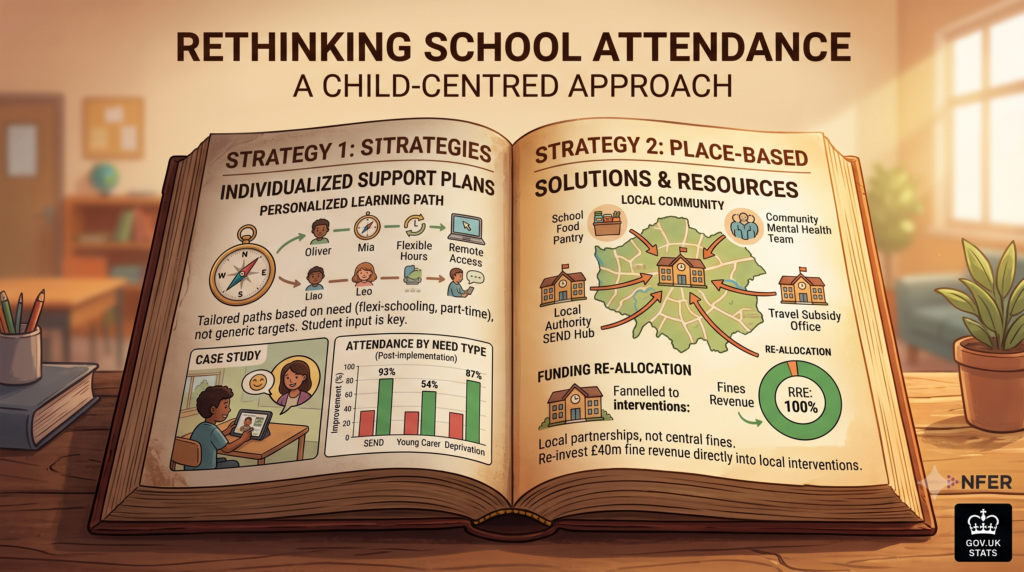
In 2024, the Department for Education (DfE) introduced heftier attendance fines and stricter data monitoring, creating what could be described as a ‘Big Brother’ style oversight of school attendance. Currently if a child’s attendance drops below 90% or after 5 missed school days, a punitive response is triggered with the threat of fines, legal action and even imprisonment used in an attempt to enforce school attendance.
These fines, which can be imposed after just 5 days of missed schooling are a minimum of £80 (and up to £160) per child per parent, if these are not paid within 28 days then escalation to a magistrates court can occur where fines can reach £2500 or even imprisonment. This cycle means that poverty leads to absence, which leads to a fine, which deepens the poverty and further creates barriers to school attendance.
On top of this more children than ever are arriving at school hungry, in inadequate clothing and without the necessary basic equipment for learning (NFER, 2023). School attendance fines will further entrench poverty and remove already limited money within an already stretched household.
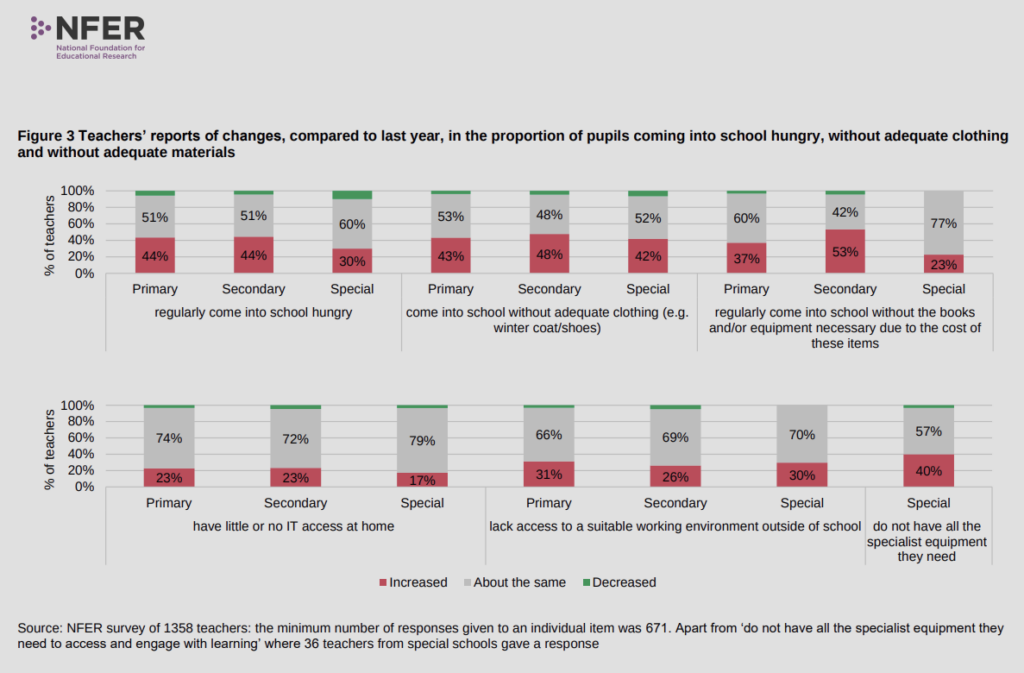
Table 1 – Teachers’ reports of changes, compared to last year, in the proportion of pupils coming into school hungry, without adequate clothing and without adequate materials
What is also surprising about school attendance fines is that they miss the mark by miles; while I would like to assume that the purpose of fines is to tackle the root cause of school attendance issues, the reality is the majority of fines are issued for term-time holidays; therefore feel more like a tax on poverty rather than a solution to the current school attendance crisis.
For many families, the only time of the year they can afford to take a family holiday is during term-time. Not to mention that many children with SEND struggle to enjoy holidays during the peak holiday periods due to sensory and cognitive overwhelm. In the UK we also have holiday companies charging extortionate prices the second schools break-up for holidays.
For example, in Figure 1 below, can you guess when the summer holidays start? This is a live example (taken on 16/05/2026) and shows that a UK based caravan holiday, for a family of 4, for 7 nights, is over £400 cheaper in the last week of term. Even with a fine of £80 per child, per parent, families are saving £80+ per holiday.
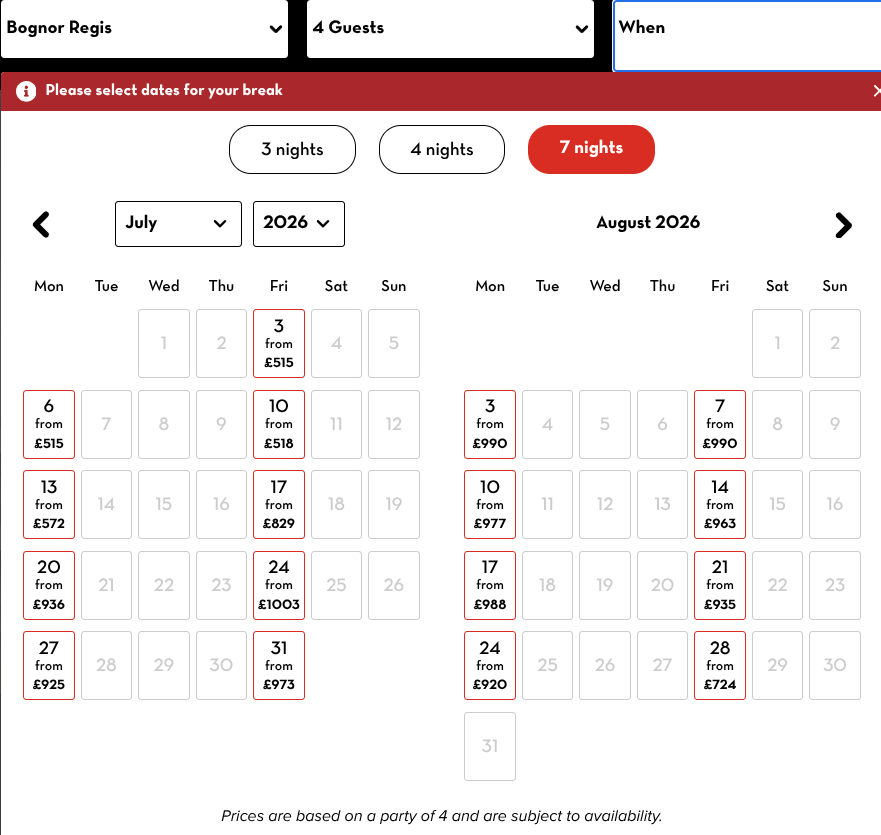
Figure 1 – Example Butlins holiday difference
UK School Attendance Fines: Comparison of Statistics
The governments own statistics database shows that in the 2024/25 academic year:
- 492,825 school attendance fines were issued
- 93% (459,288) of those were issued for unauthorised family holiday during term time
- Only 7% of the fines issued were for actual longer-term school attendance issues
For comparison in the 2018/19 academic year:
- 333,388 school attendance fines were issued
- 86% (288,239) of these being for unauthorised family holiday during term time
This shows the increasing pressures on families to weigh-up their children’s well-being against the benefits of education during the current cost of living crisis and the rising costs of family holidays.
The data suggests that parents are now prioritising their children’s well-being over 100% school attendance, and the UK government is punishing them for doing so.

Table 2 – GOV.UK National Education Statistics
While the government is raking in money from school attendance fines and penalty notices, schools are expected to provide the financial support (such as paying the local authority for extended EWO support), adding further pressure onto schools. Surely the near £40 million raised from fines (492,825 fines issued x £80 cost) should be funnelled back into school for attendance interventions? This would help create some flexibility in a system which is very rigid.
The N8 Research Partnership (2026) argues, this rigid approach must be replaced by place-based solutions that address specific local deprivation (N8 Research Partnership, 2026). The current system is backfiring; for a family already struggling financially, a fine is nothing more than an irrelevant and antagonistic burden. It adds a layer of stress that further erodes the relationship between home and school without solving the root cause of the absence.
Much like many schools are moving away from Behaviour Policies and towards Relationship Policies, schools should adapt to the current reality of there being more to education than simply sitting in a classroom.
Persistent Absence Rates: Understanding the Post-COVID Data Gap
Currently the statistical reality of the post-pandemic era reveals a concerning trend of entrenchment. When we compare data from the 2018/19 academic year (pre-COVID) and the 2022/23 academic year (the first full year unaffected by lockdowns and mandatory self-isolation) the national absence rate in the UK grew from 4.73% to 7.37% representing a 56% increase.
During the same period, persistent absentees (those missing more than 10% of their education) grew from 10.86% to 21.22%, representing a 95% increase. Lastly and even more alarming is the rise of “severe” absenteeism; children who have missed more than 50% of school, rose from 0.85% in 2018/19 to 2.03% in 2022/23.
Is it surprising to see that geographical inequalities also affect school attendance? The N8 Research partnership also highlight how living in a certain postcodes poses a greater risk of being persistently absent from school.
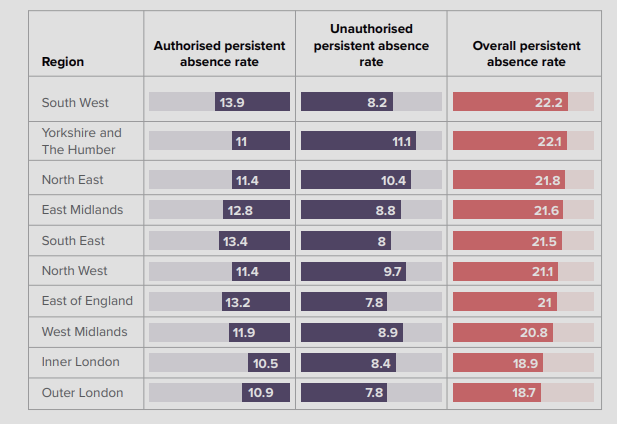
Table 3 – N8 Research Partnership: Overall persistent absence rate (%) by region in England (2022/23)
2024/25 data indicates a slight decline in overall absence (7.37% to 6.78%) and persistent absence (21.22% to 18.14%). However, the cohort missing more than 50% of schooling continued to rise, reaching 2.39% (up from 2.03%).
To put this figures in more humanistic human terms, during the 2024/25 academic year, 1.3 million pupils missed more than 10% of their education and 176,000 pupils missed more than half of their education. It should also be noted that these figures do not include the 34,700 children listed as missing from education or the 175,000 children educated outside of the school system (Elective Home Education).
While general attendance is recovering, the gap between the advantaged and the disadvantaged continues to widen.
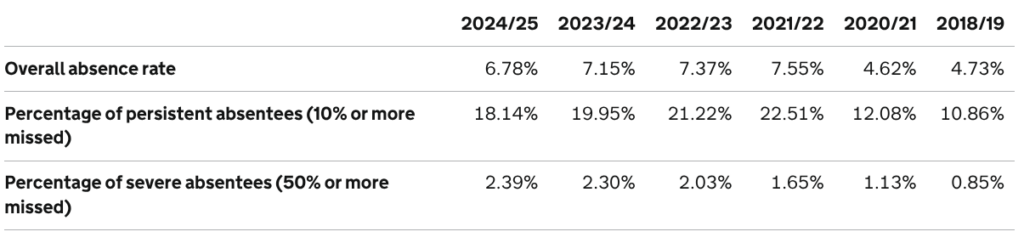
Table 4 – GOV.UK National Education Statistics
School Avoidance in Neurodivergent & Disadvantaged Pupils
The DfE’s focus on 90% school attendance as a critical threshold often fails to consider factors outside of the family’s control. The cost-of-living crisis has stripped away the disposable income used for “feel-good” stabilisers like days out or small gifts, while simultaneously increasing instability in transport costs, uniform affordability and housing.
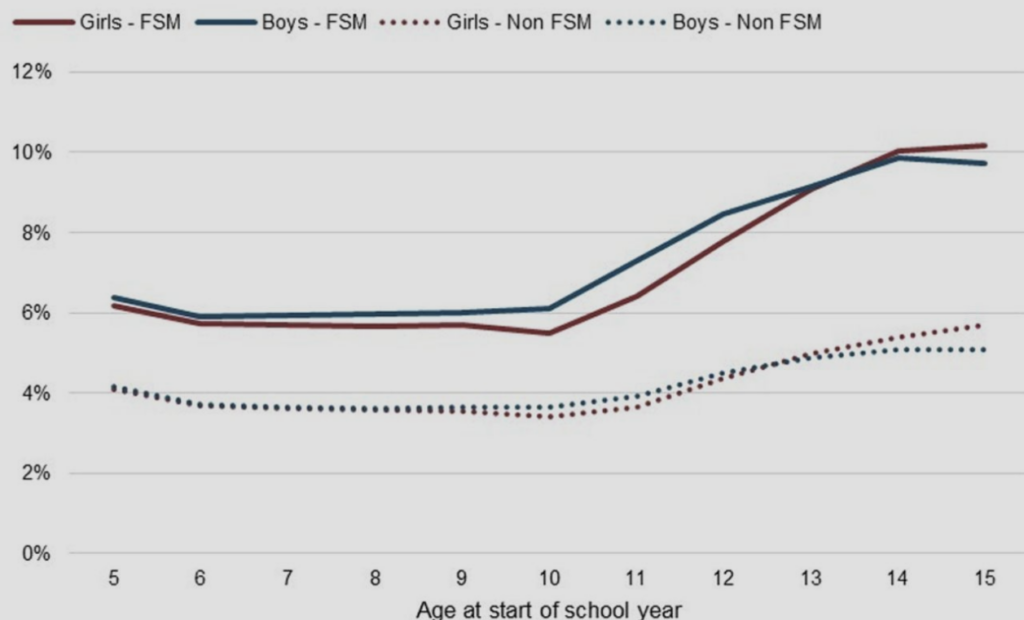
Research by The Archives of Disease in Childhood (2026) shows that poverty is a central factor in school absence with a doubling in persistent absence for children eligible for free school meals compared with non-eligible children.
For neurodivergent children, the physical school building can be a “sensory minefield.” Many become overwhelmed before they even leave the house; others “burn out” due to constant masking. A “bums on seats” metric treats attendance as a choice, whereas for many, it is a matter of self-preservation due to cognitive or sensory overwhelm. Rarely is the cause of absence due to not wanting an education.
Research by The Archives of Disease in Childhood (2026) which characterises absence not as a choice, but as a result of complex interplay of health and environmental factors highlights the following additional factors that have a negative influence on school attendance:
- Families assessed by a social worker are twice as likely to be persistently absent, four times more likely to be severely absent or suspended and seven times more likely to be permanently excluded from school.
- Children with profound, multiple learning difficulties, social, emotional and mental health needs and physical disabilities are more likely to be persistently absent.
- Children with a probable mental health condition are seven times more likely to miss at least 15 days of school than their peers; punitive responses can worsen mental health and increase the risk of absence.
- Children from low socio-economical have a higher risk of behavioural problems (leading to suspensions) and more commonly have physical and mental health challenges.
- Children with SEND are five times more likely to be excluded from school and seven times more likely to be severely absent. Studies suggest that 92.1% of children who experience school distress are neurodivergent and 83.4% are autistic.
- Bullying accounts for 16000 school absences each day, with 52.9% of victims of bullying feeling like schools responded to disclosures poorly.
The truth is, there are many children struggling to attend school all day, every day who have underlying unmet needs which could be due to undiagnosed needs, poor mental health support, insufficient funding or simply lack of SEND provisions which can provide specialist support.
Why Punitive Measures Fail to Address School Attendance Issues
Threatening families with fines or legal action is counter-productive. Imposing fines on a family already struggling with deprivation will not incentivise attendance; it increases household stress, exacerbates child anxiety, and can force parents towards Elective Home Education (EHE), potentially increasing the child’s vulnerability.
Neither an eighty-pound fine nor a thousand-pound court summons will resolve clinical school avoidance or school-induced distress. When fear of prosecution becomes the primary driver, the relationship between home and school becomes adversarial.
Government Statistics (2026) show that while school attendance fines have increased, 93% of these were issued for unauthorised holidays (GOV.UK, 2026), meaning that the system is punishing life experiences while failing to address the severe absence of the most vulnerable learners .
Furthermore, these measures risk isolating families from support services, leading to greater risks of exploitation or entry into the criminal justice system as children become further disconnected from society.
How the COVID-19 Pandemic Shifted Parental Attitudes to Attendance
The 2020/21 pandemic changed the world’s operating model. Beyond Zoom calls and online shopping, it acted as a “proof of concept” for alternative learning. For many parents, the pandemic proved that children do not need to be inside a physical school building to learn. Formal education could be achieved digitally, and “learning outside” offered additional benefits for mental health and well-being.
For neurodiverse children, hybrid models provided a sense of safety by removing transitions and sensory triggers. Consequently, parents no longer view 100% school attendance as a “moral duty”.
The Absent Ambition report published by The Centre for Social Justice (2025) found that almost half (44%) of parents now believe it is reasonable for a child to miss one in every ten days of school. This view brings the parental view of expected attendance closer to 90% that the previous 100%.
Heightened health fears and the social isolation of the pandemic have also shifted priorities. Parents are now more willing to prioritise immediate mental health over a “present” mark in a register. Research by Impetus (2025) indicates that this post-COVID relationship breakdown has led parents to prioritise immediate well-being and life experiences over rigid metrics.
The Human Cost: Beyond the Register
When the primary concern of authorities is an internal data dashboard, the child becomes nothing more than a statistic. Re-engaging a vulnerable learner requires a foundation of psychological safety. Punitive letters and “Big Brother” tracking damage the rapport required to rebuild that safety.
We must also acknowledge the children who attend but struggle, these are the “masked” successes. These children appear as a success on the register, but beneath the surface, they are experiencing profound sensory overload or trauma. While present in the building, they are absent from learning, as their energy is entirely consumed by the effort of “keeping it together.”
A study of 1.1 million children by Loughborough University (2025) found that Education, Health and Care (EHC) plans significantly lessen the impact of mental ill-health on attendance. This suggests that support, not school attendance fines, are the effective variable in getting children back to school.
A Call for Connection-First Attendance
To bridge the attendance gap, the UK must pivot from a culture of policing to a culture of partnership. We need a relational, connection-first, and child-centred approach.
Key Recommendations for Change:
- Move Beyond the Register: Transition from tracking data to tracking need.
- Acknowledge Financial Realities: Support families with the “minimum cost of education” rather than fining them for being unable to meet it.
- Place-Based Support: Implement localised, community-led interventions that understand the specific barriers of a postcode.
- Neuro-Inclusive Environments: Recognise that “school refusal” is often “school distress” requiring environmental adjustment, not legal punishment.
The current punitive system attempts to solve a complex emotional problem with a blunt financial instrument. Until we prioritise the child’s sense of safety and belonging over their attendance percentage, the gap will only continue to grow.
Frequently Asked Questions (FAQ)
Q. What happens if my child’s school attendance falls below 90% in the UK?
A. In the UK, attendance below 90% is classed as persistent absence. Under current DfE guidelines, dropping below this threshold or missing 5 consecutive days without authorisation can trigger punitive action, including Local Authority penalty notices (fines) starting at £80 per parent.
Q. Why are the majority of school attendance fines issued in the UK?
A. According to GOV.UK statistics, over 90% of penalty notices are issued for unauthorised family holidays taken during term time. High holiday price hikes during official school breaks lead many families to weigh fine costs against overall holiday savings.
Q. How does school refusal differ for neurodivergent children?
A. For neurodivergent children (including autistic pupils or those with SEND), missing school is rarely a choice or wilful truancy. It is often caused by sensory overload, masking burnout, or severe school distress requiring environmental adaptations rather than punitive measures.
References
- Archives of Disease in Childhood (2026). Addressing school absence in clinical practice. BMJ. https://adc.bmj.com/content/early/2026/02/19/archdischild-2024-327832
- Centre for Social Justice (2025). Absent ambition: The attendance crisis plaguing UK schools.
- Child Poverty Action Group (2025). Written evidence: Cost of the school day.
- Department for Education (2024). Working together to improve school attendance.
- Education Endowment Foundation (2025). Biggest challenges to disadvantaged pupils’ attainment.
- GOV.UK (2026). Parental responsibility measures: Academic year 2024/25.
- Impetus (2025). Parental support for full-time schooling has collapsed.
- Loughborough University (2025). School absence linked to poor mental health.
- N8 Research Partnership (2026). An evidence-based plan for improving school attendance.
- Sibieta, L., Drayton, E., Farquharson, C., & Tahir, I. (2023). Annual report on education spending in England: 2023. Institute for Fiscal Studies (IFS). https://ifs.org.uk/publications/annual-report-education-spending-england-2023