


Please Enter Your Email ID
Table of Contents
Human development is not a process that halts once physical maturity is reached; rather, it represents a dynamic, lifelong progression. Human growth and lifespan development examines how individuals evolve, adapt, and transform from conception to late adulthood. By exploring the multidimensional interaction between physical biology, cognitive functions, emotional regulation, and social networks, developmental psychology provides profound insight into the human condition.
Historically, developmental theorists often concentrated on childhood as the primary developmental period. However, modern research acknowledges that growth and neural malleability continue across the entire life course (Osher et al., 2018). Whether navigating early attachment bonds or managing identity transitions in retirement, each phase introduces distinct milestones, opportunities, and psychological challenges.
This article is particularly useful for anyone undertaking a social work degree as it covers the Year 1 Module: Human Growth and Lifespan Development: Understanding physical, emotional, and social development across the life course.
Foundational Domains of Lifespan Development
To grasp how individuals change over time, developmental scientists partition progress into three interconnected domains:
The Physical Domain
The physical domain encompasses biological changes, motor skill acquisition, sensory capacities, brain maturation, and general health. From rapid physical growth in infancy to cellular senescence in late adulthood, the physical body provides the structural baseline for every life experience.
The Emotional Domain
Emotional development governs self-concept, emotional literacy, temperament, resilience, and subjective well-being. It determines how an individual interprets emotional cues, copes with environmental stress, and constructs psychological defences across varying age cohorts.
The Social Domain
The social domain analyses interpersonal connections, moral reasoning, social roles, cultural assimilation, and communication skills. As individuals mature, their primary social sphere shifts from caregivers to peer groups, romantic partners, professional colleagues, and the broader community.
| Developmental Domain | Core Characteristics | Key Developmental Indicators |
| Physical | Cellular growth, neurogenesis, motor abilities, physical health | Fine and gross motor control, puberty, sensory decline |
| Emotional | Affective regulation, identity formation, self-efficacy | Emotional literacy, coping strategies, life satisfaction |
| Social | Interpersonal bonds, cultural integration, moral values | Attachment patterns, socialisation, relationship quality |
Key Theoretical Frameworks of Human Growth and Lifespan Development
Modern developmental psychology relies on several seminal stage-based and ecological theories to contextualise human progress:
Erik Erikson: Psychosocial Development Theory
Erikson proposed eight distinct developmental crises across the life course, wherein each stage requires the resolution of opposing psychosocial forces. Successful navigation yields ego strengths and fundamental virtues:
- Trust vs. Mistrust (Infancy) – Hope
- Autonomy vs. Shame & Doubt (Early Childhood) – Will
- Initiative vs. Guilt (Preschool) – Purpose
- Industry vs. Inferiority (School Age) – Competence
- Identity vs. Role Confusion (Adolescence) – Fidelity
- Intimacy vs. Isolation (Early Adulthood) – Love
- Generativity vs. Stagnation (Middle Adulthood) – Care
- Ego Integrity vs. Despair (Late Adulthood) – Wisdom
Jean Piaget: Cognitive Development Theory
Piaget established that children construct mental representations (schemas) of the world through four sequential, qualitatively different cognitive stages:
- Sensorimotor Stage (0–2 years): Knowledge acquired through sensory perceptions and reflexive motor actions; development of object permanence.
- Preoperational Stage (2–7 years): Symbolic thinking and emergence of language; marked by intuitive thought and egocentrism.
- Concrete Operational Stage (7–11 years): Practical and logical manipulation of concrete objects, understanding conservation and reversibility.
- Formal Operational Stage (12+ years): Systematic logic, deductive reasoning, and abstract hypothesis testing.
John Bowlby and Mary Ainsworth: Attachment Theory
Attachment theory posits that instinctive human survival hinges on forming secure emotional bonds with primary caregivers. Secure attachment in early life fosters emotional safety, whereas insecure attachment styles (avoidant, ambivalent, disorganised) can impair socio-emotional functioning well into adulthood.
Stages of Human Growth Across the Life Course
Stage 1: The Prenatal Period and Infancy (Conception to 2 Years)
Development begins with rapid biological mitosis. During the germinal, embryonic, and foetal periods, structural organs and neural pathways are laid down. Following birth, infancy marks an astonishing rate of physical transformation, fine motor coordination, and sensory integration.
- Physical: Rapid neurodevelopment, establishment of reflexes, transition from rolling to crawling and walking.
- Emotional: Expression of foundational emotions (distress, joy, surprise); emergence of stranger anxiety.
- Social: Establishment of dyadic interactions, social smiling, and early caregiver attachment bonds.
Stage 2: Early and Middle Childhood (3 to 11 Years)
Childhood witnesses the expansion of linguistic abilities, peer networks, and moral understanding. Physical growth steadies while cognitive architecture develops rapidly.
- Early Childhood (3–6 Years): Play acts as the primary vehicle for learning. Children develop emotional self-regulation and begin grasping theory of mind—understanding that others possess individual desires and beliefs.
- Middle Childhood (7–11 Years): Formal schooling introduces academic expectations and competitive environments. Social comparisons become prevalent as children build self-worth, social competencies, and deep friendships.
Stage 3: Adolescence (12 to 18 Years)
Adolescence marks the biological transition into reproductive maturity, triggered by the endocrine shifts of puberty.
- Physical: Growth spurts, secondary sexual characteristics, and substantial neurological remodelling in the prefrontal cortex.
- Emotional: Emotional volatility driven by hormone changes, neurobiological development, and the quest for autonomy and self-identity.
- Social: Peer groups frequently eclipse parental influence; exploration of social identities, moral ethics, and early romantic relationships.
Stage 4: Early Adulthood (19 to 39 Years)
Early adulthood represents peak physiological performance alongside critical life decisions regarding higher education, career paths, and domestic arrangements.
- Physical: Optimal biological capacity, muscular strength, and sensory sharpness, followed by subtle physiological changes in late thirties.
- Emotional: Consolidation of personal values; navigation of career pressures and life transitions.
- Social: Prioritisation of intimate partnerships, long-term romantic commitments, social network refinement, and parenthood.
Stage 5: Middle Adulthood (40 to 65 Years)
Often characterised by the balance of career peaks and caregiving duties (both for children and ageing parents), middle adulthood centres on productivity and purpose.
- Physical: Noticeable signs of biological ageing, reduced metabolic rate, presbyopia, and hormonal shifts (such as the female climacteric and menopause).
- Emotional: Self-reflection regarding achievements and purpose; managing mid-career adjustments and transitions such as empty-nest syndrome.
- Social: Pursuit of generativity by mentoring younger generations, community involvement, and deep-seated marital or social companionship.
Stage 6: Late Adulthood (65+ Years)
Late adulthood involves reflection, adaptation, and sustained personal engagement. While physical vulnerabilities increase, emotional wisdom and perspective frequently deepen.
- Physical: Gradual decline in cardiovascular efficiency, motor agility, and sensory acuity; increased prevalence of chronic health conditions.
- Emotional: Life review and attainment of ego integrity; acceptance of one’s personal life trajectory.
- Social: Readjustment following retirement, evolving family dynamics, navigation of bereavement, and preservation of close-knit social ties.
Influences: The Nature vs Nurture Interplay
Human growth and lifespan development cannot be attributed solely to genetics or the environment. Instead, developmental systems theories demonstrate that biological processes, environmental exposures, and social relationships continually influence one another (Osher et al., 2018).
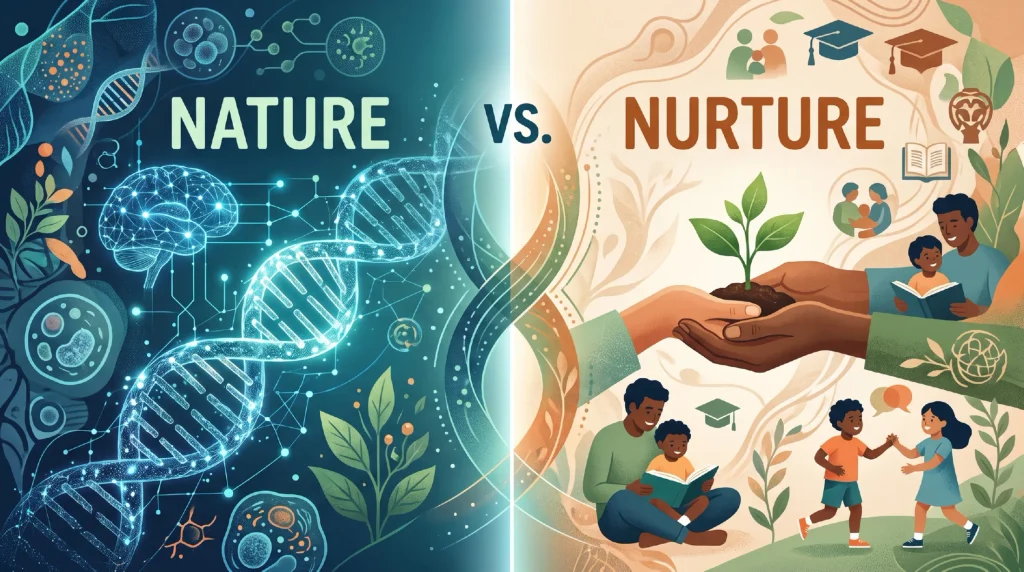
- Epigenetics: Environmental stressors, nutrition, and psychological safety can alter gene expression without mutating the underlying DNA sequence.
- Socioeconomic Status (SES): Access to healthcare, educational resources, safe environments, and proper nutrition heavily affects physical and cognitive development across the life course.
- Culture and Community: Cultural norms dictate parenting approaches, social expectations, identity formation, and the care provided to elders (Greve, 2023).
Practical Applications for Health and Social Care
Understanding human growth and lifespan development across life stages is essential for practitioners across social care, nursing, education, and counselling:
- Developmentally Appropriate Care: Tailoring communication to match the patient’s cognitive and emotional maturity (e.g., using pictorial guides for concrete operational children).
- Early Intervention: Identifying delays in fine motor development or socio-emotional milestones to facilitate timely therapeutic support.
- Compassionate Ageing Support: Recognising the psychosocial need for agency and independence among elderly individuals within care home environments.
Frequently Asked Questions (FAQ)
What are the main domains of human growth and lifespan development?
The three primary domains of human growth and lifespan development are physical development (biological growth, brain maturation, and motor skills), emotional development (self-awareness, feelings, and coping mechanisms), and social development (relationships, communication, and moral values).
Why is studying human growth and lifespan development important?
Studying lifespan development helps educators, medical professionals, and carers anticipate developmental milestones, detect anomalies or delays early, and offer supportive interventions tailored to an individual’s cognitive, emotional, and physical stage.
How does Piaget’s cognitive theory differ from Erikson’s psychosocial theory?
Jean Piaget focused on cognitive development—the intellectual processes children use to understand and think about the external world. Erik Erikson focused on psychosocial development—the social challenges and personality conflicts individuals confront across all eight stages of the life course.
Can adults experience cognitive and emotional development?
Yes. Contemporary neuroscience shows that the brain exhibits neuroplasticity well into late adulthood. Adults continually refine emotional intelligence, problem-solving strategies, and cognitive frameworks as they encounter new life experiences (Greve, 2023).
References
Greve, W. (2023). Adaptation across the Lifespan: Towards a Processual Evolutionary Explanation of Human Development. Integrative Psychological and Behavioral Science, 57, 1119–1139. https://doi.org/10.1007/s12124-023-09767-y Cited by: 28
Osher, D., Cantor, P., Berg, J., Steyer, L., & Rose, T. (2018). Drivers of human development: How relationships and context shape learning and development. Applied Developmental Science, 24, 6–36. https://doi.org/10.1080/10888691.2017.1398650 Cited by: 1176