

Please Enter Your Email ID
Table of Contents
When a child is locked in a spiral of dysregulation, whether triggered by acute trauma, chronic stress, or sensory overload, traditional reasoning falls flat. Telling an overwhelmed pupil or child to “calm down” or “think logically” is biologically impossible; the prefrontal cortex has effectively gone offline, leaving the primitive survival brain in charge.
Healing and de-escalation do not begin with spoken logic. They begin beneath the level of conscious thought, mediated by the autonomic nervous system.
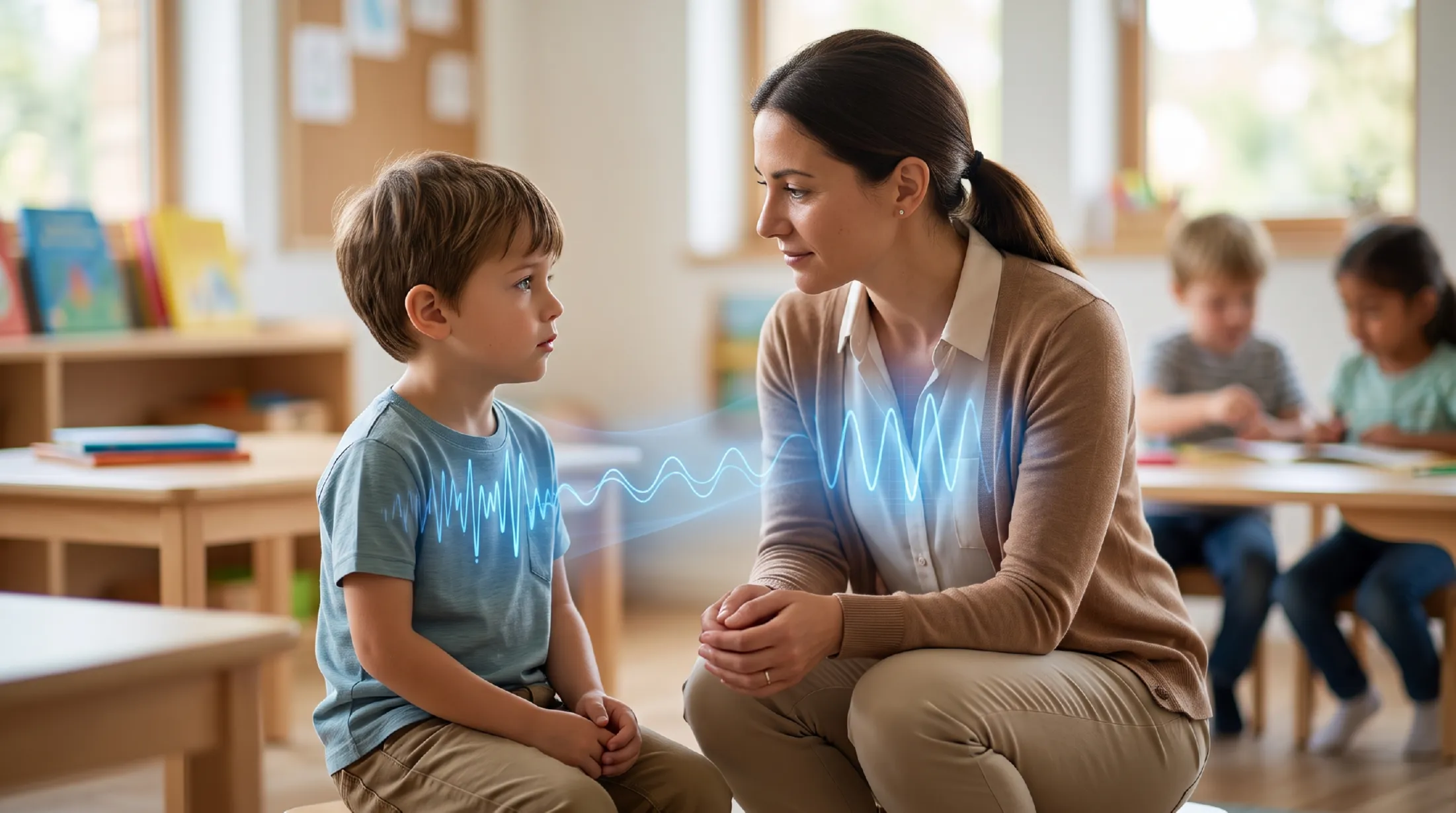
The most powerful intervention available to educators, practitioners, and parents is physiological synchrony: the biological phenomenon wherein two bodies subconsciously align their nervous systems, breathing rhythms, and heart rate variability. By intentionally grounding your own body, you offer a steady baseline that the child’s survival circuits can borrow to step down from fight, flight, or freeze.
What Is Physiological Synchrony?
Physiological synchrony describes the temporal coordination of biological signals, heart rate, electrodermal activity (sweat response), respiration, and neural oscillations, between two or more interacting individuals. Often referred to in clinical developmental science as autonomic attunement or biobehavioural synchrony, this mechanism serves as the physiological architecture of connection.
Human beings are obligate social mammals. From infancy, survival depends on an external regulator. An infant cannot soothe its own elevated cortisol or slow its racing pulse; it relies on the caregiver’s calm physiology during skin-to-skin contact, gentle rocking, and steady vocal tones.
While older children develop internal regulatory tools, developmental trauma and chronic adverse childhood experiences (ACEs) disrupt this maturation. When severe distress occurs, the nervous system regresses to its primary biological need: an external autonomic anchor.
Polyvagal Theory and the Biology of Co-Regulation
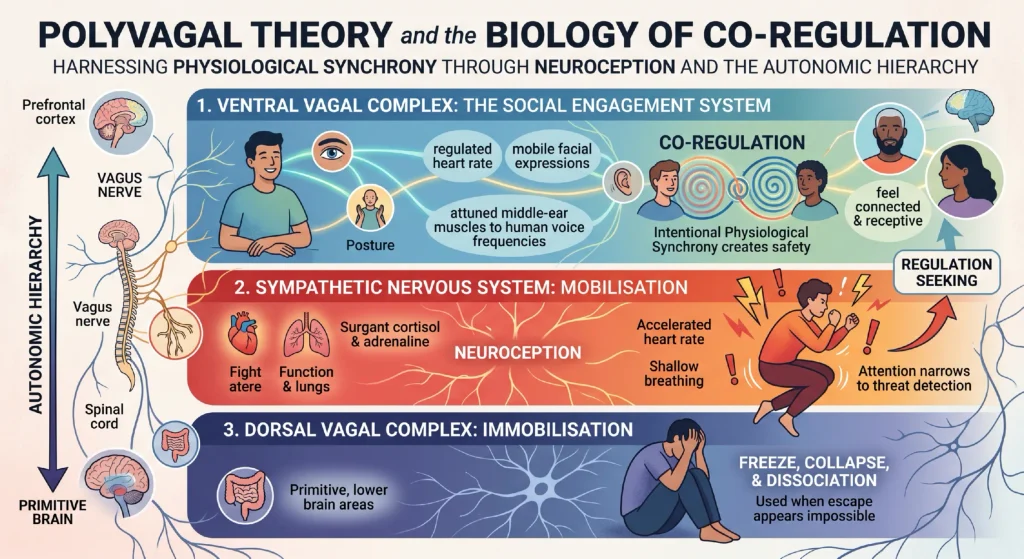
To harness physiological synchrony intentionally, we must look to Dr Stephen Porges’ Polyvagal Theory. Porges posits that our autonomic nervous system constantly scans the environment for safety and danger through neuroception—a subconscious, reflex-driven surveillance system.
The autonomic hierarchy operates across three primary pathways:
- The Ventral Vagal Complex (Social Engagement System): The newest evolutionary branch of the parasympathetic nervous system. When active, heart rates are regulated, facial expressions are mobile, middle-ear muscles tune into human vocal frequencies, and we feel connected and receptive.
- The Sympathetic Nervous System (Mobilisation): The survival circuit driving fight-or-flight. Cortisol and adrenaline surge, heart rate accelerates, breathing becomes shallow, and attention narrows strictly to threat detection.
- The Dorsal Vagal Complex (Immobilisation): The primitive parasympathetic pathway driving freeze, collapse, and dissociation when escape appears impossible.
A traumatised child exists in a state of faulty neuroception. Neutral stimuli—a teacher’s raised eyebrow, a sudden classroom noise, or a shift in routine—are processed as mortal threats, thrusting them directly into sympathetic fight/flight or dorsal freeze.
Crucially, a child cannot shift from sympathetic panic to ventral vagal safety entirely on their own. They must borrow ventral vagal activation from another nervous system. When an adult steps into the room with steady, regulated autonomic functioning, the child’s neuroception registers the absence of biological threat, initiating physiological entrainment.
The Mechanics of Borrowing a Nervous System
How does an internal state transfer from one person to another? Physiological synchrony operates through several precise somatic vectors:
Mirror Neuron Systems
Mirror neurons in the premotor cortex and inferior parietal lobule fire both when performing an action and when observing someone else perform it. When a practitioner models slow, diaphragmatic exhalations, dropped shoulders, and unclenched posture, the child’s brain maps those physical states internally, priming their muscles and respiratory system to follow suit.
Respiratory Sinus Arrhythmia (RSA) and Vagal Tone
Heart rate naturally accelerates slightly during inhalation and decelerates during exhalation. This variation, known as Respiratory Sinus Arrhythmia, reflects healthy vagal nerve influence on the heart. An adult practising prolonged exhalations actively brakes their own heart rate. Through auditory and visual cues of relaxed breathing, the proximity of this regulated rhythm encourages the child’s autonomic system to decelerate via sympathetic withdrawal.
Prosody and the Acoustic Safety Band
The ventral vagus nerve innervates the muscles of the larynx and pharynx as well as the tiny muscles of the middle ear (the stapedius). When you are calm, your voice carries natural musicality, warmth, and pitch variation (prosody). A flat, tense, or urgent voice signals threat to a child’s neuroception. A rhythmic, lower-register tone lands in the frequency band humans associate with safety, triggering mirror relaxation in the child’s auditory processing centers.
Operational Practice: Using Yourself as the Baseline
Applying physiological synchrony in classrooms, residential settings, and clinical environments requires deliberate discipline. When confronted with an explosive or shut-down child, the adult’s mirror system instinctively matches the threat response: pulses race, breathing shallows, and voices sharpen.
To act as an anchor, you must interrupt your own survival reflexes and consciously anchor your physiology first.
| Practitioner Action | Somatic / Neurological Impact | Child’s Subconscious Response |
| Prolonged Exhalation (4-in, 7-out) | Activates vagal brake, slows adult heart rate | Mirror neurons track respiration cadence |
| Shoulder Drop & Postural Unclench | Eliminates visual threat cues of attack posture | Neuroception registers decrease in environmental threat |
| Side-on Posture (45-degree angle) | Reduces confrontational frontal eye contact | Decreases amygdala hyperactivation |
| Modulated, Rhythmic Vocal Prosody | Engages the ventral vagal social engagement system | Middle ear muscles tune into voice rather than threat cues |
| Internal Affect Stillness | Prevents adult escalation/counter-transference | Interrupts cyclical behavioral feedback loops |
Step 1: The Pre-Contact Internal Audit
Before approaching or speaking, assess your own physiological baseline:
- Where is your breath originating—chest or belly?
- Are your jaw, shoulders, and hands tense?
- Is your heart rate elevated?
Take three deep diaphragmatic breaths where the exhalation is double the length of the inhalation. This simple shift increases vagal nerve stimulation and mechanically reduces your pulse.
Step 2: Spatial Posturing and Body Geometry
Direct, squared-off confrontations trigger defensive postures in a dysregulated nervous system. Approach at an angle (roughly 45 degrees), sit or crouch to bring your eye level below the child’s, and ensure your hands are visible, open, and relaxed. This non-threatening alignment allows the child’s visual cortex to confirm you are not preparing to strike, grab, or restrain.
Step 3: Silence and Somatic Holding
Resist the urge to lecture, reassure verbally, or demand explanations. Words require high-level cognitive processing that the child cannot currently supply. Sit in calm proximity, breathe deliberately and audibly enough to be perceived, and allow silence to do the heavy lifting. The child’s physiology will slowly entrain to the dominant, calm biological signal in the space: yours.
Overcoming Dysregulation Across Childhood Contexts
Case Study A: The Explosive Fight-or-Flight Response
Scenario: Ten-year-old Callum overturns a desk, screams insults, and stands with clenched fists, trapped in a full sympathetic surge.
Traditional Approach: Demanding he sit down, threatening sanctions, or speaking over him.
Result: Callum’s neuroception detects an escalating hostile presence; his sympathetic system pushes harder into violence or flight.
Synchrony Approach: The practitioner stands six feet away at an angle, hands open by the waist. The practitioner takes visible, slow diaphragmatic breaths, deliberately lowering their chin and relaxing their facial musculature. When speaking, the practitioner delivers brief, three-word statements in a melodic, low-frequency tone: “You are safe. I am here.” Within four minutes, Callum’s breathing begins to slow in unprompted mimicry of the practitioner’s, his hands release, and tears replace the adrenaline-fuelled rage.
Case Study B: The Dorsal Vagal Freeze / Shutdown
Scenario: Fourteen-year-old Maya experiences sudden dissociation, slumping in her seat with glazed eyes, unresponsive to direct questions.
Traditional Approach: Shaking her shoulder, demanding eye contact, or attempting to force engagement.
Result: Maya sinks deeper into immobilisation, perceiving the sensory demands as an overwhelming threat.
Synchrony Approach: The practitioner sits nearby without demanding eye contact, matching the low energy of the room while maintaining open, grounded posture. The practitioner offers rhythmic sensory input—tapping a gentle, slow rhythm on their own knee, humming quietly, or rocking slightly. By presenting a predictable, safe, low-demand rhythm, Maya’s nervous system is guided gently out of dorsal freeze back toward social engagement.
The Vulnerability of the Anchor: Compassion Fatigue and Secondary Trauma
Acting as a biological baseline is deeply demanding work. Physiological synchrony is a two-way street: just as a child’s physiology can borrow your calm, your autonomic system naturally absorbs the erratic, high-stress rhythms of the dysregulated child.
This process, known as autonomic counter-transference, explains why practitioners working with traumatised children frequently leave shifts feeling physically depleted, experiencing palpitations, brain fog, and chronic fatigue. Over time, repeated exposure without recovery leads directly to secondary traumatic stress and autonomic burnout.
Preserving Your Baseline
To remain an effective regulator for others, practitioners must cultivate aggressive recovery protocols:
- Discharge Rituals: Immediately after de-escalating a high-stress incident, shake out your limbs, take brisk walks, or splash cold water on your face to break sympathetic retention.
- Peer Co-Regulation: Adults need external regulators, too. Debrief incidents with colleagues who offer calm, non-judgmental presence rather than shared outrage or panic.
- Somatic Rest: Prioritise activities that stimulate your own ventral vagus nerve—singing, deep sleep hygiene, immersion in nature, and physical exercise.
Conclusion: Connection Precedes Correction
When working with children navigating trauma and severe dysregulation, biological state always dictates psychological capacity. No cognitive insight, behavioural contract, or disciplinary consequence can land while a child is trapped in autonomic panic.
By understanding physiological synchrony, we shift our perspective from asking “How do I make this child behave?” to “What is my nervous system communicating to theirs right now?”
When you discipline yourself to remain the calmest, most anchored biological entity in the room, you provide a biological bridge out of trauma. Your steady heartbeat, unhurried breath, and quiet presence become the living blueprint from which a child can safely rebuild their own capacity for calm.
Frequentley Asked Questions (FAQ)
What is the difference between co-regulation and physiological synchrony?
Co-regulation is the broader relational process where one individual helps another manage emotional and behavioural states through comfort, boundary setting, and dialogue. Physiological synchrony is the underlying, measurable biological engine of co-regulation—the direct alignment of heart rates, autonomic nervous systems, and breathing patterns.
Can physiological synchrony work if the adult is also feeling anxious?
No. Children possess highly sensitive neuroception and will detect micro-signals of stress (pupil dilation, voice tremor, muscular tension) that contradict calm words. If the adult is dysregulated, the child’s nervous system will synchronise with that anxiety instead. The adult must regulate their own body first before attempting to anchor the child.
How long does it take for a child’s nervous system to sync with an adult’s?
While neurochemical changes begin within seconds of perceiving safety cues, measurable autonomic synchrony (such as heart rate slowing and muscle tone softening) typically takes between 3 to 15 minutes of uninterrupted, calm presence, depending on the severity of the child’s trauma activation.
Is physical touch required for physiological synchrony to occur?
No. While safe, supportive touch can facilitate synchrony (such as a hand on the shoulder for a child who welcomes it), synchrony occurs effectively through visual tracking, shared auditory rhythm, vocal prosody, and mirror-neuron activation across physical space. Touch should never be forced, particularly with children carrying trauma histories.
References
- Porges, S. W. (2001). ‘The polyvagal theory: phylogenetic substrates of a social engagement system.’ International Journal of Psychophysiology, 42(2), pp. 123–146. https://doi.org/10.1016/s0167-8760(01)00162-3
- Porges, S. W. (2004). ‘Neuroception: A subconscious system for detecting threats and safety.’ Zero to Three, 24(5), pp. 19–24.
- Porges, S. W. (2022). ‘Polyvagal Theory: A Science of Safety.’ Frontiers in Integrative Neuroscience, 16, 871227.https://doi.org/10.3389/fnint.2022.871227
- Feldman, R. (2007). ‘Parent–infant synchrony and the construction of shared timing; physiological precursors, developmental outcomes, and risk conditions.’ Journal of Child Psychology and Psychiatry, 48(3‐4), pp. 329–354. https://doi.org/10.1111/j.1469-7610.2006.01701.x
- Feldman, R. (2017). ‘The neurobiology of human attachments.’ Trends in Cognitive Sciences, 21(2), pp. 80–99. https://doi.org/10.1016/j.tics.2016.11.007
- Feldman, R. (2020). ‘What is resilience: an affiliative neuroscience approach.’ World Psychiatry, 19(2), pp. 132–150. https://doi.org/10.1002/wps.20729
- Palumbo, R. V., Marraccini, M. E., Weyandt, L. L., et al. (2017). ‘Interpersonal Autonomic Physiology: A Systematic Review of the Literature.’ Personality and Social Psychology Review, 21(2), pp. 99–141. https://doi.org/10.1177/1088868316628405
- Rizzolatti, G., and Craighero, L. (2004). ‘The mirror-neuron system.’ Annual Review of Neuroscience, 27(1), pp. 169–192. https://doi.org/10.1146/annurev.neuro.27.070203.144230
- Gallese, V. (2003). ‘The manifold nature of interpersonal relations: the role of shared manifold hypothesis.’ Philosophical Transactions of the Royal Society of London. Series B: Biological Sciences, 358(1431), pp. 517–528. https://doi.org/10.1098/rstb.2002.1234
- Perry, B. D. (2006). ‘Applying principles of neurodevelopment to clinical work with maltreated and traumatized children: The Neurosequential Model of Therapeutics.’ Working with traumatized youth in child welfare, pp. 27–52.
- Schore, A. N. (2001). ‘Effects of a secure attachment relationship on right brain development, affect regulation, and infant mental health.’ Infant Mental Health Journal, 22(1‐2), pp. 7–66.
- van der Kolk, B. A. (2014).The Body Keeps the Score: Mind, Brain and Body in the Transformation of Trauma. London: Penguin Books.