

Please Enter Your Email ID
Table of Contents
This article explore how Maria Montessori influenced child development; her theories which were formed in the 1800’s continue to influence modern day child development.
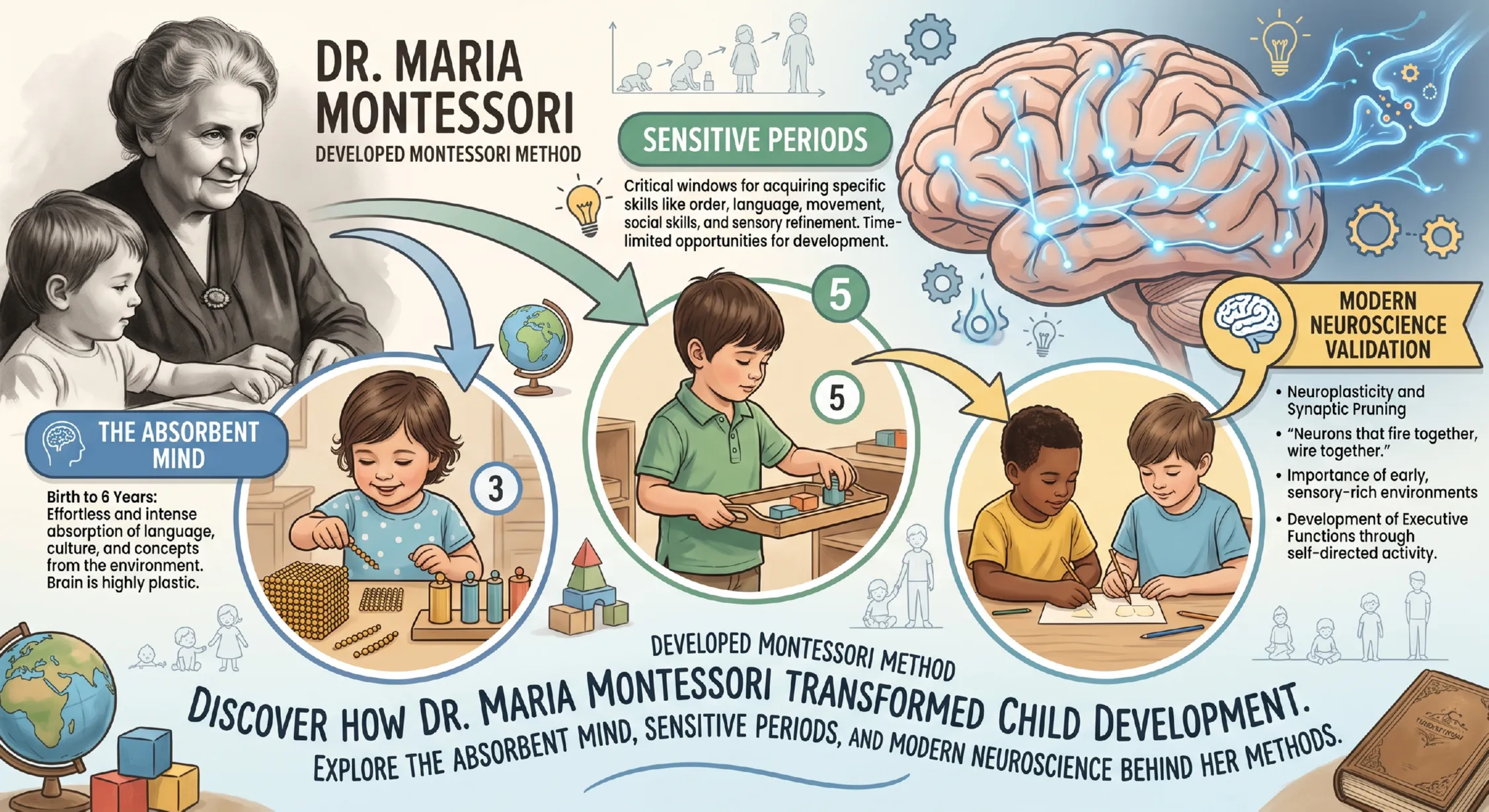
At the turn of the twentieth century, conventional schooling regarded the child as an empty vessel to be filled with rigid discipline and rote instruction. Classrooms were structured around silence, immobility, and external obedience enforced through rewards and punishments. Dr Maria Montessori, one of Italy’s first female physicians, a psychiatrist, and an anthropologist challenged this paradigm entirely. Through rigorous clinical observation, she uncovered a fundamental truth: children are not passive recipients of knowledge, but self-motivated architects of their own intellectual, emotional, and physical development.
Montessori’s scientific pedagogy shifted the focus of education from the teacher to the learner. Her discoveries regarding self-directed activity, sensitive periods of growth, the “absorbent mind”, and prepared physical environments anticipated modern developmental psychology and neuroscience by decades. Today, her methodologies continue to shape early years curricula, progressive educational frameworks, and child rearing practices worldwide.
The Scientific Foundations of Montessori’s Work
Maria Montessori influenced child development by bringing a clinical, empirical perspective to education. Her work began not in typical primary classrooms, but in psychiatric clinics working with children labelled as mentally disabled, and later in 1907 at the Casa dei Bambini (Children’s House) in the working-class San Lorenzo district of Rome.
Montessori treated the classroom as a living laboratory. Rather than applying preconceived theories, she observed how children interacted with objects, spaces, and peers when given liberty within structured boundaries. She noted that when provided with sensory-rich, self-correcting materials matched to their developmental stages, children exhibited:
- Deep concentration and sustained attention spans
- A spontaneous desire for order, routine, and care of their environment
- Self-regulation and reduced behavioural disruptions without external punishment
- Intrinsic joy in completing purposeful tasks (“work” rather than aimless play)
These clinical findings formed the cornerstone of her developmental theory: given the right environment, children naturally drive their own cognitive, motor, and psychological growth.
Core Pillars: How Maria Montessori Influenced Child Development
Montessori’s paradigm rests on several core developmental theories that directly influenced subsequent psychological frameworks, including those of Jean Piaget, Lev Vygotsky, and modern neurobiology.
1. The Absorbent Mind (Ages 0–6)
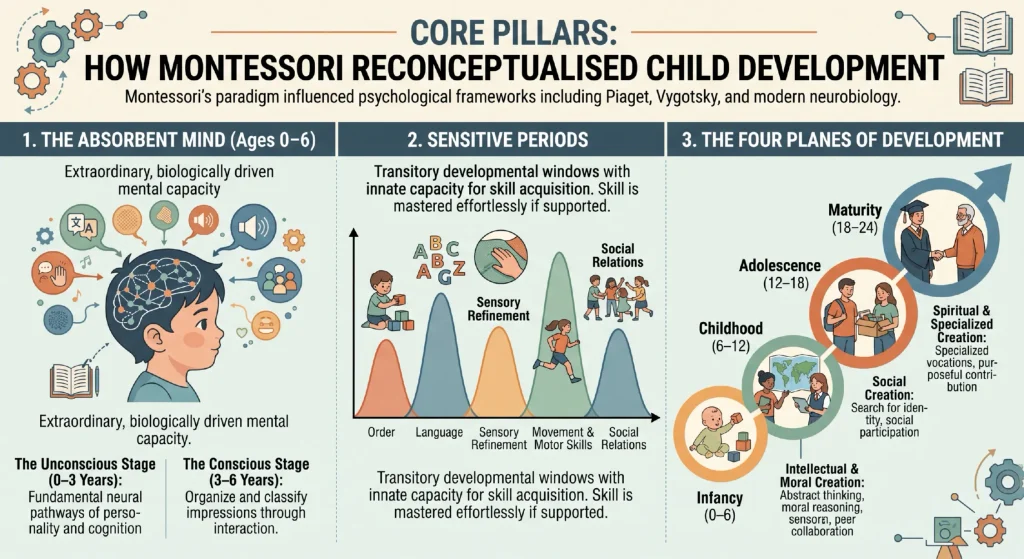
Montessori identified that children from birth to age six possess an extraordinary, biologically driven mental capacity she termed the Absorbent Mind. Unlike adults, who acquire knowledge through conscious reasoning and deliberate effort, young children absorb impressions directly from their surroundings effortlessly and indelibly.
She divided this stage into two sub-phases:
- The Unconscious Stage (0–3 Years): The infant and toddler absorb language, spatial relations, cultural norms, and physical movement unconsciously, forming the fundamental neural pathways of personality and cognition.
- The Conscious Stage (3–6 Years): The child begins to organise, classify, and refine these absorbed impressions deliberately through hands-on interaction with physical objects.
2. Sensitive Periods
Long before modern developmental neurobiology identified “critical windows” of brain plasticity, Montessori identified Sensitive Periods—transitory developmental windows during which a child exhibits an intense fascination and innate capacity for acquiring specific skills.
| Sensitive Period | Approximate Age Range | Developmental Focus |
| Order | Birth to 3 Years | Establishing cognitive baseline, spatial orientation, and psychological security. |
| Language | Birth to 6 Years | Rapid vocabulary acquisition, grammar absorption, phonological awareness. |
| Sensory Refinement | 2.5 to 6 Years | Dissecting sensory input (weight, texture, pitch, dimension) to organise thought. |
| Movement & Motor Skills | 18 Months to 4 Years | Refining gross and fine motor coordination; hand-eye control. |
| Social Relations | 2.5 to 6 Years | Understanding group dynamics, manners, empathy, and collaborative activity. |
If a child is supported during these periods with appropriate stimuli, the skill is mastered rapidly and effortlessly. If the window passes without engagement, learning the skill requires significantly more deliberate effort later in life.
3. The Four Planes of Development
Montessori mapped human development into four distinct six-year stages, each characterised by unique physical, psychological, and social needs:
- Infancy (Ages 0–6) – The Individual & Physical Creation: Focus on physical independence, functional movement, primary language, and sensory classification.
- Childhood (Ages 6–12) – The Intellectual & Moral Creation: Transition to abstract thinking, moral reasoning (justice, right vs wrong), peer collaboration, and cosmic education (how the universe works).
- Adolescence (Ages 12–18) – The Social Creation: Physical transformation, search for identity, self-worth, and economic/social participation within a broader community.
- Maturity (Ages 18–24) – The Spiritual & Specialized Creation: Attaining full independence, entering specialised vocations, and contributing purposefully to society.
The Prepared Environment and Child Agency
Maria Montessori influenced child development with the concept of the Prepared Environment. She recognised that traditional adult spaces are physically and psychologically alienating to small children.
To foster independence, Montessori redesigned educational spaces from the ground up:
- Child-Sized Furniture and Accessible Shelves: Low tables, lightweight chairs, and open, low-profile shelving enabled children to choose their activities without adult intervention.
- Aesthetic Simplicity and Order: Spaces are calm, uncluttered, and flooded with natural light, reducing sensory overload and encouraging focus.
- Self-Correcting Materials (Control of Error): Educational materials are engineered so that errors are immediately apparent to the child without adult correction (e.g., cylinder blocks that fit only into their matching cut-outs). This develops objective problem-solving, resilience, and analytical thinking.
- Practical Life Activities: Real tasks—such as pouring water, washing dishes, sweeping, and fastening buttons—are integrated into daily routines. These build fine motor control, hand-eye coordination, executive function, and personal responsibility.
In this framework, the teacher’s role shifts from an authoritarian instructor to a dynamic observer and guide. The educator prepares the environment, introduces materials, and steps back to let the child explore independently.
Cognitive and Executive Function: What Modern Science Validates
Over the past three decades, advancements in developmental psychology, cognitive science, and neuroimaging have consistently validate how Maria Montessori influenced child development through her early-twentieth-century observations.
Executive Function Development
Executive function, the suite of cognitive skills including working memory, cognitive flexibility, and inhibitory control is the strongest predictor of academic success and life satisfaction. Montessori environments directly foster executive functioning through:
- Uninterrupted Work Cycles: Standard three-hour blocks of work cultivate deep sustained attention and task completion.
- Freedom within Limits: Children select their tasks, navigate social turn-taking with limited sets of materials, and manage their time independently.
- Movement-Integrated Learning: Neuroscience has confirmed that physical movement is intimately linked with cognitive processing in young children. The brain areas governing motor control (such as the cerebellum) develop in direct tandem with prefrontal executive networks.
Intrinsic vs Extrinsic Motivation
Contemporary psychological research (notably Self-Determination Theory by Deci and Ryan) demonstrates that extrinsic motivators—such as gold stars, letter grades, and ranking systems—diminish long-term creativity and curiosity. Montessori classrooms eschew competitive grading and punishment in favour of intrinsic satisfaction derived from mastering a challenge.
Comparison: Traditional Early Education vs Montessori Approach
| Parameter | Traditional Early Childhood Model | Montessori Approach |
| Learning Structure | Teacher-directed, whole-group instruction | Child-directed, individual & small-group exploration |
| Pacing | Fixed timetable dictated by school schedule | Individualised pacing based on master of concept |
| Class Composition | Strict single-year age groups | Multi-age classrooms (3-year spans: 0–3, 3–6, 6–9) |
| Role of the Teacher | Primary source of knowledge and disciplinarian | Facilitator, observer, and environmental designer |
| Assessment | Standardised testing, external grades, rewards | Observational records, portfolios, self-assessment |
| Materials | Abstract textbooks, worksheets, passive toys | Concrete, tactile, self-correcting didactic tools |
The Lasting Legacy of Maria Montessori
Maria Montessori’s influence extends far beyond the thousands of accredited Montessori schools operating worldwide today (https://montessori-ami.org/). Her insights catalysed fundamental changes throughout mainstream global education:
- Universal Adoption of Child-Sized Spaces: Modern preschools, daycares, libraries, and paediatric clinics routinely feature child-accessible tables, sinks, and seating.
- Constructivist Learning: Her emphasis on tactile, concrete manipulation prior to abstract mathematics and language paved the way for modern STEM teaching strategies.
- Neurodiversity and Individualised Support: Her initial work with developmentally delayed children proved that inclusive, adaptive environments unlock potential that rigid institutional methods suppress.
By placing trust in the child’s natural drive for self-perfection, Maria Montessori influenced child development from mere supervision to an indispensable, scientifically grounded phase of human formation.
Frequently Asked Questions (FAQ)
What is the primary difference between Montessori and standard preschools?
The primary difference lies in autonomy and structure. Standard preschools generally follow a teacher-led schedule where all children perform the same activity simultaneously. Montessori classrooms use multi-age groupings, uninterrupted three-hour work periods, and self-correcting materials where children select their own tasks based on developmental readiness.
Are Montessori methods suitable for all children?
Yes. Because Montessori is grounded in self-directed pacing and sensory-based learning, it accommodates a broad spectrum of learning styles, temperaments, and developmental profiles. However, its effectiveness relies heavily on a properly prepared environment and trained guides who know how to scaffold each child’s independence.
How does Montessori foster social skills if children work individually?
Montessori classrooms are multi-age communities (typically spanning three years, such as ages 3 to 6). Older children naturally mentor younger peers, reinforcing their own mastery and developing empathy. Shared materials teach patience, turn-taking, conflict resolution, and mutual respect within a collaborative social ecosystem.
Why do Montessori classrooms avoid traditional grades and tests?
Dr Montessori discovered that extrinsic rewards (such as grades, praise stickers, and test scores) undermine a child’s intrinsic curiosity and foster performance anxiety. Assessment in a Montessori setting is qualitative and continuous, based on detailed observational records maintained by the educator.
References
- Montessori, M. (1949). The Absorbent Mind. Theosophical Publishing House.
- Montessori, M. (1912). The Montessori Method: Scientific Pedagogy as Applied to Child Education in ‘The Children’s Houses’. Frederick A. Stokes Company.
- Montessori, M. (1936). The Secret of Childhood. Longmans, Green and Co.
- Lillard, A. S., & Else-Quest, N. (2006). Evaluating Montessori education. Science, 313(5795), 1893–1894.
- Lillard, A. S. (2005 / revised eds.). Montessori: The Science Behind the Genius. Oxford University Press.
- Marshall, C. (2017). Montessori education: a review of the evidence base. npj Science of Learning, 2(1), 1–9.
- Randolph, J. J., et al. (2023). Montessori education’s impact on academic and nonacademic outcomes: A systematic review. Campbell Systematic Reviews, 19(3).
- Piaget, J. (1952). The Origins of Intelligence in Children. International Universities Press.
- Deci, E. L., & Ryan, R. M. (2000). The “what” and “why” of goal pursuits: Human needs and the self-determination of behavior. Psychological Inquiry, 11(4), 227–268.