

Please Enter Your Email ID
Table of Contents
Understanding how children connect, communicate, and seek security is one of the most transformative aspects of child development. At the heart of this understanding lies attachment theory, a framework that explains how early relationships with primary caregivers shape a child’s emotional growth, behaviour, and future relationships.
Whether you are a parent, carer, educator, or practitioner, recognising the different attachment styles in children provides vital clues about what a child’s behaviour is trying to communicate.
What Are Attachment Styles in Child Development?
An attachment style is the characteristic pattern of behaviour a child uses to seek proximity, safety, and comfort from their primary caregivers.
First conceptualised by British psychologist John Bowlby and expanded by developmental psychologist Mary Ainsworth, attachment theory posits that human infants are biologically driven to seek closeness to a protective figure. When a child feels safe, their brain can relax its survival mechanisms and focus on learning, play, and social exploration.
Attachment styles in children are not a fixed personality trait or a diagnostic label. Instead, it is an adaptive strategy, a way the child’s nervous system learns to navigate their environment based on the consistency and responsiveness of the adults around them.
The 4 Main Attachment Styles in Children
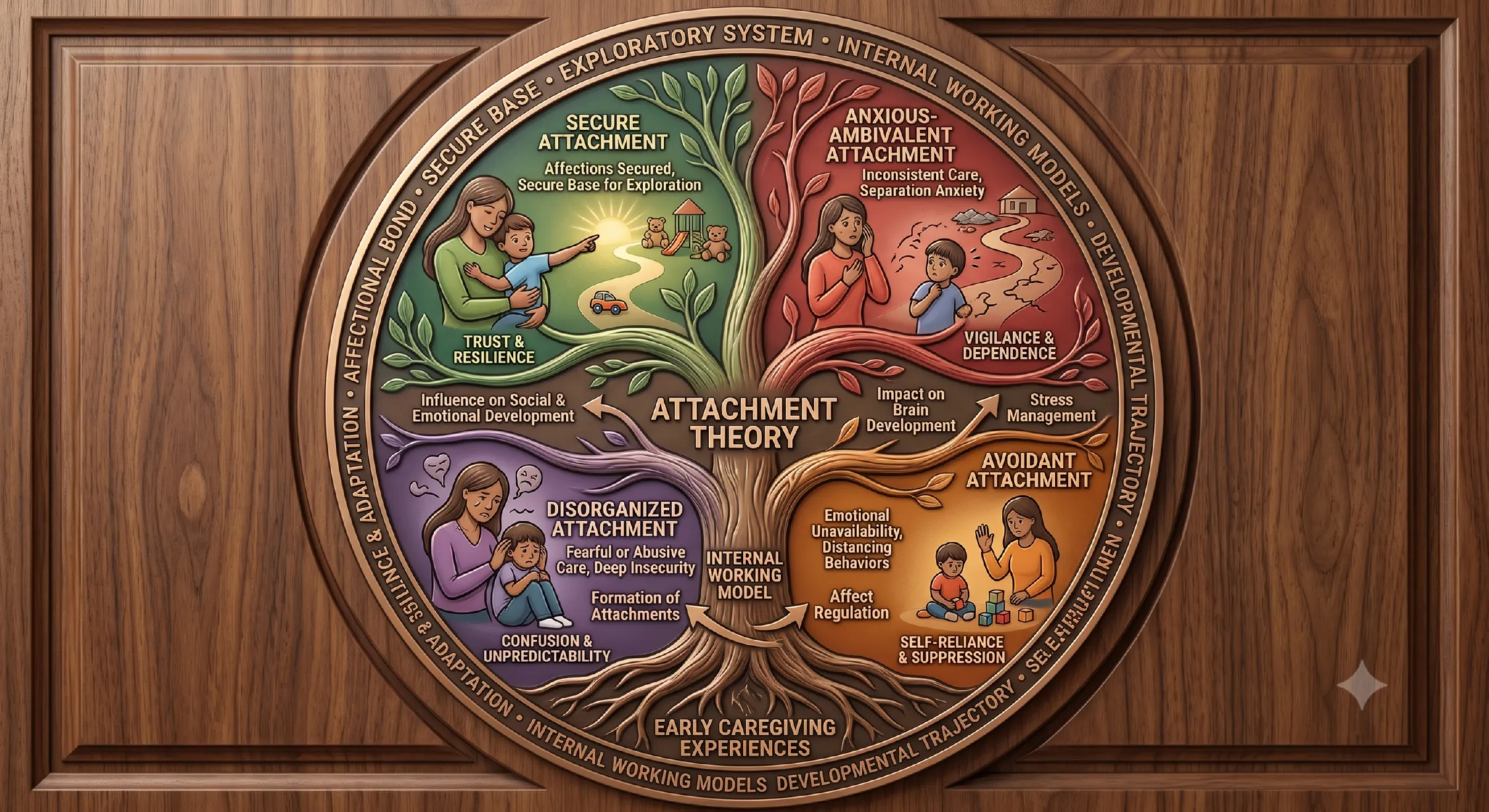
Developmental psychologists categorize attachment styles in children into four primary styles: one secure and three insecure patterns.
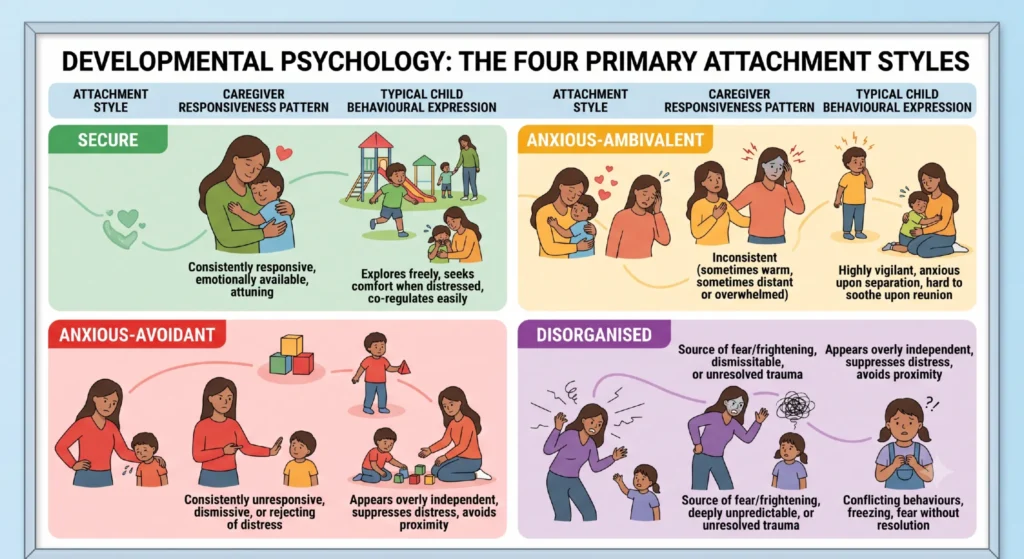
| Attachment Styles in Children | Caregiver Responsiveness Pattern | Typical Child Behavioural Expression |
| Secure | Consistently responsive, emotionally available, attuning | Explores freely, seeks comfort when distressed, co-regulates easily |
| Anxious-Ambivalent | Inconsistent (sometimes warm, sometimes distant or overwhelmed) | Highly vigilant, anxious upon separation, hard to soothe upon reunion |
| Anxious-Avoidant | Consistently unresponsive, dismissive, or rejecting of distress | Appears overly independent, suppresses distress, avoids proximity |
| Disorganised | Source of fear/frightening, deeply unpredictable, or unresolved trauma | Conflicting behaviours, freezing, fear without resolution |
1. Secure Attachment Style
Children with a secure attachment style view their caregivers as a reliable “safe base” from which to explore the world and a “secure haven” to return to when distressed.
- Key Behaviours: They may become upset when separated from a caregiver, but they welcome them back warmly upon return and soothe quickly. They feel confident exploring new environments because they trust help is available if needed.
- Caregiver Pattern: Caregivers are consistently responsive, emotionally available, and attuned to the child’s physical and emotional cues.
2. Anxious-Ambivalent (Resistant) Attachment
Children with an anxious-ambivalent attachment style often feel uncertain about whether their needs will be met. Because care has been unpredictable, their strategy is to stay close and amplify their distress signals to ensure they aren’t ignored.
- Key Behaviours: They can be clingy, hesitant to explore independently, and deeply distressed by separation. Upon reunion, they may seek closeness but simultaneously display anger, resistance, or distress, making them difficult to comfort.
- Caregiver Pattern: Caregivers are often well-meaning but inconsistent—sometimes warmly responsive, other times preoccupied, distant, or overwhelmed.
3. Anxious-Avoidant Attachment
Children with an anxious-avoidant attachment style have learned that expressing distress does not result in comfort or connection. To protect themselves from rejection or emotional overwhelm, they adapt by hiding their feelings and minimizing their reliance on adults.
- Key Behaviours: They often appear remarkably independent, calm, or indifferent when a caregiver leaves or returns. However, physiological studies show that their internal stress levels (such as heart rate and cortisol) remain extremely high despite their calm exterior.
- Caregiver Pattern: Caregivers may consistently discourage expressions of distress, push independence too early, or feel uncomfortable with intense emotional displays.
4. Disorganised Attachment
A disorganised attachment style occurs when the child’s primary source of safety is also a source of fear or unpredictability. The child experiences an unsolvable dilemma: their biological drive pushes them to seek comfort from a caregiver, but their survival instinct tells them to flee.
- Key Behaviours: The child exhibits confused, contradictory, or fragmented responses, such as running toward a parent while looking away, freezing in place, or showing sudden fear during routine interactions.
- Caregiver Pattern: Caregivers may be experiencing unresolved trauma, severe mental health struggles, or displaying frightening, erratic, or abusive behaviours.
How Attachment Styles Affect Behaviour and Learning
Attachment experiences directly influence brain development, specifically the nervous system’s capacity for emotional regulation.
When a child feels securely attached, their brain allocates cognitive resources to curiosity, problem-solving, and social engagement. In contrast, children with insecure attachment styles often spend significant cognitive energy assessing their environment for safety.
- In the Classroom: Securely attached children are more likely to seek help when stuck on a task. Avoidant children may suffer in silence rather than ask a teacher for assistance, while ambivalent children may struggle to settle into independent work due to separation anxiety.
- Peer Relationships: Secure children generally demonstrate higher empathy and stronger conflict-resolution skills. Insecure attachment can manifest as withdrawal, hyper-defensiveness, or difficulties forming trusting friendships.
Practical Strategies to Foster a Secure Attachment
The encouraging reality of attachment theory is that attachment styles in children are malleable. Through consistent, relational interactions, adults can foster what clinicians refer to as earned security.
- Practice Co-Regulation: Young children cannot regulate their intense emotions alone. When a child experiences a meltdown, stay calm, lower your vocal pitch, and provide a steady presence to help their nervous system settle.
- Prioritise Connection Before Correction: Address a child’s emotional state before addressing their behaviour. Validating their feelings (“I see you are really frustrated right now“) builds trust before setting a boundary.
- Be Consistently Responsive: You do not need to be a “perfect” parent or educator. Research shows that caregivers only need to be attuning and responsive about 30% of the time to build a secure attachment, provided ruptures in the relationship are followed by warm repair.
- Offer a Predictable Environment: Routines, visual schedules, and clear transitions help anxious or hyper-vigilant children feel secure because they know what to expect next.
Frequently Asked Questions About Child Attachment
Q: What are the four attachment styles in children?
A: The four primary attachment styles in children are secure, anxious-ambivalent (resistant), anxious-avoidant, and disorganised. These styles reflect how a child seeks safety, comfort, and connection from their primary caregivers.
Can a child’s attachment style change over time?
A: Yes. Attachment patterns are not fixed personality traits. Through consistent, responsive caregiving, supportive environments, and positive relational experiences, a child can transition toward a more secure attachment style over time.
Q: Who originally developed attachment theory?
A: Attachment theory was initially formulated by British psychologist John Bowlby in the mid-20th century and significantly expanded by developmental psychologist Mary Ainsworth through her research on early caregiver interactions.
References & External Resources
Key Academic Literature
- Ainsworth, M. D. S., & Bell, S. M. (1970). Attachment, Exploration, and Separation: Illustrated by the Behavior of One-Year-Olds in a Strange Situation. Child Development, 41(1), 49–67. doi:10.2307/1127388
- Bowlby, J. (1969). Attachment and Loss: Vol. 1. Attachment. Basic Books.
- Main, M., & Solomon, J. (1990). Procedures for Identifying Infants as Disorganised/Disoriented during the Ainsworth Strange Situation. In M. T. Greenberg, D. Cicchetti, & E. M. Cummings (Eds.), Attachment in the Preschool Years: Theory, Research, and Intervention (pp. 121–160). The University of Chicago Press.
Authoritative Guidance & Support
- National Institute for Health and Care Excellence (NICE): Children’s Attachment: Attachment in Children and Young People Who Are Adopted from Care, in Care, or at Risk of Going into Care (NG26)
- NSPCC Learning: Understanding Attachment and Child Development in the Early Years
- Anna Freud National Centre for Children and Families: Early Years Mental Health Frameworks and Relational Support