

Please Enter Your Email ID
Table of Contents
What Makes a Good Safeguarding Referral?
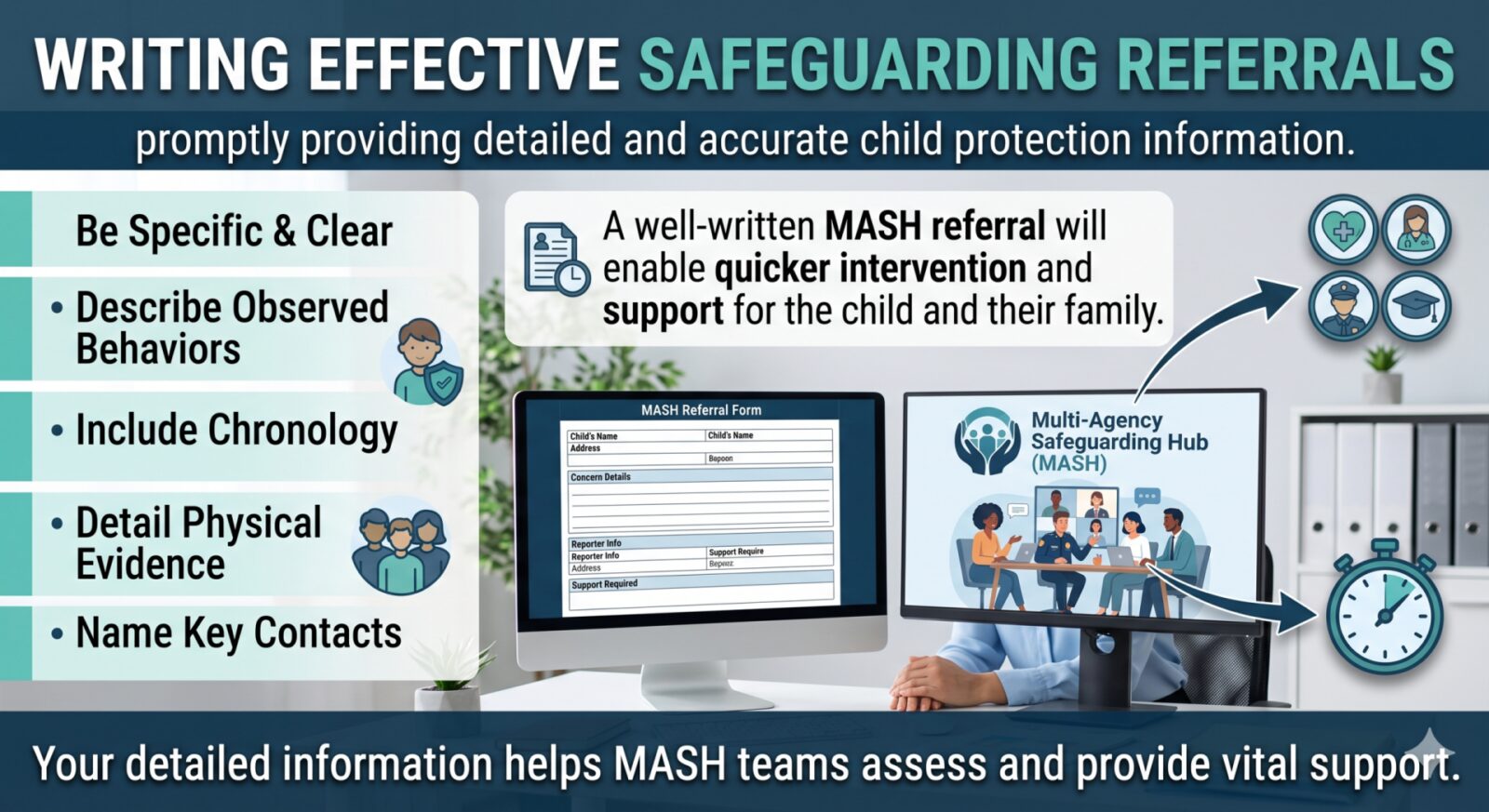
Learning how to write a social care referral effectively is one of the most vital skills for any safeguarding professional. A clear, well-structured children’s social care referral ensures rapid multi-agency intervention, helping vulnerable pupils and families receive timely support.
Conversely, a vague or incomplete referral risks failing to meet the local authority threshold of need. This can cause dangerous delays, leaving a child exposed to further risk and harm. In this guide, we walk through every step of writing a clear, child-centred, and evidence-based safeguarding referral.
Knowing what details to include, especially in high-stress moments immediately following a child abuse disclosure can feel overwhelming. While local authority templates and Children’s Safeguarding Partnerships vary by region, every effective social care referral requires a core set of factual evidence. Use the step-by-step checklist below to ensure your referral is accurate, actionable, and robust.
Remember, if there is an immediate risk to the child, call 999.
What Basic Information is Needed for a MASH Social Care Referral?
When completing a Social Care/MASH referral (Multi-Agency Safeguarding Hub or your local equivalent social care team), providing accurate baseline details ensures social care can locate the child on their database immediately.
As an absolute minimum, your referral must include the child’s name and date of birth or address. When the child has additional needs or an EHCP, you should include these details also.
To ensure your safeguarding referral is actionable and avoids delay, include the following details wherever possible:
- Child’s Key Details: Full legal name, date of birth, current school or setting, and any known medical conditions or disabilities.
- Sibling Details: Names, ages, and schools of all known siblings living inside or outside the home.
- Parent and Carer Details: Full names, contact details, parental responsibility (PR) status, and home addresses of primary caregivers.
- Household Composition & Relationships: Details of any other adults living in or frequently visiting the home, including their relationship to the child.
Safeguarding Tip: Identifying "unknown" or unaccounted-for adults who regularly access the home is critical, as unassessed individuals can pose significant contextual risks. Drawing a basic genogram (family tree structure) can help social care visualise complex household dynamics quickly.

How to Document Your Reasons for a Social Care Referral
When detailing your reasons for making a social care referral, you must provide clear context. The social worker or Multi-Agency Safeguarding Hub (MASH) officer reading your report will likely have zero prior knowledge of the child or family.
To write a clear, effective safeguarding referral, outline your concerns using the “What, Where, When, and Impact” framework:
- What Happened: Clearly detail the specific incident, disclosure, or pattern of behaviour that triggered the concern.
- When and Where: Include exact dates, times, and locations rather than vague timeframes like “recently” or “a while ago”.
- Who Was Involved: State who observed the concern, who was present, and any alleged perpetrators or individuals involved.
- Impact on the Child: Explicitly state how the concern is affecting the child’s physical health, emotional well-being, or developmental progress.
Safeguarding Tip for Practitioners: Treat this section as a step-by-step summary of your concerns. Assume the MASH practitioner knows nothing about the school or family context, spell out every detail clearly and factually.
Factual Evidence vs Opinion: How to Record Details in a Social Care Referral
When writing a social care referral, accuracy and objectivity are essential. Multi-Agency Safeguarding Hub (MASH) teams and social workers rely on concrete, verifiable evidence to assess the statutory threshold of need.
Subjective assumptions or vague summaries can lead to misunderstandings, potential legal challenges, or delays in getting support to a vulnerable child.
Key Rules for Recording Factual Evidence:
- Record Direct Quotes Verbatim: Use exact words in quotation marks, including slang or emotional language used by the child.
- Describe Physical Observations Objectively: State exact locations, measurements, and appearance of injuries without diagnosing the cause.
- Separate Fact from Professional Judgement: Clearly state what was directly seen or heard versus your professional analysis.
Examples: Objective Safeguarding Evidence vs Vague Opinion
| Vague / Subjective Statement (Avoid) | Factual / Objective Statement (Use This) | Why This Difference Matters |
|---|---|---|
| “The parents fought last night.” | “I am concerned because X stated verbatim: ‘Daddy hurt Mummy last night.'” | Differentiates hearsay from a direct, verifiable disclosure from the child. |
| “Mum looked like she had been beaten up.” | “When Mum collected X from school, the teacher observed a fresh 2cm bruise and small cut above her left eye socket. When asked if she was OK, Mum looked at the ground and walked away without replying.” | Replaces subjective speculation with measurable, observable facts and behaviours. |
| “The child comes from a neglectful household.” | “X has arrived at school wearing unwashed clothes for 4 consecutive days and stated they have not eaten breakfast today.” | Provides specific, chronological evidence of unmet needs rather than a sweeping label. |
| “Dad was aggressive toward staff.” | “Dad raised his voice, pointed his finger within 6 inches of the receptionist’s face, and stated: ‘You have no right to talk to me.'” | Documents exact physical actions and quotes, allowing social care to accurately gauge risk. |
| “The pupil was acting out as usual.” | “During maths at 10:15 AM, X threw their chair across the room and shouted ‘I can’t do this,’ before running out of the classroom.” | Establishes the exact context, time, and specific behavioural trigger for the incident. |
Safeguarding Rule of Thumb: Ask yourself, “Did I personally observe this, or did someone tell me?” If you observed it, describe it using sensory facts (what you saw, heard, or measured). If a child disclosed it, write down their exact words inside speech marks.
If you are adding your opinion, be sure to differentiate what is factual and what is opinion. This distinction is vital as it helps the MASH team to trust the information provided.
Each local authority will have a threshold of needs document (see Page 28 for an example), which demonstrates what would be considered normal developmental behaviours and what would be considered a concern. When writing your referral, you can directly quote from the threshold of needs document. The assessment triangle is also a valuable resource for identifying areas of concern.
Including Safeguarding Chronology and Previous Support
You should also go ahead and describe any previous concerns for the child or family (add a chronology if it helps to build a pattern/picture).
It is helpful to demonstrate what support has already been offered, so you should list details of any actions taken (for current and historic concerns). For example, this might be the second or third time that you have made a referral for this family due to similar problems. Also, list any meetings that you have held with the family and any interventions that have been held with the child and note any progress that has been made following the support you have offered.
Include a description of how the parent/carer explained the incidents or how they reacted to you discussing it with them. Did they seem genuinely concerned? Were they dismissive?
How to Capture the Child’s Voice in a Referral
Including the child’s voice in the referral is crucial. It ensures the referral remains child-centred, focusing on the child’s experiences and needs. When recording the child’s voice, ensure that the words the child uses are written verbatim, including slang or offensive language. You can add clarification of slang words after quoting the child.
It’s essential to describe how the current situation is impacting the child. For example, you may have noticed a decline in behaviour over the past two weeks, or every Monday after spending the weekend with family, the child may appear very withdrawn. This helps the MASH team understand the urgency and potential severity of the situation, making it easier for them to prioritise their response.
Using tools such as the 3 house assessment or Voice of the child template can help here.
Meeting the Threshold of Need for Social Care Referrals
Children’s social care highly values your professional opinion and expertise; after all, you are more likely to understand the child and their family better.
It’s crucial to offer your professional judgment regarding the level of risk and potential harm to the child. For example, you could say, “We are concerned that if additional support for X’s mental health is not provided now, the long-term risk is that the child will not meet their expected academic levels due to their inability to focus in class.” This professional judgment is valuable as it helps to guide the reader’s understanding of the situation.
Another example could be saying, “We are concerned that if support is not offered for mum’s alcohol misuse, X will be emotionally and socially isolated as he takes on the role of carer for his two siblings when mum is intoxicated. We have referred X to young carers for additional support; however, unless Mum seeks help, X will continue to be the primary carer for his siblings and will not be able to have a childhood.”
What is the Aim of the Referral?
You can say what you would like to happen next; for example, based on their threshold of needs, you might feel that a Level 3 Child in Need plan is appropriate, or you may think an immediate strategy meeting needs to be held as the risk is high and requires a swift multi-agency response.
You can also say how you/your agency will contribute to any assessment or plan that is agreed upon moving forward.
Parental Consent When Making a Social Care Referral
Unless it is likely to place the child at an increased risk of harm, it is best practice to speak with the parent/carer before making a referral to children’s social care. Some parents might be grateful for the additional support, and others may become hostile. However, you should at least try to gain consent before making the referral.
If consent was not gained, you should explain why. This could be that you feel that gaining consent will put the child at a greater risk of harm, or when you spoke to parents, they declined to give consent. Lack of consent should not prevent you from making a referral. If you have concerns, note why you have overridden the need for consent.
Your Contact Details
Ensure you include your contact details so the MASH team can contact you for any follow-up; you usually provide a contact number and email address.
Include the details of other professionals or services working with the family, such as GP, Health Visitor, CAMHS, etc.
Things to avoid in your referral
It is best if you avoid jargon and acronyms. If describing something technical (such as a medical diagnosis), explain what this means and how it impacts the child.
Lack of detail will also affect how your social care referral is triaged by the MASH team, be specific and as detailed as possible.
| Vague Statement (High Risk of Rejection) | Explicit, Impact-Driven Description (High Priority for MASH) | Why This Works for Safeguarding Thresholds |
| “The child has poor attendance.” | “The child has 68% attendance this academic year, having missed 32 full days of school. As a result, they are failing to reach age-related expectations in literacy and numeracy. Continued trajectory at this rate will severely impair their ability to achieve standard GCSE passes in Year 11.” | Quantifies impact: Replaces subjective generalisations with precise data, linking current attendance directly to long-term developmental and educational harm. |
| “The children are not being looked after properly.” | “Parents have failed to meet basic physical needs, resulting in the children arriving late 4 out of 5 mornings this week without breakfast and in unwashed uniforms. 2 out of 3 children report persistent toothache over the past 7 days; parents have failed to engage with dental services despite school support.” | Provides tangible evidence: Demonstrates a persistent pattern of neglect through clear timelines, frequency metrics, and documented physical health impacts. |
| “Dad gets angry and aggressive at home.” | “On 12th May at 15:30, Child A disclosed: ‘Daddy threw a mug at the wall and screamed in Mummy’s face because the kitchen was messy.’ Child A was observed shaking during disclosure and hid under a desk when voices were raised in the classroom later that afternoon.” | Uses verbatim evidence & behavioural indicators: Replaces assumption with direct child quotes and observed trauma responses, establishing psychological impact. |
| “The family is struggling financially.” | “The family has had no electricity or heating in the home for the past 10 days. The child reported eating only cold canned food at home over the weekend and arrived at school on Monday wearing summer clothing in 4°C weather.” | Highlights immediate environmental risk: Clearly identifies physical indicators of poverty/neglect that require immediate intervention under Section 17 (Child in Need). |
| “Mum’s mental health is impacting the children.” | “Mother was unable to rise from bed to care for the children on 3 separate occasions this fortnight. Child B (aged 8) reported preparing meals for two younger siblings and missing school on Friday to supervise them.” | Identifies young carer roles & impairment: Shows precisely how a parent’s condition directly impacts daily care, safety, and school attendance. |
You should also avoid hyping up, exaggerating or making a referral just in case. If in doubt, speak to the MASH team first.
What key information should be included in a child social care referral?
A high-quality social care referral should clearly state basic demographic details, explicit factual observations (using dates, times, and direct quotes), the impact of the concern on the child, baseline parent/carer responses, and actions already taken by your organisation. Avoid subjective opinion or unverified assumptions.
Should I inform parents before submitting a social care referral?
In most circumstances, practitioners should seek parental consent or inform parents before making a referral to Children’s Social Care. However, you must not inform parents if doing so would place the child at immediate risk of harm, impede a police investigation, or cause undue delay in securing protection.
How do I differentiate between fact and opinion in a safeguarding referral?
Distinguish facts from opinions by documenting exact statements, observed physical indicators, or clear behavioural patterns rather than interpretation. If professional judgement or context is necessary, label it explicitly (e.g., “In my professional opinion as DSL…”).
What should I do if my referral is rejected or meets the threshold for early help only?
If Local Authority Multi-Agency Safeguarding Hub (MASH) teams determine the referral does not meet Section 47 or Section 17 thresholds, review their written rationale. If you believe the risk remains unmanaged, exercise your professional escalation procedure, submit additional supporting evidence, or re-engage via an Early Help assessment framework.
- How to make a ‘good’ referral – Enfield Council
- Referring to children’s social care: advice and examples
- Making Effective Referrals: A guide for DSLs
- What makes a good assessment? | Practice points – NSPCC Learning
- Referrals to Children’s Social Care – Safeguarding Network
- Guidance on Making a Good Request for Help & Support /Referral to Children’s Social Care