

Please Enter Your Email ID
Table of Contents
Why Relational Practice Matters in Child Development
Building relationships with children is often a gradual process that strengthens over time. Trust cannot be rushed, especially with children who may have experienced trauma or challenging circumstances. Such children often recognise when a relationship feels superficial or forced, perceiving it as insincere or transactional. Genuine connection takes patience, consistency, and an authentic approach.
Recognising that some relationships may take longer to form than others is key. Even when a bond is established, relationships require ongoing care and attention to grow. Focusing on the strategies below can build trust and rapport, helping children feel safe, valued, and supported.
Key Pillars of Building Relationships with Children
A genuine and authentic adult is crucial in creating an environment built on safety and trust. This solid foundation helps children feel valued, understood, and respected, paving the way for more substantial and positive relationships.
When children sense that an adult is authentic, they are likelier to open up, share their feelings, and form a meaningful connection. Authenticity also gives children a positive role model, teaching them the value of honesty and vulnerability in relationships.
You can foster a safe and supportive relationship where children can be themselves by showing genuine interest, consistency, and honesty. This empowers caregivers and educators to be responsible for creating an authentic environment that supports children’s growth and development.
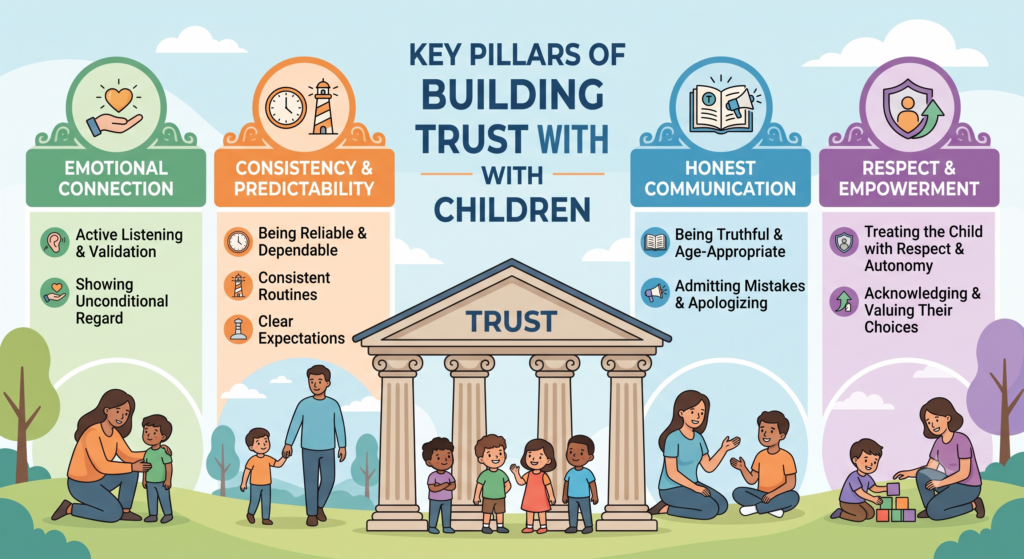
A great tool for building relationships with children is being authentic. Critical approaches to being authentic include:
- Actively engage with your child’s thoughts, feelings, and experiences to show genuine interest in their world.
- Recognise and celebrate their uniqueness, avoiding comparisons to others to honour their individuality.
- Show you care by asking questions about what is important to them.
- Demonstrate honesty and transparency by admitting when you don’t know something or have made a mistake.
- Stay fully present and concentrate on the moment.
- Build trust with your child by consistently following through on your promises.
- Be authentic by being true to yourself and avoiding pretence.
Active Listening and Unconditional Positive Regard
An adult practising active listening creates a safe, respectful, and supportive environment where children feel heard and valued. This approach makes caregivers and educators feel integral to the relationship, knowing that their active listening fosters trust, builds mutual respect, and promotes confidence and emotional growth.
Building relationships with children is impossible if you are unable to listen. Fundamental approaches to help improve listening skills include:
- Maintain eye contact, eliminate distractions, and position yourself at the child’s level to show them they have your full attention.
- Use verbal and non-verbal communication to acknowledge and respond to your child effectively.
- Reflect on what children share by paraphrasing their words and asking open-ended questions. This helps to clarify misunderstandings and deepen understanding.
- Validate their feelings by acknowledging their emotions in a non-judgmental way.
- Demonstrate patience by embracing pauses and silences, giving them time to gather their thoughts during conversations.
- Ensure they feel heard and understood by acknowledging their words before suggesting solutions.
- Confidentiality should be the foundation of your relationship, except for safety concerns. Ensure children understand situations where confidentiality might need to be broken.
Creating Psychological Safety for Trauma-Impacted Youth
An adult who demonstrates empathetic understanding creates an environment where a child feels genuinely heard, valued, and supported. This connection builds trust, fostering emotional growth in children and young people.
Critical approaches to empathetic understanding include:
- Acknowledge and validate children’s emotions by recognising their feelings in a non-judgmental way.
- Align with your child physically and emotionally by getting down to their level.
- Demonstrate patience by giving your children the time to express themselves, especially when they struggle to find the right words.
- Warm eye contact, a calm tone of voice, and open body language are reassuring non-verbal cues that help create a sense of safety and connection.
- Reframe situations while validating their feelings as normal to help children gain alternative perspectives and process events constructively.
- Respect children’s perspectives by avoiding dismissing their feelings and demonstrating understanding of their viewpoint, even when it differs from yours.
Authenticity and Consistency
To become a trusted and secure presence in a child’s life, you must first demonstrate reliability. Consistency and dependability foster trust and support children’s confidence and emotional growth. By being the reliable adult they can count on, you create a foundation for a solid and supportive relationship.
Reliability is a key ingredient when building relationships with children. Being a reliable adult looks like:
- Keeping promises and following through on commitments lays the foundation for demonstrating reliability.
- Demonstrate consistency by maintaining regular routines and behaviours, providing children stability and security.
- Communicate effectively with children by using clear, simple, and age-appropriate language tailored to their stage of development.
- Avoid making unrealistic promises or ones you may be unable to keep. This sets realistic expectations and builds trust in your relationship.
- Be predictable by responding to situations calmly and consistently, helping children feel secure and understand what to expect from you.
Setting and Respecting Boundaries
Setting and respecting boundaries is crucial for building relationships with children as boundaries help foster a safe, respectful, and structured environment that allows your relationships to thrive. Clear boundaries help children feel secure, understand expectations, and cultivate their sense of self-discipline and autonomy.
By establishing and maintaining boundaries, you create a foundation for mutual respect and trust, which supports the growth of a positive and healthy relationship.
Setting boundaries looks like:
- Establishing consistency by applying boundaries uniformly across different situations.
- By involving children in setting boundaries, you encourage their ownership and commitment to the relationship and teach them about respect and responsibility.
- Clearly explaining the consequences of crossing boundaries to ensure children understand the expectations and outcomes.
- Modelling the respect for boundaries you expect children to follow, demonstrating consistency and integrity.
- Listening to your child’s reasons for pushing against boundaries to understand their perspective better and address their needs effectively.
- Enforcing boundaries calmly and without escalation to avoid power struggles and maintain a positive, respectful atmosphere.
- Regularly reviewing and reassessing boundaries with children to adapt to their changing needs and development as they grow.
Adapting the Relationship to the Needs of the Child
Relationship-based practises recognise children’s individuality and adjusts the environment to meet their needs, creating a supportive space that nurtures their growth and development.
All children are unique and therefore a one-size-fits-all approach to building relationships with children will likely fail. Key approaches to adapting to individual needs of children include:
- Understanding that an infant may not have the same attention span as a teenager, you can adapt your communication and activities accordingly. Understanding children’s developmental stages enables you to adapt communication, expectations, and activities to suit their age and abilities.
- Maintaining flexibility to adapt to your child’s moods, interests, and energy levels.
- Building a solid connection by learning about their personality, strengths, hobbies, and experiences.
- Encouraging children’s autonomy by supporting them in making their own choices and solving problems independently.
- Showing patience and responsiveness to children’s emotional needs to support their well-being and development.
- Celebrating success, growth, and progress by offering positive reinforcement to encourage and motivate children.
Creating a Safe Space for Building Relationships with Children
To create a safe space where children feel valued, respected, and free to express themselves without fear of judgment, consider adopting the following fundamental approaches:
- Being consistent, reliable, and approachable helps build trust and respect.
- Ensure your environment is secure and hazard-free to guarantee physical safety.
- Practising active listening and validating children’s feelings encourages open communication in your relationship.
- Embracing differences and celebrating diversity promotes inclusivity, fostering an environment where children feel valued and heard.
- Setting clear boundaries and modelling expectations helps create a safe and supportive space in your relationship.
- Maintain confidentiality where appropriate and discuss any situations where confidentiality might need to be broken beforehand.
- Avoid criticising mistakes and reassure children that making mistakes is a natural and valuable part of learning.
Trust the process
Building a relationship with children requires time and patience. Trusting the process means applying all of the above advice and, above all, showing genuine care, consistency, and understanding as the relationship develops.
The list below summarises the key aspects of building relationships with children:
- Ensure consistency by showing up regularly and keeping your promises.
- Practice patience, allowing children to open up at their own pace.
- Validate children’s feelings and experiences to show understanding and support.
- Celebrate small steps in your relationship, recognising that progress is often a slow and gradual process.
- Accept that mistakes, setbacks, and challenges are part of the journey; overcoming them together can strengthen your relationship.
Frequently Asked Questions (FAQ)
Q: What is relational practice when working with children?
A: Relational practice is an approach in education, social care, and youth work that prioritises strong, authentic, and trusting adult-child relationships as the foundation for developmental growth, emotional well-being, and positive behavior. Rather than relying solely on transactional rules or consequences, it focuses on empathy, consistency, and mutual respect.
Q: How long does it take to build trust with a child who has experienced trauma?
A: Building trust with a trauma-impacted child is a gradual process that varies for every young person. Children with relational trauma often test boundaries to see if adults remain safe and consistent. Trust cannot be forced; it develops over time through predictable routines, active listening, authentic interactions, and reliable emotional availability.
Q: What are low-pressure connection strategies for building rapport?
A: Low-pressure strategies allow a child to connect without feeling put on the spot. Examples include:
Parallel Activities: Drawing, building, or playing a game side-by-side rather than sitting eye-to-eye across a table.
Shared Interests: Engaging in topics the child genuinely enjoys (such as hobbies, sports, or creative arts).
Micro-Connections: Brief, non-demanding daily check-ins (“I noticed you were working hard on that earlier”) that signal care without requiring an intense response.
Q: How do you repair a relationship with a child after a disagreement or boundary enforcement?
A: Relational repair requires the adult to take the initiative. Acknowledge what happened calmly, validate the child’s underlying feelings, and separate their behaviour from their worth as an individual (e.g., “I had to enforce that boundary to keep everyone safe, but our relationship is still solid, and we start fresh now”). Showing that the connection survives conflict builds long-term psychological safety.
References
- Erikson, E. H. (1963). Childhood and Society (2nd ed.). W. W. Norton & Company. (Overview via NIH / NCBI Bookshelf)
- Bowlby, J. (1988). A Secure Base: Parent-Child Attachment and Healthy Human Development. Basic Books. (Discussion on Secure Base Theory via PubMed Central)
- Rogers, C. R. (1951). Client-Centered Therapy: Its Current Practice, Implications, and Theory. Houghton Mifflin. (Historical analysis via PubMed Central)
- Gordon, T. (1970). Parent Effectiveness Training: The Tested New Way to Raise Responsible Children. Peter H. Wyden. (Resource information via Gordon Training International)
- Bronfenbrenner, U. (1979). The Ecology of Human Development: Experiments by Nature and Design. Harvard University Press. (Overview via Frontiers in Psychology)
- Siegel, D. J., & Bryson, T. P. (2012). The Whole-Brain Child: 12 Revolutionary Strategies to Nurture Your Child’s Developing Mind. Bantam Books. (Resource profile via Dr. Dan Siegel)
- Vygotsky, L. S. (1978). Mind in Society: The Development of Higher Psychological Processes. Harvard University Press. (Digital edition via Marxists Internet Archive / Harvard University Press)
- Ginsburg, K. R. (2007). Building Resilience in Children and Teens: Giving Kids Roots and Wings. American Academy of Pediatrics. (Resource summary via American Academy of Pediatrics)
- Barrett, P. M., & Turner, C. M. (2001). Prevention of anxiety disorders in children and adolescents. Journal of Clinical Child Psychology, 30(1), 25–35. https://doi.org/10.1207/S15374424JCCP3001_4 (Source via Taylor & Francis Online)