
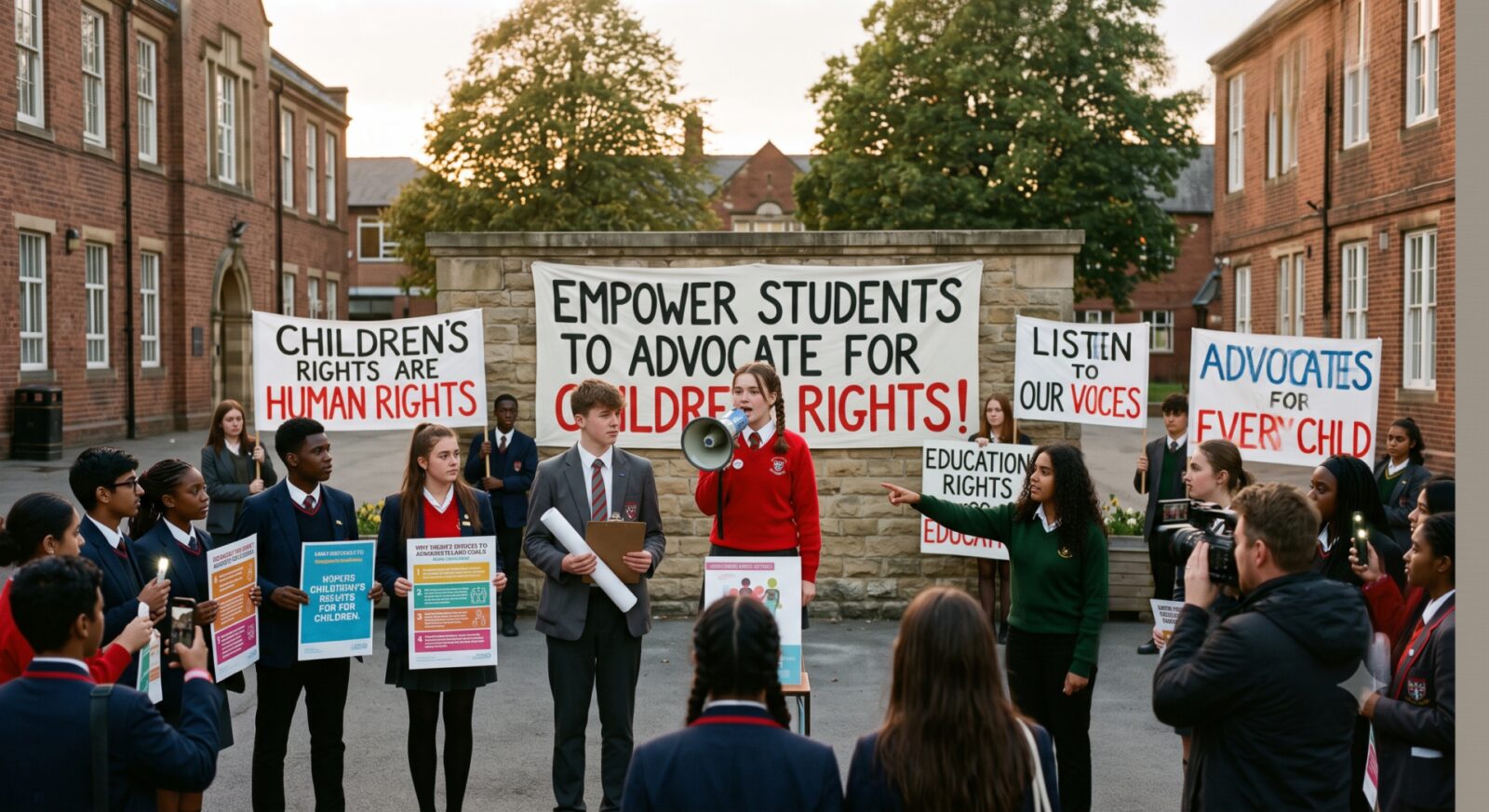

Please Enter Your Email ID
Table of Contents
What Are Children’s Rights and Why Do They Matter?
Children’s rights are a fundamental part of human rights, and with your support, we can create a world where children are heard, valued and respected.
Empowering students to become advocates for children’s rights is not just an educational task; it’s a transformative journey. By removing barriers such as the notion that ‘adults know best’ or sidestepping controversial issues, we are equipping children with a superpower – the power of knowledge.
Understanding their rights not only builds their confidence and empowers them to speak up against unfair treatment but also fosters a sense of justice and fairness, protecting them from harm and preparing them for adulthood.
The Role of the UNCRC in UK Education
The United Nations Convention on the Rights of the Child (UNCRC) was adopted in 1989 (the UK signed it in 1991) and is a legally binding agreement signed by 196 countries. In the UK, the Human Rights Act, Child Act and Equality Act help further protect children’s rights.
The UNCRC, a universally recognised document, is a practical guide for how grown-ups should treat children. It meticulously details 54 rights that every child in the world is entitled to, regardless of their background or location. The universal nature of children’s rights is a powerful reminder that all individuals under 18 years old have rights.
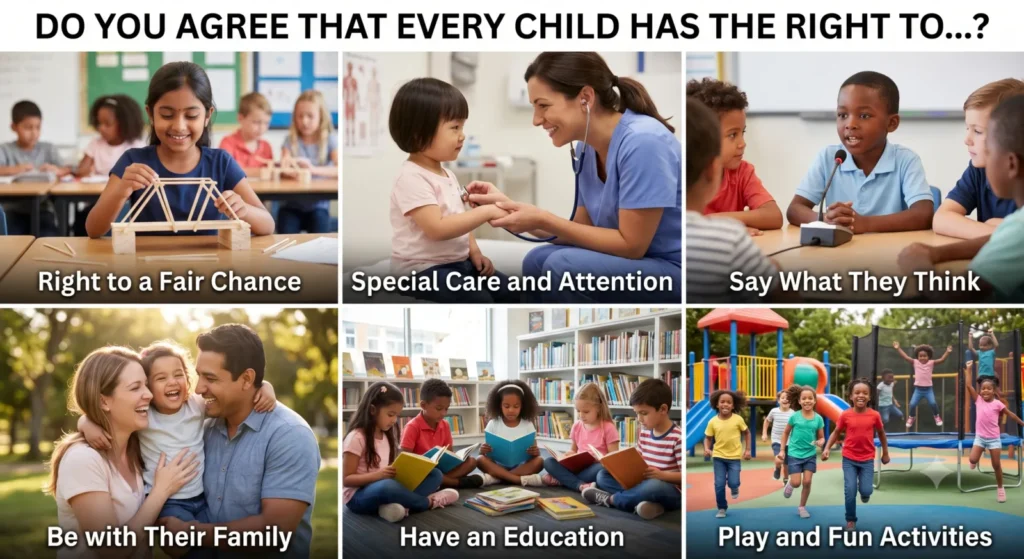
Do you agree that every child has the right to …?
- A fair chance?
- Special care and attention?
- Say what they think?
- Be with their family?
- Have an education?
- Play and fun activities?
- Be protected from harm?
Teachers (and I mean anyone who can impart knowledge to a child) have the power to create safe spaces where children’s rights can be introduced, discussed and understood. This can spark curiosity in children, allowing them to explore different perspectives and think critically about the world.
Good teachers can expand on this and provide opportunities through class discussions and role-playing where children can practice their advocacy skills.
Why Empowering Students to Become Advocates for Children’s Rights Transforms Classrooms
Understanding and exercising children’s rights is like discovering a ‘‘cheat code” in a favourite game. It’s not about winning unfairly but levelling up their sense of fairness, respect, and confidence to speak out. This metaphorical ‘‘cheat code” builds a strong foundation for children, helping them understand their rights and develop important values such as equality, justice, and empathy. These values will undoubtedly influence their future decisions.
Developing Core Life Skills Through Pupil Advocacy
When adults advocate for children’s rights, they amplify the child’s voice, giving them a platform to share their ideas, concerns, and hopes for the future. Additionally, advocacy helps children develop essential skills, including critical thinking, communication, collaboration, and problem-solving. You can think of this space as a training ground for them to become influential leaders in the future.
If provided with the ‘How’ and given a reason for ‘Why’, children can become great advocates for the rights of others; some examples might be:
Taking a Stand Against Bullying
A group of children has witnessed another child being bullied and wanted to take a stand against bullying. They decided to speak to the head teacher and start an anti-bullying squad. Furthermore, they create posters around the school and hold workshops on conflict resolution and empathy – as a result, the school has become more inclusive, and children feel safer.
Improving the environment
A group of children noticed that there was always rubbish on the floor of their playground, so they decided to hold a campaign highlighting this concern. The campaign established a recycling station and additional bins throughout the school. This group also contacted a local litter-picking group, which meets once a month in the local community to help the environment beyond the school gates.
Practical Strategies for Empowering Students to Become Advocates
As a teacher, you are in a prime position to empower students to become advocates for children’s rights, and you can start this by creating a rights-respecting classroom. In a rights-respecting classroom, you can build an environment where everyone feels valued, respected and empowered. This is not just a suggestion but a responsibility and a commitment that we, as educators, should take seriously.
Creating a Rights-Respecting Classroom Charter
Once you have introduced the rights to the children, you can involve them in creating a classroom charter based on their rights. Rather than having a rule stating that “you do not hit others”, you could have a classroom right of “I have the right not to be hurt” – this will help give the children ownership while assisting them to understand the importance of respecting each other’s rights.
You can extend your rights respecting classroom further by creating dedicated time where they can share concerns or ideas for the classroom – this will allow their voices to be heard whilst actively participating in decision-making.
Children who stand out can be recognised through a compliments wall or appreciation station where others (staff and peers) can write a note of appreciation, which can be read out at the end of the day or week.
Amplifying the Voice of the Child Across the School
Once you are set up in your classroom, you can extend this to the broader school community (and beyond); this will create a rights-respecting school that positively impacts the lives of all the children who attend.
You can form a student-led group that promotes children’s rights within the school. They could meet regularly to discuss concerns and share ideas, meet with senior leaders and governors to advise on policies, and hold events such as assemblies to raise awareness.
Overcoming Common Barriers to Student Advocacy in Schools
Empowering students to become advocates for children’s rights does not come without obstacles; You and the children you work with might face challenges and barriers in your fight to improve the world. All obstacles can be overcome with a growth mindset, positivity, and a desire to make a difference. Some examples of barriers you might face are listed below.
Managing Limited Time and Budget Constraints
While getting started should not cost anything, you might want to invest in some resources to create displays or posters for around the school. However, these costs are likely not budgeted for and will need funding. You can overcome funding problems by holding fundraising drives such as car washes or a clothes day (in exchange for money donations). You can also work with the PTA or local groups to apply for external funding.
We are all busy, and new projects can quickly become time-consuming. However, if you choose to start small, such as running a club during lunchtime that meets weekly, it will at least provide you with a starting point. Another thing to consider is that by creating a rights-respecting classroom, you will likely have a more productive classroom with fewer behavioural incidents – leading to more time for you to teach.
Navigating Sensitive and Controversial Topics Safely
Discussing certain rights may lead to controversial topics, so you must be prepared to research each right (and the potential controversial subjects it may raise) to provide accurate information. You can create a safe space to discuss these topics if time is allocated to rights discussions.
Lack of support or interest
To start with, you might be the only person interested in this project, but that should not mean it’s not a worthwhile endeavour. Even if you only help one child find their voice, it is one more than yesterday. Once your project has a plan, you can discuss it with other teachers, parents, and community members to find those willing to support your idea.
Conclusion: Championing the Next Generation of Advocates
Imagine a world where every child is confident enough to fight for their rights (and the rights of others). This world is possible, and it starts with you. Empowering students to become advocates, sparks a transformation that can change their lives.
It might seem minor, but teaching children about their rights gives them a voice to speak out against injustice and inequality; by doing this, we unleash their potential to become something great – leaders who can shape a world where rights are respected and upheld.
Understanding children’s rights and creating right-respecting environments (such as classrooms), you provide opportunities for advocacy and empower children to become superheroes who are the champions of a better future for all children.
Together, let’s empower children to raise their voices and create a world where every child thrives. The future is in their hands. However, their future begins with you.
Frequently Asked Questions (FAQ)
Q1: How can teachers start empowering students to become advocates in the classroom?
Answer: Teachers can start empowering students to become advocates for children’s rights by introducing the UNCRC in age-appropriate ways, co-creating a classroom charter focused on rights rather than restrictive rules, and establishing regular dedicated time for pupils to share their views and lead small community projects.
Q2: What are the benefits of student advocacy in schools?
Answer: Empowering students to become advocates builds critical thinking, communication, and leadership skills. It enhances empathy, fosters an inclusive school climate, and reduces behavioural incidents by giving pupils active ownership of their environment.
Q3: What is the UNCRC, and how does it relate to student rights in the UK?
Answer: The United Nations Convention on the Rights of the Child (UNCRC) is a legally binding international agreement detailing 54 rights for individuals under 18. In the UK, it underpins key legislation like the Children Act and Equality Act, serving as a framework for rights-respecting school environments.
Q4: How can schools overcome time and budget limits when promoting children’s rights?
Answer: Schools can start small by launching weekly lunchtime clubs, involving local community groups, or utilizing free online educational resources. Integrating rights-based discussions into existing subjects (like PSHE or Literacy) avoids needing extra timetable allocations.
References
- Rooting Child Rights in Early Childhood Education, Primary and Secondary Schools
- Teaching and learning about, through and for rights
- Children’s rights and advocacy
- National Youth Advocacy Service (NYAS)
- Empowering students: Pedagogy that benefits educators and learners
- The Power of Young People: Advocating for Children’s Rights in Emergency