

Please Enter Your Email ID
Table of Contents
What is the UN Convention on the Rights of the Child (UNCRC)?
The United Nations Convention on the Rights of the Child (UNCRC) is a landmark international treaty that delineates the civil, economic, political, and cultural rights of children globally. Ratified by 196 countries, the UNCRC establishes that every child is an individual with distinct rights, rather than a passive recipient of adult care.
For professionals in education and social care, understanding this framework is the essential first step in learning how to promote children’s rights across daily practice.
Key Principles for Upholding Children’s Rights in Practice
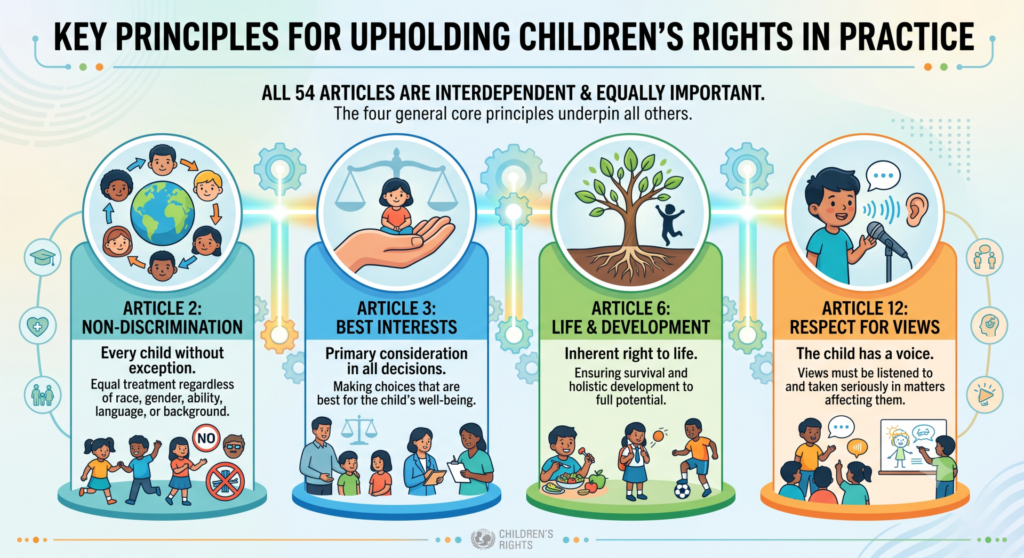
While all 54 articles are interdependent and equally important, Articles 2 (Non-discrimination), 3 (Best interests), 6 (Life and development), and 12 (Respect for views) are recognised as the four general core principles that underpin all others. Learning how to promote children’s rights through these 4 principle articles will lay the foundations for enabling and promoting the rights of all children and young person you work with.
| Article | Principle | Description |
|---|---|---|
| 2 | Non-Discrimination | Every child has the right to the same protection and opportunities, regardless of race, religion, or ability. |
| 3 | Best Interests | The childs welfare must be a primary consideration in all decisions affecting them. |
| 6 | Life & Development | Governments must ensure the survival and development of the child to the maximum extent possible. |
| 12 | Respect for Views | Children have the right to express their views freely, and these should be given weight according to their maturity. |
Summary of the 54 Articles of the UNCRC
The United Nations Convention on the Rights of the Child (UNCRC) consists of 54 individual articles. Articles 1 to 42 outline the specific human rights guaranteed to every young person, while Articles 43 to 54 detail how adults, governments, and international bodies must work together to enforce these rights.
Below is a categorised breakdown of the core articles most relevant to education, social care, and child protection practitioners:
Civil Rights & Identity (Articles 1–8 & 12–17)
These articles protect a child’s fundamental identity, personal liberty, and right to participate in decisions affecting their life:
- Article 1 (Definition of the Child): Everyone under 18 years of age has all the rights in the Convention.
- Article 2 (Non-Discrimination): Rights apply to every child without exception, regardless of ethnicity, gender, religion, ability, or background.
- Article 7 & 8 (Identity & Nationality): Every child has the right to a registered name, nationality, and official identity.
- Article 12 (Respect for the Views of the Child): Every child has the right to express their opinion freely in all matters affecting them, and their views must be given due weight in accordance with their age and maturity.
- Article 13–15 (Freedoms of Expression & Association): Children have the right to seek and share information, hold beliefs, and join groups or associations safely.
Family, Care & Protection (Articles 9–11, 18–21, & 25)
Focusing on the child’s right to a safe family life, appropriate alternative care, and protection from harm:
- Article 9 & 10 (Family Life & Reunification): Children should not be separated from their parents unless it is in their best interests, with right of contact maintained.
- Article 18 (Parental Responsibilities): Both parents share primary responsibility for bringing up a child, supported by government services.
- Article 19 (Protection from Violence & Neglect): Governments must protect children from all forms of physical or mental violence, injury, abuse, neglect, or exploitation.
- Article 20 & 21 (Children in Care & Adoption): Children who cannot live with their birth families have the right to special protection, culturally appropriate care, or safe adoption processes.
Health, Welfare & Disability Support (Articles 6, 23–27)
Ensuring every child receives the essential resources required for healthy development and physical well-being:
- Article 6 (Life, Survival & Development): Every child has the inherent right to life and maximum developmental support.
- Article 23 (Children with Disabilities): Neurodivergent children and young people with physical or learning disabilities have the right to a full, dignified life with active community participation and tailored support.
- Article 24 (Health & Healthcare): Access to good quality healthcare, clean water, nutritious food, and a clean environment.
- Article 27 (Adequate Standard of Living): The right to housing, food, and clothing suitable for the child’s physical, mental, and social development.
Education, Leisure & Culture (Articles 28–31)
Safeguarding the right to learn, play, and engage in social life:
- Article 28 (Right to Education): Primary education must be free and compulsory, with accessible secondary and higher education options. Disciplinary measures must respect the child’s dignity.
- Article 29 (Goals of Education): Education must develop every child’s personality, talents, and abilities to their fullest potential while promoting respect for human rights.
- Article 31 (Leisure, Play & Culture): The right to rest, play, join in artistic activities, and access recreational spaces.
Protection from Exploitation & Harm (Articles 32–42)
Shielding children from dangerous labor, violence, and institutional injustice:
- Article 32–36 (Exploitation & Abuse): Protection from harmful child labour, drug abuse, sexual exploitation, trafficking, and abduction.
- Article 37 & 40 (Detention & Juvenile Justice): Children accused of breaking the law must be treated with dignity, receiving fair legal assistance without cruel or inhumane treatment.
- Article 39 (Rehabilitation & Recovery): Children who have experienced neglect, exploitation, or trauma have the right to specialised recovery and social reintegration support.
- Article 42 (Knowledge of Rights): Governments and adults must make the UNCRC widely known to both adults and children.
Implementation & Government Accountability (Articles 43–54)
Articles 43–54 detail how international committees, governments, non-governmental organisations (NGOs), and adults must continuously collaborate, monitor progress, and report on the realisation of children’s rights worldwide.
How to Promote Children’s Rights in Everyday Practice
Promoting the rights of children goes beyond knowing the 54 articles of the UNCRC—it requires translating these international standards into daily, relational practice. Whether you work in education, social care, or youth work, here is how you can promote children’s rights every day:
Prioritise the “Voice of the Child” (Article 12)
Article 12 gives every child the right to express their views freely on matters affecting them. To promote this authentically:
- Avoid tokenism: Ensure feedback mechanisms (such as student voice panels or care reviews) lead to tangible outcomes that are fed back to the young person.
- Adapt communication: Use visual aids, drawing exercises, or digital tools to support children who struggle with verbal expression.
Co-Create Rights-Respecting Charters
Rather than displaying a static poster of rules, work directly with children to establish shared agreements based on rights. For example, frame classroom expectations around Article 28 (Right to Education) and Article 19 (Protection from Violence), helping young people understand that rights come with collective responsibility.
Balance Protection with Participation (Article 3)
When making safeguarding or welfare decisions, professionals must act in the child’s best interests. However, acting in a child’s best interest should never mean excluding them from the process. Involve young people in setting their own support targets and safety plans wherever age-appropriate.
Frequently Asked Questions (FAQ)
What is the most important article in the UNCRC?
While all 54 articles are interdependent and equally important, Articles 2 (Non-discrimination), 3 (Best interests), 6 (Life and development), and 12 (Respect for views) are recognised as the four general core principles that underpin all others.
How can teachers promote children’s rights in the classroom?
Teachers can promote children’s rights by establishing a class rights charter, involving pupils in decision-making, ensuring inclusive learning for all abilities, and explicitly teaching the UNCRC through social-emotional learning modules.
What does “the best interests of the child” mean in practice?
Article 3 mandates that in all administrative, legal, or educational decisions affecting a child, their physical, emotional, and developmental welfare must be a primary consideration.