


Please Enter Your Email ID
Table of Contents
Persistent school absenteeism across England remains one of the most stubborn structural challenges of the post-lockdown educational landscape, therefore, working together to improve school attendance is crucial. National pupil absence data collected by the Department for Education (DfE) highlights an acute shift: overall absence climbed from 4.73% in the pre-pandemic 2018/19 baseline to 6.93% in 2025/26. While overall absence and persistent absence (pupils missing 10% or more of sessions) experienced minor marginal fluctuations over recent cycles, severe absence—pupils missing more than 50% of their schooling—has more than doubled, climbing from 1.13% in 2020/21 to 2.39% in 2024/25.
In response to this attendance crisis, the Department for Education placed its guidance on a statutory footing through Working Together to Improve School Attendance. The statutory framework was designed to embed a preventative ladder—instructing schools to expect, monitor, listen and understand, facilitate support, formalise support, and enforce compliance only as a last resort. Alongside this support ladder, the guidance nationalised financial enforcement through the National Framework for Penalty Notices, standardising fines at £80 (rising to £160 if unpaid within 21 days) whenever a child accumulates 10 unauthorised sessions across a 10-school-week window. You can read my thoughts on school attendance fines here: Rethinking UK School Attendance Fines & Persistent Absence.
Despite the statutory assertion that attendance difficulties are “almost always a symptom of wider circumstances,” the lived reality inside schools and family living rooms tells a sharply different story. For parents and school leaders alike, the gap between national statutory policy and domestic reality is widening.
Drawing on empirical research from a nationwide survey of 522 UK parents and carers alongside clinical and educational literature, this article examines why punitive compliance mechanisms falter and outlines how school leaders, pastoral teams, and parents can build an empathetic, relational bridge back into education.
The Post-Pandemic Attendance Divide: Understanding the Shift
Educators and policymakers can work together to improve school attendancemust but must first acknowledge that the pre-2020 educational landscape no longer exists. Prior to the pandemic, regular attendance was an unquestioned civic and family norm. The regularisation of emergency remote learning, however, permanently reset the psychological framing of education.
As Lee Elliot Major and Andrew Eyles (2022) establish, post-lockdown absence deficits represent an entrenched educational divide rather than temporary post-viral disruption. Crucially, persistent absence has diffused across all demographic groups. While severe attendance barriers were historically concentrated within socio-economically disadvantaged communities, attendance erosion is now visible across broad mainstream cohorts (Major, Eyles, & Lillywhite, 2023).
The empirical survey of 522 parents and carers reveals the depth of this cultural shift:
- 74.1% of parents reject the notion that formal education takes precedence over a child’s emotional wellbeing.
- 74.6% disagree that schools should prioritise academic progress over mental health.
- 52.5% state that institutional pressure to meet arbitrary percentage targets (such as 96%+) actively causes domestic stress within their household.
- 42.8% feel torn between supporting their child’s emotional mental health and meeting institutional attendance expectations at least once a week, with 22.2% experiencing this painful conflict daily.
These metrics demonstrate that when schools treat attendance solely as a mathematical key performance indicator (KPI), they risk alienating families who are trying to navigate real domestic vulnerability.
Emotionally Based School Avoidance (EBSA) and “School Distress”
When evaluating the primary causes of attendance barriers, the survey findings reveal that anxiety and mental health distress are the single largest obstacle to regular school attendance, cited by 19.5% of respondents—more than double the rate of physical health issues (8.1%). When coupled with negative past experiences of school (10.4%) and perceived institutional inflexibility (9.6%), the evidence is conclusive: pupils are overwhelmingly kept away by sensory, emotional, and relational friction, not conscious truancy.
Clinical literature has redefined these barriers as School Distress and Emotionally Based School Avoidance (EBSA). McDonald, Lester, and Michelson (2023) highlight how prolonged disruptions during formative years fractured behavioural habits and heightened separation anxiety. Expanding this into secondary education and special educational needs, Mullally and Connolly (2025) demonstrate that neurodivergent children—including autistic pupils, those with ADHD, and children with sensory processing differences—frequently experience the sensory overstimulation, noisy corridors, and rigid expectations of mainstream environments as physically intolerable.
Pushing a dysregulated, anxious child through a school gate without proactive environmental accommodations is not neutral; it causes secondary harm. Mullally and Connolly (2025) note that parents experience significant secondary trauma when institutions accuse them of collusive parenting or issue legal warnings while they are fighting to protect their child’s mental stability. Creswell et al. (2022) confirm that this constant caregiver strain erodes domestic resilience, turning morning routines into high-stress flashpoints.
Longitudinal research by van Poortvliet (2025) clarifies that pupil mental health and academic progress operate bidirectionally. Forcing physical classroom attendance while ignoring underlying panic, neurodivergent masking, or sensory burnout impairs cognitive processing and executive functioning. In short, a child whose nervous system is trapped in survival mode cannot absorb the curriculum.
By working together to improve school attendance, school leaders, parents and health professionals can get to the root cause of school attendance issues.
The Breakdown of the Home–School Social Contract
The divergence between administrative accountability and family lived experience has generated what researchers call a “communicative vacuum” (Nielsen & Thastum, 2023). School leaders, under intense surveillance from local authorities, multi-academy trust executives, and Ofsted, are forced into automated compliance tracking.
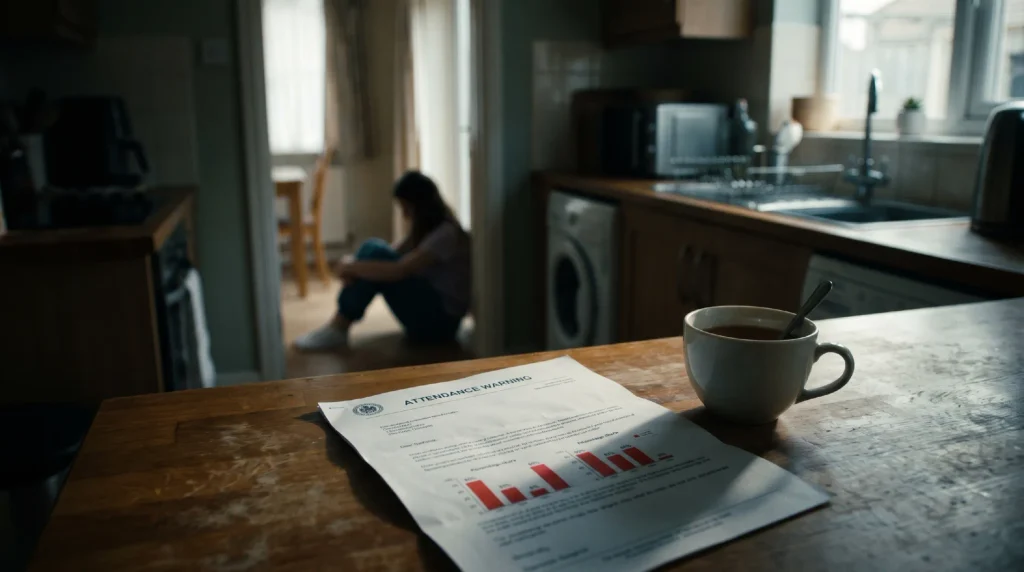
Griffiths, Franklin, and Heyne (2023) observe that England’s statutory data regimes reward automated bureaucracy at the expense of early relational intervention. Computerised attendance monitoring systems routinely trigger cold, automated warning letters the moment a pupil’s attendance drops below 95% or 90%.
To a parent supporting a child through panic attacks, self-harm, or severe sensory overload, receiving an automated letter threatening legal fines and criminal prosecution under Section 444 of the Education Act 1996 feels adversarial. As one parent noted in the qualitative findings:
“Stop threatening to report us to the Attendance Welfare Officer. Offer support rather than threats when a child is physically unable to cope with the school building. Automated warning letters feel like an attack on our parenting when we are already in crisis.” (Parent, KS3 Mainstream)
The qualitative evidence also reveals widespread frustration with legacy incentives like 100% attendance awards. Far from motivating pupils, these schemes directly penalise children with lifelong health conditions, disabilities, or neurodivergence, while actively encouraging pupils to attend school visibly infectious.
When asked whether their child’s school had successfully adapted its attendance framework post-COVID, 41.0% of parents reported no adaptation whatsoever, noting that schools had maintained rigid targets or grown increasingly punitive. Only 14.8% felt their school had adapted effectively. This administrative rigidity breaks trust and drives vulnerable families toward formal appeals, contentious tribunal hearings, or Elective Home Education (EHE).
Why Statutory Attendance Fines Miss the Mark
Under the statutory National Framework for Penalty Notices, local authorities issue fines when an unauthorized threshold of 10 sessions (5 school days) is reached within a rolling 10-week window. The empirical survey data delivers an overwhelming verdict on this enforcement model:
- 77.1% of parents state that attendance fines are ineffective at improving attendance (with 43.4% strongly disagreeing with their use).
- Only 9.6% believe financial sanctions improve school engagement.
Financial penalties rest on the flawed assumption that non-attendance is a conscious consumer choice driven by parental apathy. When applied to EBSA, neurodivergent burnout, or severe mental health distress, fines operate as an institutional punishment for an unresolved medical and environmental crisis. Fining a financially strained family does not make a sensory-overloaded child feel safer in a noisy classroom; it merely drains the family’s material resources and magnifies target-induced domestic stress.
Term-Time Leave: Distinguishing Convenience from Therapeutic Respite
A contentious aspect of the attendance debate is term-time leave. 70.2% of surveyed parents assert that term-time family holidays can hold equivalent developmental value to classroom lessons.
School leaders carry legitimate concerns here: widespread, unmanaged term-time holidays disrupt structured learning sequences, place administrative strain on classroom teachers, and elevate school-level persistent absence data. Yet the qualitative research indicates that parental reasons for requesting leave are not uniform:
| Absence Classification | Primary Underlying Motivations | Systemic Friction & Impact |
| Commercial & Consumer Requests | Prohibitive peak-season travel costs, corporate leave restrictions on parents, and travel industry price-gouging. | Conflicts directly with statutory expectations for academic continuity and disrupts curriculum progression. |
| Essential & Neurodiversity-Affirming Respite | Families caring for children with severe SEND, sensory processing sensitivities, or acute EBSA. Peak holiday environments trigger debilitating sensory overload. | Low-season travel serves as essential mental health recuperation, preventing total nervous system burnout. |
The central issue is that the national statutory framework strips headteachers of discretionary nuance. By treating all non-exceptional absences with rigid financial penalties under the 10-session rule, national policy forces school leaders to penalise vulnerable families whose children cannot safely access high-season holidays, driving a deeper wedge into the home–school partnership.
Working Together to Improve School Attendance: Systemic Recommendations for Schools and Policymakers
Bridging England’s post-pandemic attendance divide requires an intentional move away from punitive enforcement toward an empathetic, trauma-informed, relational model. Working together to improve school attendance means changing the current system, some ideas for this include the following:
For Multi-Academy Trust Executives & Headteachers
- Replace Automated Letters with Resourced Relational Triage: Discontinue automated, software-generated percentage warning letters. Instead, fund dedicated, non-teaching attendance mentors and pastoral liaisons tasked with building personal relationships with struggling families before formal triggers are hit. Relational outreach must be protected from routine classroom cover duties to remain effective.
- Eliminate Unlawful Demands for Medical Evidence: Statutory guidance explicitly clarifies that schools must not operate blanket rules requiring medical notes, and should request medical proof only in exceptional cases. School leaders must cease demanding GP letters for minor illness or early-stage mental distress, recognizing that GP practices routinely decline these administrative requests.
- Establish Low-Stimulus Reintegration Pathways: Create soft-arrival entrances away from the noisy school gates, sensory decompression zones, and personalized morning check-ins with trusted key-workers.
- Embrace Structured Flexibility: 89.0% of parents support flexible school models. Where a pupil is in crisis, establish time-limited phased returns, hybrid learning bridges, and adapted timetables that protect the child’s emotional safety while gradually rebuilding classroom tolerance.
For National Policymakers (DfE, Ofsted, and Local Authorities)
- Introduce Statutory SEND & EBSA Safeguards on Fines: Amend the National Framework for Penalty Notices to mandate clear statutory exemptions, preventing penalty notices from being issued where a child has identified SEND, an active CAMHS referral, or documented EBSA.
- Create a Dedicated Mental Health Absence Code: Create an authorized absence sub-code under the illness (‘I’) registration category specifically for severe mental health distress. Supported by 62.7% of surveyed parents, this adjustment would legitimise mental health parity and prevent vulnerable families from being threatened with criminalization.
- Rebalance Ofsted Inspection Metrics: Adjust inspection handbooks so schools are actively rewarded, rather than penalized, for implementing compassionate, phased return plans that support vulnerable learners back into sustained education.
Summary of Empirical Research Metrics
The empirical survey of 522 UK parents and carers highlights the key pain points in current attendance policy:
- 77.1% – Reject statutory fines as an effective tool for improving pupil attendance.
- 74.1% – Reject the idea that formal schooling takes priority over a child’s mental health.
- 70.2% – State that family holidays during term time provide equivalent developmental value.
- 62.7% – Want acute mental health distress formally recognised as an authorised medical absence.
- 52.5% – Report that institutional pressure to achieve 96%+ targets causes household stress.
- 19.5% – Cite anxiety and mental health distress as their child’s primary barrier to attendance.
Frequently Asked Questions (FAQ)
Can parents be fined if a child misses school due to mental health issues?
Under the current statutory guidance, Working Together to Improve School Attendance, headteachers determine whether an absence is authorized. If a school records an anxiety-related absence as unauthorized, it counts toward the national threshold of 10 unauthorized sessions (5 days) over a 10-week period, which can prompt the local authority to issue a penalty notice. However, statutory guidance emphasizes that schools should implement supportive frameworks prior to issuing legal sanctions.
What is Emotionally Based School Avoidance (EBSA)?
Emotionally Based School Avoidance (EBSA)—often clinically described as School Distress—refers to severe difficulty attending school rooted in emotional, sensory, or psychological distress. Unlike deliberate truancy, where pupils skip school without parental knowledge, EBSA typically manifests as debilitating anxiety, physical panic symptoms, and nervous system dysregulation when faced with the school environment.
Do schools have the legal right to demand a GP note for every absence?
No. The DfE statutory guidance (Working together to improve school attendance) explicitly prohibits schools from operating blanket medical evidence policies. Schools should only request medical evidence in exceptional, justifiable circumstances where there is reasonable doubt regarding the authenticity of the illness.
What alternatives exist to punitive attendance enforcement?
Effective alternatives rely on relational and trauma-informed practices. These include establishing designated non-teaching pastoral key-workers, offering soft-start morning arrivals, creating low-sensory quiet spaces, implementing time-limited phased return timetables, and working with multi-agency early help services to address environmental barriers.
References
- Creswell, C., Shum, A., Pearcey, S., Skripkauskaite, S., Patalay, P., & Waite, P. (2022). Young people’s mental health during the COVID-19 pandemic: Rapid review of harmful impacts on caregivers and families in the UK. JCPP Advances, 2(1), e12095. https://doi.org/10.1002/jcv2.12095
- Department for Education. (2024). Working together to improve school attendance: Statutory guidance for maintained schools, academies, independent schools, and local authorities (Updated July 2026). DfE Publications / GOV.UK. https://assets.publishing.service.gov.uk/media/6a4f9ec6a6586e258d371bd0/Working_together_to_improve_school_attendance_2026.pdf
- Griffiths, C., Franklin, A., & Heyne, D. (2023). Unpacking attendance data regimes: The impact of statutory performance indicators on vulnerable learners in England. Orbis Scholae, 17(2), 45–68. https://doi.org/10.14712/23363177.2023.15
- Major, L. E., & Eyles, A. (2022). Rising school absences: The post-pandemic education divide. LSE British Politics and Policy, 1–6. Research Online LSE (Eprint 117331). https://researchonline.lse.ac.uk/id/eprint/117331/1/politicsandpolicy_2022_10_17_rising_school_absences_the_post_pandemic_education_divide.pdf
- Major, L. E., Eyles, A., & Lillywhite, E. (2023). The rising tide of school absences in the post-pandemic era: Trends across socio-economic and demographic cohorts. LSE CentrePiece / British Politics and Policy, 1–8. LSE Research Online (Eprint 122294). http://eprints.lse.ac.uk/122294/1/politicsandpolicy_2023_6_28_the_rising_tide_of_school_absences_in_the_post_pandemic_era.pdf
- McDonald, R., Lester, K. J., & Michelson, D. (2023). School attendance problems in the wake of the COVID-19 pandemic: Primary school perspectives on anxiety, habits, and school return. British Journal of Educational Psychology, 93(2), 412–429. https://doi.org/10.1111/bjep.12562
- Mullally, S. L., & Connolly, B. (2025). School Distress and Emotionally Based School Avoidance: The hidden trauma of parental blame and institutional confrontation. Frontiers in Psychiatry, 16, 1489316. https://doi.org/10.3389/fpsyt.2025.1489316
- Nielsen, L. S., & Thastum, M. (2023). The communicative vacuum: School–parent negotiations during chronic school attendance problems. Nordic Studies in Education, 43(3), 215–234. https://doi.org/10.23865/nse.v43.4080
- University of Lincoln Repository. (2024). Persistent absence, neurodiversity and local authority intervention models in post-lockdown England. Lincoln Research Archive. https://doi.org/10.24385/lincoln.26379484.v1
- van Poortvliet, M. (2025). The bidirectional relationship between pupil mental ill-health, persistent absence, and academic attainment: A longitudinal UK cohort analysis. Child and Youth Services Review, 168, 108634. https://doi.org/10.1016/j.childyouth.2025.108634