

Please Enter Your Email ID
When American psychologist Jerome Bruner entered the field in the mid-twentieth century, child development was split between two extremes: behaviourists who viewed children as passive subjects conditioned by external stimuli, and early cognitive theorists who believed learning was locked behind biological maturation stages. Jerome Bruner’s theory broke through both paradigms, demonstrating that children are active, intuitive meaning-makers capable of mastering complex ideas when provided with appropriate cognitive representations and structured social support.
Table of Contents
The Cognitive Shift: Active Construction vs Passive Learning
In 1960, Jerome Bruner co-founded the Centre for Cognitive Studies at Harvard University alongside George Miller. The centre’s core objective was to pioneer what is now known as the Cognitive Revolution—re-establishing mental processes, intentionality, and concept formation as legitimate areas of scientific inquiry after decades of behaviourist dominance.
In developmental psychology, Bruner championed cognitive constructivism. He asserted that human learning is not a matter of passive stimulus-response conditioning, but an active process wherein learners build new concepts on top of their existing cognitive structures (Bruner, 1960).
Core Tenets of Bruner’s Constructivism:
- Categorisation as Thought: Bruner posited that perception, conceptualisation, and decision-making all rely on the mental act of categorisation. Children organise their complex sensory world by grouping objects and experiences according to shared attributes and conceptual rules.
- Intrinsic Drive for Mastery: Rather than relying entirely on extrinsic rewards (such as test scores, tokens, or adult praise), Bruner identified three innate internal motivators in children: curiosity, the drive towards competence, and reciprocity (the innate desire to cooperate and communicate with others).
Jerome Bruner’s Theory Using Three Modes of Representation
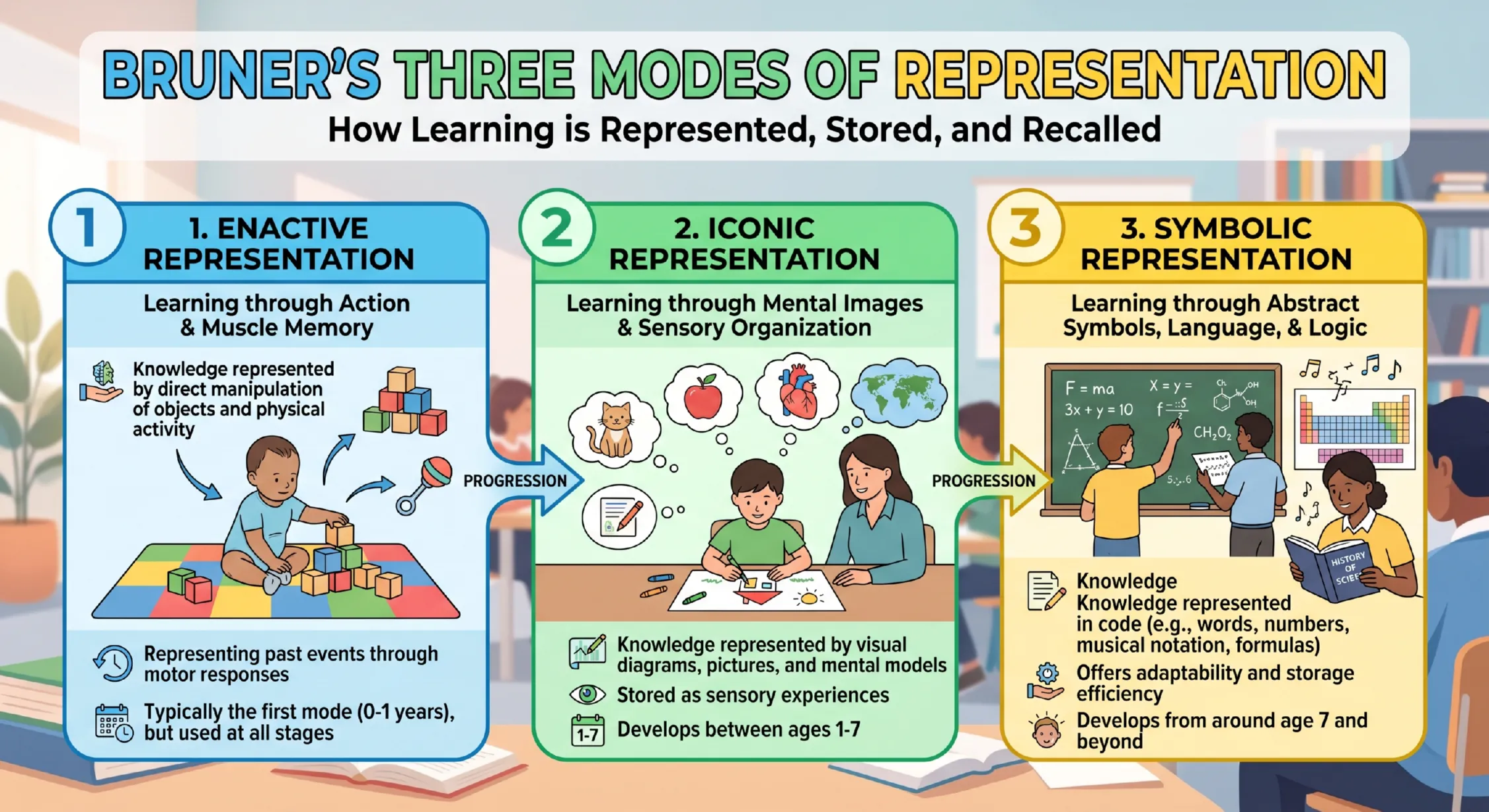
One of Bruner’s most influential contributions is his framework of Modes of Representation (Bruner, 1966). Rather than proposing rigid, age-gated stages that replace one another, Bruner argued that children store and process knowledge through three distinct, interconnected modes that remain active across the entire lifespan.
| Mode of Representation | Dominant Stage | Primary Medium | Cognitive Operation | Classroom & Real-World Example |
| 1. Enactive | Infancy (0–1+ years) through Early Years | Physical action & muscle memory | Knowledge is encoded directly through physical movement and direct manipulation of concrete objects. | Learning to ride a bicycle; physically moving wooden blocks to grasp numerical quantities. |
| 2. Iconic | Early Childhood (1–6+ years) | Visual imagery & sensory models | Information is retained as mental pictures, sensory representations, and spatial diagrams without requiring immediate touch. | Recognising objects in picture books; interpreting a floor plan; using bar models and pie charts for fractions. |
| 3. Symbolic | 7+ years through Adulthood | Abstract symbols, language, & logic | Information is stored using abstract, arbitrary symbol systems that can be manipulated according to formal rules. | Writing analytical essays; calculating algebraic formulas ($x + y = z$); understanding legal and philosophical axioms. |
Crucially, Bruner noted that whenever a learner of any age encounters a radically novel or difficult discipline, their cognitive system naturally cycles back through these three stages: first enacting the physical movements, then building mental/iconic models, and finally translating those experiences into symbolic fluency.
The Spiral Curriculum: Rethinking Developmental Readiness
In his seminal 1960 work The Process of Education, Bruner put forward a daring proposition that challenged prevailing educational conservatism:
“Any subject can be taught effectively in some intellectually honest form to any child at any stage of development.”
(Bruner, 1960, p. 33)
Rather than waiting for a child to reach an arbitrary chronological age before introducing fundamental disciplines such as physics, philosophy, or algebra, Bruner introduced the concept of the Spiral Curriculum.
Key Principles of the Spiral Model:
- Early Introduction of Core Ideas: Foundational concepts are introduced early through intuitive, concrete (enactive or iconic) representations.
- Periodic Revisitation: As the child’s cognitive tools and language abilities develop, these same core principles are revisited at periodic intervals.
- Increasing Sophistication: Each visit deepens the child’s understanding, moving systematically from concrete experience to formal, abstract, symbolic mastery.
Practical Example: A four-year-old explores the principles of balance and equilibrium enactively on a see-saw. At age nine, the child investigates balance iconically using diagrams, scales, and balance beams. By age fifteen, the student calculates mechanical advantage and torque symbolically using algebraic equations.
The Mechanics of Scaffolding and Guided Discovery
While the metaphor of educational scaffolding is frequently attributed to Lev Vygotsky, the term was formally coined, operationalised, and experimentally studied by David Wood, Jerome Bruner, and Gail Ross (Wood et al., 1976).
Scaffolding describes the temporary supportive framework provided by an adult or more competent peer that allows a child to solve a problem or complete a task that would otherwise fall just outside their independent reach.
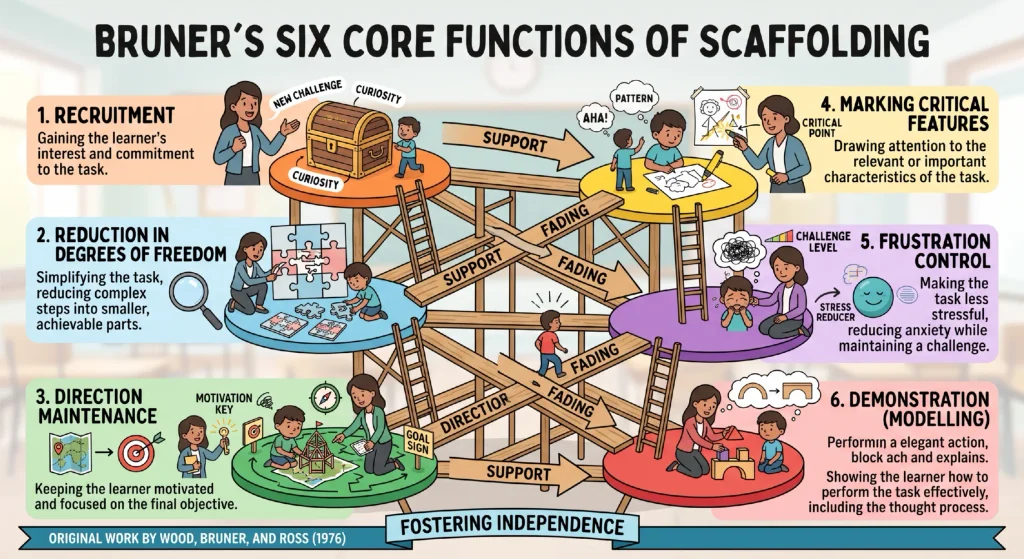
The Six Core Functions of Scaffolding:
- Recruitment: Engaging the child’s interest and enlisting their active commitment to the challenge.
- Reduction in Degrees of Freedom: Breaking a complex task down into smaller, manageable steps to prevent cognitive overload.
- Direction Maintenance: Keeping the learner motivated, focused on the goal, and on-task during setbacks.
- Marking Critical Features: Highlighting relevant discrepancies between what the child has produced and the desired outcome.
- Frustration Control: Managing emotional load and stress so problem-solving remains constructive rather than overwhelming.
- Demonstration (Modelling): Displaying an idealised solution or demonstrating an operational step for the learner to imitate.
As the child acquires genuine competence, this adult support is systematically and progressively faded—leaving the child with independent mastery and self-efficacy.
Language Acquisition: The LASS vs Chomsky’s LAD
During the late 1960s, linguistic discourse was dominated by Noam Chomsky’s theory of the Language Acquisition Device (LAD), which posited that humans possess an innate, genetically determined module for universal grammar (Chomsky, 1965).
Jerome Bruner’s Theory acknowledged our biological predisposition for speech, but argued that a biological apparatus cannot function without a reciprocal social environment. To explain this interaction, Bruner proposed the Language Acquisition Support System (LASS) (Bruner, 1983).
Key Components of the LASS:
- Social Formats and Routines: Language develops within predictable daily rituals (e.g. peek-a-boo games, feeding routines, bath-time dialogues). Because the social context is reliable, the child can focus mental resources on interpreting linguistic cues.
- Joint Attention: Long before uttering words, infants and caregivers engage in shared visual attention and pointing, establishing a shared psychological referent for objects.
- Child-Directed Speech (Motherese): Caregivers organically adapt their speech—slowing tempo, raising pitch, and repeating key structures—providing an intuitive auditory scaffold for early syntax acquisition.
Jerome Bruner vs Jean Piaget: Key Theoretical Differences
While both Jean Piaget and Jerome Bruner were pioneering constructivists who agreed that children actively build knowledge, their core assumptions diverged across several key areas:
| Theoretical Dimension | Jean Piaget’s Theory | Jerome Bruner’s Theory |
| Nature of Progression | Linear, biological, age-locked stages. Movement to a higher stage requires cognitive maturation. | Continuous, flexible modes of representation that coexist and remain accessible for life. |
| Role of Language | Language reflects thought; it is an outcome/symptom of the child’s current cognitive stage. | Language is a primary tool for thought; linguistic dialogue directly drives cognitive growth. |
| Instruction & Readiness | Instruction must wait for developmental readiness; teaching abstract ideas too early is ineffective. | Instruction can accelerate understanding when ideas are translated into suitable modes of representation. |
| Social-Cultural Context | Focuses primarily on the individual child exploring their environment (the “lone scientist”). | Emphasises cultural mediation, social dialogue, and guided participation with adults and peers. |
Narrative Psychology: Meaning-Making Beyond Cold Logic
In his later works, including Actual Minds, Possible Worlds (Bruner, 1986) and Acts of Meaning (Bruner, 1990), Jerome Bruner’s Theory pushed back against cognitive psychology’s narrow focus on computational information processing. He argued that the human mind does not run merely on formal calculations, but on the pursuit of subjective meaning.
Bruner identified two distinct, irreducible modes of human cognitive functioning:
- Paradigmatic (Logico-Scientific) Mode: Governed by formal logic, empirical verification, mathematical deduction, and objective causal analysis.
- Narrative Mode: Governed by human intentions, emotional states, subjective experiences, and the temporal unfolding of human stories.
Bruner emphasised that children organise their personal identities, socio-emotional understanding, and cultural values primarily through the narrative mode. Children use story structures to resolve emotional discrepancies, understand social norms, and make sense of their daily lives.
Legacy in Modern Pedagogy and Policy
Bruner’s intellectual legacy remains visible in classrooms, national curriculum frameworks, and early years policy internationally:
- Concrete-Pictorial-Abstract (CPA) Mathematics: Modern mastery teaching frameworks (such as Singapore Math and the UK National Curriculum for primary mathematics) directly translate Bruner’s enactive, iconic, and symbolic progression into practice.
- Early Intervention Frameworks: Bruner’s work on early cognitive development and social scaffolding served as an academic foundation for early childhood interventions such as the US Head Start programme and the UK’s Sure Start centres (Bruner, 1996).
- The Reggio Emilia Approach: Bruner was a strong advocate and collaborative partner of Loris Malaguzzi, supporting the Reggio Emilia ethos which views children as active researchers possessing “a hundred languages” of expression.
Frequently Asked Questions (FAQ)
What is Jerome Bruner’s main contribution to child development?
Bruner established that children are active, autonomous learners who construct understanding rather than passively absorbing information. His most significant contributions include:
The Three Modes of Representation (Enactive, Iconic, and Symbolic)
The concept of Scaffolding (developed with Wood and Ross)
The Spiral Curriculum
The Language Acquisition Support System (LASS)
Discovery Learning within structured, guided environments
How do Bruner’s three modes of representation differ from Piaget’s developmental stages?
While Piaget viewed cognitive development as a sequence of fixed, age-bound stages that replace one another, Bruner saw his modes of representation as continuous, flexible, and lifelong:
Enactive: Action-based, physical manipulation and muscle memory.
Iconic: Image-based, visual and spatial mental models.
Symbolic: Abstract, language- and logic-based representations.
In Bruner’s model, older children and adults do not lose the enactive or iconic modes; they return to them whenever they encounter unfamiliar or complex concepts.
What is the “Spiral Curriculum”?
The spiral curriculum is an educational framework based on Bruner’s assertion that any concept can be taught to any child at any stage of development if presented in an intellectually honest form.
Instead of teaching a topic once, key principles are introduced early using accessible concrete or visual methods. The curriculum then revisits the same topics at increasing levels of depth, complexity, and abstraction as the learner’s cognitive and symbolic skills mature.
Did Jerome Bruner’s Theory invent the concept of educational “scaffolding”?
Yes, the term scaffolding was formally coined and operationalised by David Wood, Jerome Bruner, and Gail Ross in their 1976 study on child problem-solving.
While the concept aligns closely with Lev Vygotsky’s Zone of Proximal Development (ZPD), Wood, Bruner, and Ross defined the explicit mechanics of how adults support a child’s learning—such as breaking down complex tasks, reducing frustration, and demonstrating solutions—before gradually fading that support as the child gains competence.
How does Jerome Bruner’s theory influence modern classroom teaching?
Jerome Bruner’s theory form the foundation of several contemporary educational practices:
Concrete-Pictorial-Abstract (CPA) Approach: Widely used in modern primary mathematics (such as Singapore Math), directly mirroring the enactive > symbolic progression.
Inquiry- and Discovery-Based Learning: Encouraging students to experiment, categorise, and deduce rules rather than memorising static facts.
Early Intervention Programs: Bruner’s research on social scaffolding informed policies such as Head Start (US) and Sure Start (UK).
References & Key Works
- Bruner, J. S. (1960). The Process of Education. Cambridge, MA: Harvard University Press.
- Bruner, J. S. (1966). Toward a Theory of Instruction. Cambridge, MA: Belknap Press of Harvard University Press.
- Bruner, J. S. (1983). Child’s Talk: Learning to Use Language. Oxford: Oxford University Press.
- Bruner, J. S. (1986). Actual Minds, Possible Worlds. Cambridge, MA: Harvard University Press.
- Bruner, J. S. (1990). Acts of Meaning. Cambridge, MA: Harvard University Press.
- Bruner, J. S. (1996). The Culture of Education. Cambridge, MA: Harvard University Press.
- Chomsky, N. (1965). Aspects of the Theory of Syntax. Cambridge, MA: MIT Press.
- Wood, D., Bruner, J. S., & Ross, G. (1976). The role of tutoring in problem solving. Journal of Child Psychology and Psychiatry, 17(2), 89–100. DOI: 10.1111/j.1469-7610.1976.tb00381.x