

Please Enter Your Email ID
Table of Contents
Introduction
Attachment theory in child development was initially conceptualised by John Bowlby. The idea offers a comprehensive framework for understanding the lasting emotional bonds that develop between individuals, especially between infants and their primary caregivers. This theoretical approach suggests that humans have an innate psychobiological system that drives them to seek proximity to important others, particularly in times of need or danger, to ensure safety and survival.
Over the years, attachment theory has significantly influenced developmental psychology, shaping both research and clinical practice by clarifying the developmental pathways of personality and the formation of close relationships.
The foundational principles have been expanded and refined by researchers like Mary Ainsworth, assessing how various attachment styles influence socioemotional, cognitive, and behavioural outcomes across the lifespan.
What is Attachment Theory in Child Development?
Origins and Historical Context
John Bowlby developed attachment theory in the mid-20th century, drawing on ethology, cybernetics, developmental psychology, and psychoanalysis. His early observations emphasised the harmful effects of maternal deprivation, prompting him to challenge dominant psychoanalytic ideas.
Bowlby suggested that infants seek proximity for protection, rooted in evolutionary biology, providing a secure base from which to explore and a safe haven to return to.
Internal Working Models (IWM)
An IWM is a cognitive-affective framework regarding oneself and others based on early caregiving. These models serve as an internal guidance system, filtering social interactions and guiding behaviour. Although formed early, they are ‘working’ models because they can develop through later experiences.
Attachment Behaviours Crying, smiling, clinging, and following to maintain closeness.
Caregiver Role Reliability and responsiveness foster trust and safety.
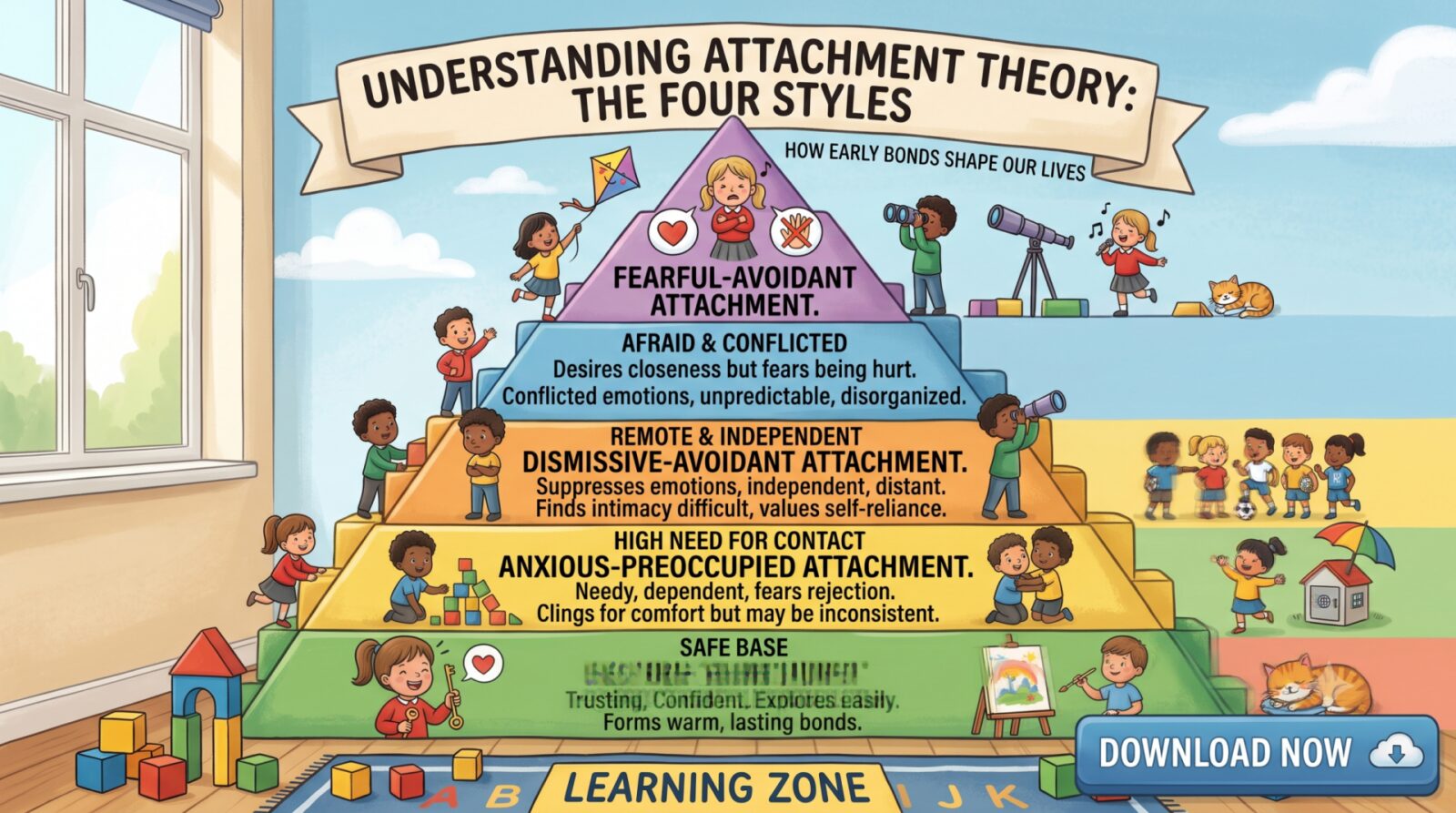
The 4 Key Attachment Styles in Children
The classification of attachment styles was pioneered by developmental psychologist Mary Ainsworth through her landmark “Strange Situation” protocol. By observing how infants reacted to brief separations and reunions with their primary caregivers, Ainsworth and later Mary Main, identified four distinct patterns of attachment.
These early styles act as a blueprint for how children manage stress, express emotions, and navigate social relationships. Further details on different attachment styles can be found in our follow-up article here: Attachment Styles in Children: A Complete Guide to for Parents and Educators
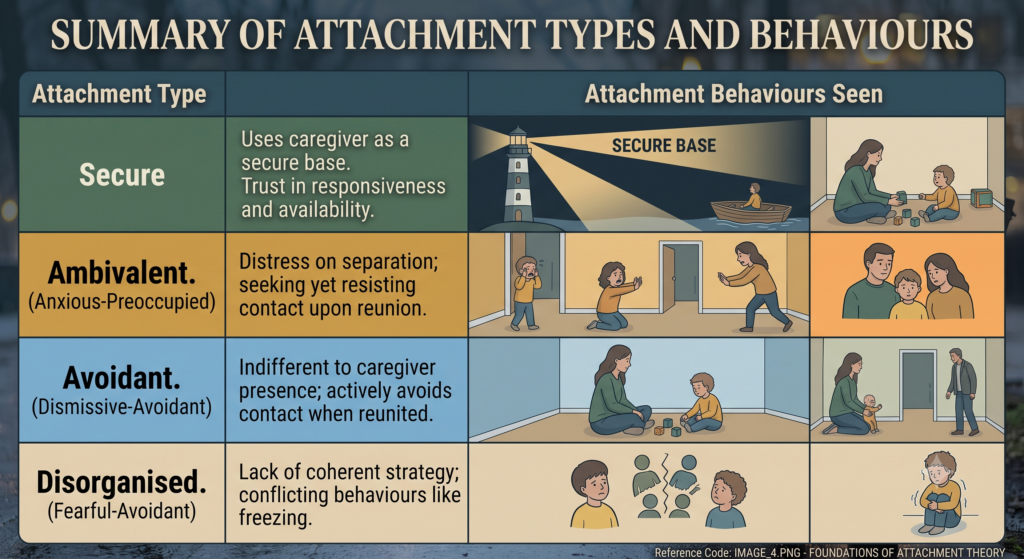
| Attachment Type | Attachment Behaviours Seen |
|---|---|
| Secure Attachment | Characteristics: Uses caregiver as a secure base, shows mild distress on departure, warm reunion. Impact: Higher self-esteem, better emotional regulation. |
| Anxious-Ambivalent Attachment | Characteristics: Hyper-vigilant, distressed by separation, seeks closeness but shows resentment upon reunion. Impact: Anxiety in social settings, clinginess. |
| Avoidant Attachment | Characteristics: Appears independent, suppresses distress, avoids caregiver contact upon reunion. Impact: Difficulty trusting others, emotional suppression. |
| Disorganised Attachment | Characteristics: Confused or fearful behaviour, lacks a coherent coping strategy. Impact: High risk for emotional and behavioural challenges later in life. |
1. Secure Attachment
Secure attachment develops when a primary caregiver is consistently responsive, emotionally available, and attuned to the infant’s needs.
- Caregiving Environment: The caregiver acts as a reliable “secure base” for exploration and a “safe haven” during distress, responding promptly and warmly to the child’s cues.
- Observed Behaviours: In the Strange Situation, securely attached infants explore their environment freely when the caregiver is present. They become visibly distressed when the caregiver leaves, but upon their return, they seek immediate contact, are easily comforted, and quickly resume playing.
- Real-World Example: In an early years setting, a securely attached child might cry briefly when dropped off, but soon settles down to play, confident that their parent will return at the end of the day.
2. Anxious-Ambivalent Attachment (Insecure-Resistant)
Anxious-ambivalent attachment often arises when caregiving is inconsistent—sometimes warm and attentive, but at other times distant, overwhelmed, or intrusive.
- Caregiving Environment: Because caregiving is unpredictable, the child learns to amplify their distress signals to ensure their emotional and physical needs are met.
- Observed Behaviours: These children show high levels of anxiety even before separation. They become extremely distressed when the caregiver departs. Upon reunion, they seek physical proximity but simultaneously express anger, resistance, or passive helplessness, making them exceptionally difficult to soothe.
- Real-World Example: A toddler may cling fiercely to a parent’s leg, crying for attention, but then push the parent away or throw a toy when picked up.
3. Anxious-Avoidant Attachment (Insecure-Avoidant)
Anxious-avoidant attachment typically forms when a caregiver is emotionally unavailable, distant, or repeatedly rejecting of the infant’s bids for comfort.
- Caregiving Environment: The child learns that expressing vulnerability or distress leads to rejection or withdrawal. To maintain proximity to the caregiver, the child suppresses their visible distress.
- Observed Behaviours: During testing, avoidant infants appear largely indifferent to their caregiver’s presence, departure, or return. However, physiological measurements (such as heart rate and cortisol levels) reveal that these children experience high internal stress despite their calm outward appearance.
- Real-World Example: A child in a school setting may rarely ask a teacher or carer for help when injured or upset, preferring to deal with difficulty in solitary emotional isolation.
4. Disorganised Attachment (Insecure-Disorganised)
Identified by Mary Main and Judith Solomon, disorganised attachment represents the breakdown of a coherent strategy for dealing with stress.
- Caregiving Environment: This pattern frequently occurs when the caregiver is a source of fear, severe neglect, or trauma, or when the caregiver suffers from unresolved trauma themselves. The child faces a biological paradox: the innate drive to seek safety from the caregiver conflicts with the fear of the caregiver.
- Observed Behaviours: Children display confused, contradictory, or incomplete behaviours upon reunion. They may freeze, rock back and forth, approach the caregiver while looking away, or exhibit sudden outbursts of fear or disoriented distress.
- Real-World Example: A child may run toward their parent for comfort upon reunion, only to stop dead in their tracks, turn around, or collapse onto the floor, visibly overwhelmed.
How Attachment Theory Shapes Child Development
The emotional bond formed in early infancy serves as a foundation for a child’s entire developmental trajectory. From emotional self-regulation to classroom engagement, the impact of attachment security reverberates across every stage of childhood and into adult life.
1. Socioemotional Outcomes and Mental Health
Secure attachment is fundamentally linked to positive mental health and emotional resilience. When a primary caregiver responds consistently to an infant’s cues, the child internalises a sense of safety, self-worth, and trust in the world.
- Emotional Regulation: Securely attached children learn how to manage overwhelming emotions because their distress was consistently soothe by a responsive adult (co-regulation). Conversely, children with insecure attachment patterns often struggle with affective regulation—either hyper-activating their emotions (anxious-ambivalent) or deactivating them entirely (avoidant).
- Self-Concept and Identity: Early interactions build the foundation of a child’s Internal Working Model. Secure children view themselves as worthy of love and capable of success, whereas insecure children may internalise beliefs that they are unlovable, incompetent, or unsafe.
- Peer Relationships and Empathy: Children with secure backgrounds show higher levels of empathy, social competence, and prosocial behaviour. They find it easier to make friends, share, and navigate peer conflict. In contrast, insecure attachment patterns—particularly disorganised attachment—are linked to higher rates of externalising behaviours, such as aggression, defiance, and difficulty forming healthy peer groups.
2. Cognitive Growth, Exploration, and Learning
In attachment theory in child development, the primary caregiver acts as a “secure base” from which a child can explore their environment, and a “safe haven” to return to when frightened or overwhelmed. This balance is critical for cognitive development.
- Curiosity and Exploration: A securely attached infant feels safe enough to turn away from the caregiver and investigate their surroundings. This autonomous exploration directly stimulates brain development, spatial awareness, and problem-solving skills.
- Academic Persistence and Resilience: In educational settings, securely attached children demonstrate greater task persistence, higher attention spans, and lower fear of failure. When faced with a difficult learning task, they are more likely to seek help constructively rather than giving up or displaying disruptive behaviours.
- Executive Functioning: Research shows that the consistent, calm co-regulation provided by responsive caregiving supports the development of executive function skills in early childhood—including working memory, flexible thinking, and impulse control.
- Impact of Institutional and Disrupted Care: Children who experience severe early deprivation or indiscriminate caregiving (such as in unsupportive institutional settings) often exhibit difficulties with impulse control, cognitive delays, and socially indiscriminate behaviours, which can later manifest as significant behavioural challenges in school.
Contemporary Applications of Attachment Theory in the UK
Understanding attachment theory in child development has transformed practice across health, social care, and education—particularly across the UK. By translating John Bowlby and Mary Ainsworth’s foundational concepts into real-world settings, practitioners can move away from asking “What is wrong with this child?” and instead ask “What has this child experienced?”
1. Attachment Theory in UK Educational Settings
In schools and early years provisions across the UK, attachment-informed practice has become a cornerstone of positive behaviour management, emotional well-being, and inclusive education.
The Role of “Attachment-Aware” Schools
Schools that adopt attachment-aware frameworks recognise that children bring their internal working models into the classroom. For a child with an insecure or disorganised attachment, the school environment can feel unpredictable or threatening.
- Teachers as Secondary Attachment Figures: While primary caregivers remain paramount, educators can serve as secondary “secure bases.” Through consistent, calm, and predictable interactions, teachers help children feel safe enough to take intellectual risks and engage in learning.
- Reframing “Challenging” Behaviour: Rather than viewing disruptive, withdrawn, or defiant behaviour solely as a disciplinary issue, attachment-informed educators interpret these actions as emotional communication. For example:
- Anxious-ambivalent pupils may exhibit extreme clinginess, low task persistence, or frequent bids for reassurance.
- Anxious-avoidant pupils may appear overly independent, mask their stress, or reject help when struggling with academic tasks.
- Disorganised pupils may display sudden emotional outbursts or fight-or-flight responses when feeling overwhelmed.
- Relational Approaches & Co-Regulation: Modern UK educational frameworks favour relational approaches over strict exclusion or punitive measures. Techniques like Emotion Coaching teach staff to validate a child’s underlying feelings before guiding their behaviour, fostering emotional self-regulation.
2. Clinical Interventions and Therapeutic Applications
In clinical child psychology, CAMHS (Child and Adolescent Mental Health Services), and early intervention services, attachment theory underpins several evidence-based therapeutic programmes aimed at strengthening the parent-child bond.
Evidence-Based Attachment Interventions
Impact: Empowers parents to reflect on their own attachment histories, reducing the intergenerational transmission of insecure attachment.
Video-feedback Intervention to Promote Positive Parenting and Sensitive Discipline (VIPP-SD):
How it works: A trained practitioner records brief interactions between a parent and child. They then review the footage together, highlighting moments where the parent accurately read and responded to the child’s subtle cues.
Impact: VIPP-SD significantly increases caregiver sensitivity, reduces harsh discipline, and promotes secure attachment patterns in early childhood.
Attachment and Biobehavioral Catch-up (ABC):
How it works: Designed primarily for infants and toddlers who have experienced early adversity, neglect, or foster care. Practitioners provide live, in-the-moment coaching to help caregivers offer nurturance even when the child pushes them away.
Impact: Helps normalise a child’s cortisol (stress hormone) levels and fosters higher rates of secure attachment.
Circle of Security Parenting (COSP):
How it works: A visual, psychoeducational programme that teaches caregivers how to recognise their child’s emotional needs—specifically when the child needs a “secure base” to explore from or a “safe haven” to return to.
Conclusion: The Enduring Importance of Attachment Theory
From John Bowlby’s foundational insights to Mary Ainsworth’s pioneering classifications, attachment theory in child development remains one of the most robust frameworks in modern psychology. By bridging developmental research with findings from neurobiology and clinical practice, the model demonstrates how early emotional bonds fundamentally shape brain structure, stress response systems, and lifelong relational patterns.
As research evolves, contemporary attachment studies continue to expand into critical new areas:
- Neurobiological Insights: Brain imaging reveals how sensitive caregiving directly buffers a child’s amygdala reactivity and strengthens prefrontal cortex pathways responsible for executive functioning and self-regulation.
- Cultural Nuances: Cross-cultural studies are refining our understanding of how attachment behaviours manifest across diverse parenting styles, socio-economic contexts, and family structures worldwide.
- Epigenetics and Gene-Environment Interaction: Emerging research highlights how warm, responsive environments can actually influence gene expression, helping to mitigate genetic vulnerabilities to anxiety and stress.
Ultimately, attachment theory in child development provides far more than an academic lens—it offers a practical roadmap for parents, educators, and clinicians across the UK. By recognizing that every behaviour is an attempt to communicate a core emotional need, practitioners can foster secure, resilient environments where children feel safe enough to learn, explore, and thrive.
How does attachment theory influence a child’s overall development?
Attachment theory explains how early emotional bonds with primary caregivers create an internal ‘working model’ for a child. A secure attachment provides a safe base that fosters healthy brain development, emotional self-regulation, social confidence, and the ability to explore and learn effectively in educational settings.
What are the main attachment styles seen in young children?
The four primary attachment styles in child development are secure, anxious-ambivalent (resistant), anxious-avoidant, and disorganised. These styles represent adaptive strategies children use to manage safety, stress, and connection with caregivers.
How does insecure attachment affect learning and behaviour in school?
Children with insecure attachment styles may spend significant cognitive energy scanning their environment for safety. This can manifest in the classroom as heightened anxiety, social withdrawal, difficulty asking for help, emotional dysregulation, or challenges with independent learning tasks.
Can a child’s attachment style change over time?
Yes. Attachment styles are not permanent personality traits. Through consistent, responsive caregiving, supportive school environments, and relational co-regulation, children can develop what psychologists call ‘earned security’ over time.
- Buehler, S. (2017) “Handbook of Attachment, Third Edition: Theory, Research, and Clinical Applications,” Journal of Sex & Marital Therapy. Informa UK Limited. Available at: https://doi.org/10.1080/0092623x.2017.1317533 .
- Belsky, J. (2002) “Developmental origins of attachment styles,” Attachment & Human Development. Informa UK Limited. Available at: https://doi.org/10.1080/14616730210157510.
- Li, Y. (2023) “How does attachment style influence early childhood development,” Journal of Education, Humanities and Social Sciences. Darcy & Roy Press Co. Ltd. Available at: https://doi.org/10.54097/ehss.v8i.4675.
- Trowell, J. (2008) “Understanding Attachment and Attachment Disorders. Theory, Evidence and Practice. By Vivien Prior & Danya Glaser. Jessica Kingsley. 2006. 288pp. £19.99 (pb). ISBN 9781843102458,” British Journal of Psychiatry. Royal College of Psychiatrists. Available at: https://doi.org/10.1192/bjp.bp.106.032466.
- Facompré, C.R., Bernard, K. and Waters, T.E.A. (2017) “Effectiveness of interventions in preventing disorganized attachment: A meta-analysis,” Development and Psychopathology. Cambridge University Press (CUP). Available at: https://doi.org/10.1017/s0954579417000426.
- Harlow, E. (2019) “Attachment theory: developments, debates and recent applications in social work, social care and education,” Journal of Social Work Practice. Informa UK Limited. Available at: https://doi.org/10.1080/02650533.2019.1700493.
- Stern, J.A. et al. (2018) “Developmental processes across the first two years of parenthood: Stability and change in adult attachment style.,” Developmental Psychology. American Psychological Association (APA). Available at: https://doi.org/10.1037/dev0000481.
- O’Connor, T.G. and Gerard Byrne, J. (2007) “Attachment Measures for Research and Practice,” Child and Adolescent Mental Health. Wiley. Available at: https://doi.org/10.1111/j.1475-3588.2007.00444.x.
- Brumariu, L.E., Madigan, S., et al. (2018) “The Security Scale as a measure of attachment: meta-analytic evidence of validity,” Attachment & Human Development. Informa UK Limited. Available at: https://doi.org/10.1080/14616734.2018.1433217.
- Van IJzendoorn, M.H. et al. (2004) “Assessing Attachment Security With the Attachment Q Sort: Meta-Analytic Evidence for the Validity of the Observer AQS,” Child Development. Wiley. Available at: https://doi.org/10.1111/j.1467-8624.2004.00733.x.
- Strauss, B. et al. (2022) “Is there an elephant in the room? A study of convergences and divergences of adult attachment measures commonly used in clinical studies,” Psychotherapy Research. Informa UK Limited. Available at: https://doi.org/10.1080/10503307.2021.2020930.
- Gregory, M., Kannis-dymand, L. and Sharman, R. (2020) “A review of attachment-based parenting interventions: Recent advances and future considerations,” Australian Journal of Psychology. Informa UK Limited. Available at: https://doi.org/10.1111/ajpy.12270.
- Groh, A.M. et al. (2016) “Attachment and Temperament in the Early Life Course: A Meta-Analytic Review,” Child Development. Wiley. Available at: https://doi.org/10.1111/cdev.12677.
- Arguz Cildir, D. et al. (2019) “Association of prenatal attachment and early childhood emotional, behavioral, and developmental characteristics: A longitudinal study,” Infant Mental Health Journal. Wiley. Available at: https://doi.org/10.1002/imhj.21822.
- Lyons-Ruth, K. et al. (2009) “Socially indiscriminate attachment behavior in the Strange Situation: Convergent and discriminant validity in relation to caregiving risk, later behavior problems, and attachment insecurity,” Development and Psychopathology. Cambridge University Press (CUP). Available at: https://doi.org/10.1017/s0954579409000376.