

Please Enter Your Email ID
Table of Contents
Who Was Jean Piaget? Background & Approach
Jean Piaget (1896–1980) was a pioneering Swiss psychologist whose research permanently altered our understanding of child development and educational psychology. Prior to Piaget’s work, the prevailing view in Western psychology treated children essentially as mini-adults who simply possessed less knowledge. Piaget challenged this assumption by introducing a process-orientated framework demonstrating that children actually think in fundamentally different, qualitative ways than adults.
Through meticulous observation of children—including his own—in natural learning environments, Piaget concluded that intellectual growth is not a passive absorption of information. Instead, children operate as “little scientists,” actively constructing their understanding of the world by experimenting with their surroundings, testing ideas, and continually updating their mental models.
Key Concepts in Piaget’s Cognitive Development Theory
Piaget proposed that cognitive development relies on dynamic mental mechanisms that allow children to organize, process, and adapt to new information.
Schemas (Mental Frameworks)
Schemas are the fundamental building blocks of cognitive development. They act as mental filing cabinets or cognitive maps that help children organize and interpret incoming information.
For instance, a toddler might develop an initial schema for a “cat” based on a family pet: a four-legged, furry animal that meows. As flexible knowledge structures, schemas continually expand and interconnect. Over time, basic schemas for individual animals develop into higher-level categorizations such as “Domestic Pets,” “Canines,” or “Felines.”
Assimilation vs. Accommodation
Cognitive adaptation occurs through two complementary processes:
- Assimilation: Incorporating new experiences into existing schemas without altering the core structure. For example, when a child encounters a different breed of cat (such as a Persian or a Siamese), they easily fit this experience into their pre-existing “cat schema.”
- Accommodation: Modifying an existing schema—or creating an entirely new one—when new information conflicts with current mental concepts. If that same child sees a small dog for the first time and calls it a “cat,” only to hear it bark, they experience cognitive friction. They must accommodate this difference by creating a new “dog schema.”
Equilibration and Cognitive Balance
Equilibration represents the internal drive to maintain a state of cognitive balance. When a child encounters information that easily fits their existing schemas, they remain in cognitive equilibrium.
However, encountering unfamiliar or contradictory information causes disequilibrium—an uncomfortable state of confusion. To resolve this imbalance, the child uses accommodation to refine their thinking. This continuous oscillation between equilibrium and disequilibrium propels a child from one developmental stage to the next.
The 4 Stages of Piaget’s Cognitive Development Theory
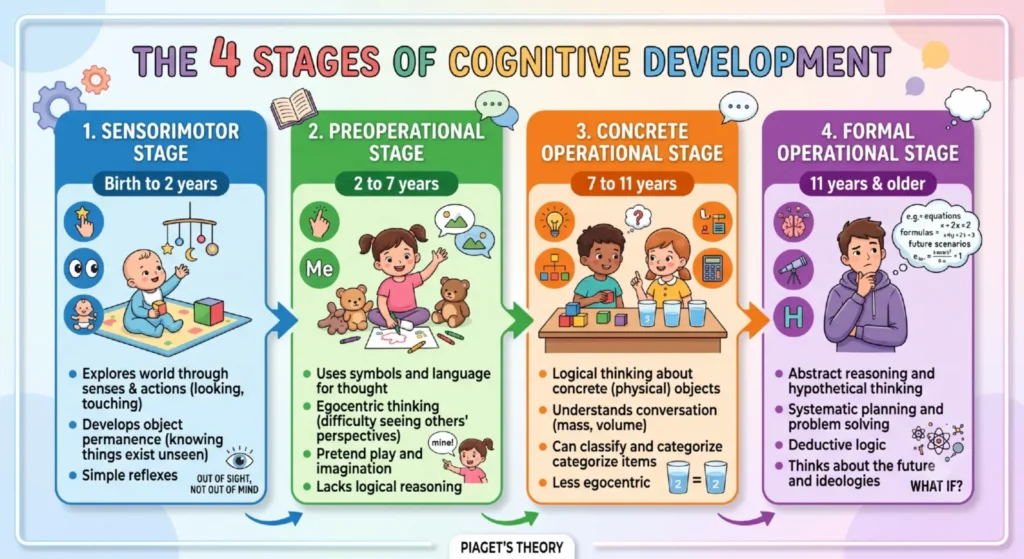
Piaget identified four distinct stages through which children progress. While the exact ages may vary based on individual development and environment, the sequence of these stages remains universal.
1. Sensorimotor Stage (Ages 0–2 Years)
In this foundational stage, infants learn about the world purely through sensory experiences (tasting, touching, seeing, hearing) and physical motor manipulation.
- Trial-and-Error Exploration: Learning happens through physical action, such as shaking a rattle to hear a noise or dropping a spoon from a high chair to observe the impact.
- Object Permanence: Developed typically between 4 and 8 months, this critical milestone refers to a child’s realization that objects continue to exist even when out of sight or reach.
- Goal-Directed Behaviour & Deferred Imitation: Older infants begin acting intentionally (e.g., pulling a blanket to reach a toy on top of it) and can imitate actions they observed hours or days earlier.
2. Preoperational Stage (Ages 2–7 Years)
During the preoperational stage of Piaget’s Cognitive Development Theory, language acquisition accelerates rapidly, and children begin to engage in symbolic thought and pretend play. However, their reasoning remains predominantly intuitive rather than logical.
- Symbolic Function: Children learn to use words, gestures, and visual symbols to represent objects or concepts not physically present.
- Egocentrism: Young children struggle to perceive situations from another person’s viewpoint. They assume others see, hear, and feel exactly as they do (as demonstrated in Piaget’s famous Three Mountains Task).
- Lack of Conservation: Children cannot yet grasp that changing the physical appearance or arrangement of a substance does not alter its quantity, volume, or mass. A child will often claim a tall, thin glass holds more juice than a short, wide container holding the exact same volume.
3. Concrete Operational Stage (Ages 7–11 Years)
This stage of Piaget’s Cognitive Development Theory marks a major turning point in cognitive development as children begin operating with true logical reasoning, provided the concepts involve concrete, real-world objects.
- Mastery of Conservation: Children understand that quantity remains unchanged despite variations in appearance, shape, or container size.
- Reversibility: Pupils realize that actions or operations can be reversed to restore an original state (e.g., understanding that a lump of clay rolled into a snake can be reshaped back into a ball).
- Classification & Seriation: Children gain the ability to sort items according to specific characteristics (e.g., size, weight, color) and organize objects into complex hierarchical sub-categories.
- Decentering: Thinking becomes less egocentric; children learn to consider multiple aspects of a problem simultaneously and appreciate alternative viewpoints.
4. Formal Operational Stage (Ages 11+ Years)
The final stage of Piaget’s Cognitive Development Theory sees adolescents transition from concrete thinking to abstract logical reasoning, extending through adulthood.
- Metacognition: Young people gain the ability to analyze their own thought processes, evaluating how they arrive at conclusions and reflecting critically on their beliefs.
- Abstract Reasoning: Individuals can process intangible concepts such as justice, morality, philosophy, and advanced algebra without relying on concrete visual models.
- Hypothetical-Deductive Reasoning: Adolescents systematically formulate hypotheses, isolate variables, and systematically test potential outcomes (the classic “what if” mindset required in scientific inquiry).
Practical Classroom Applications for Educators
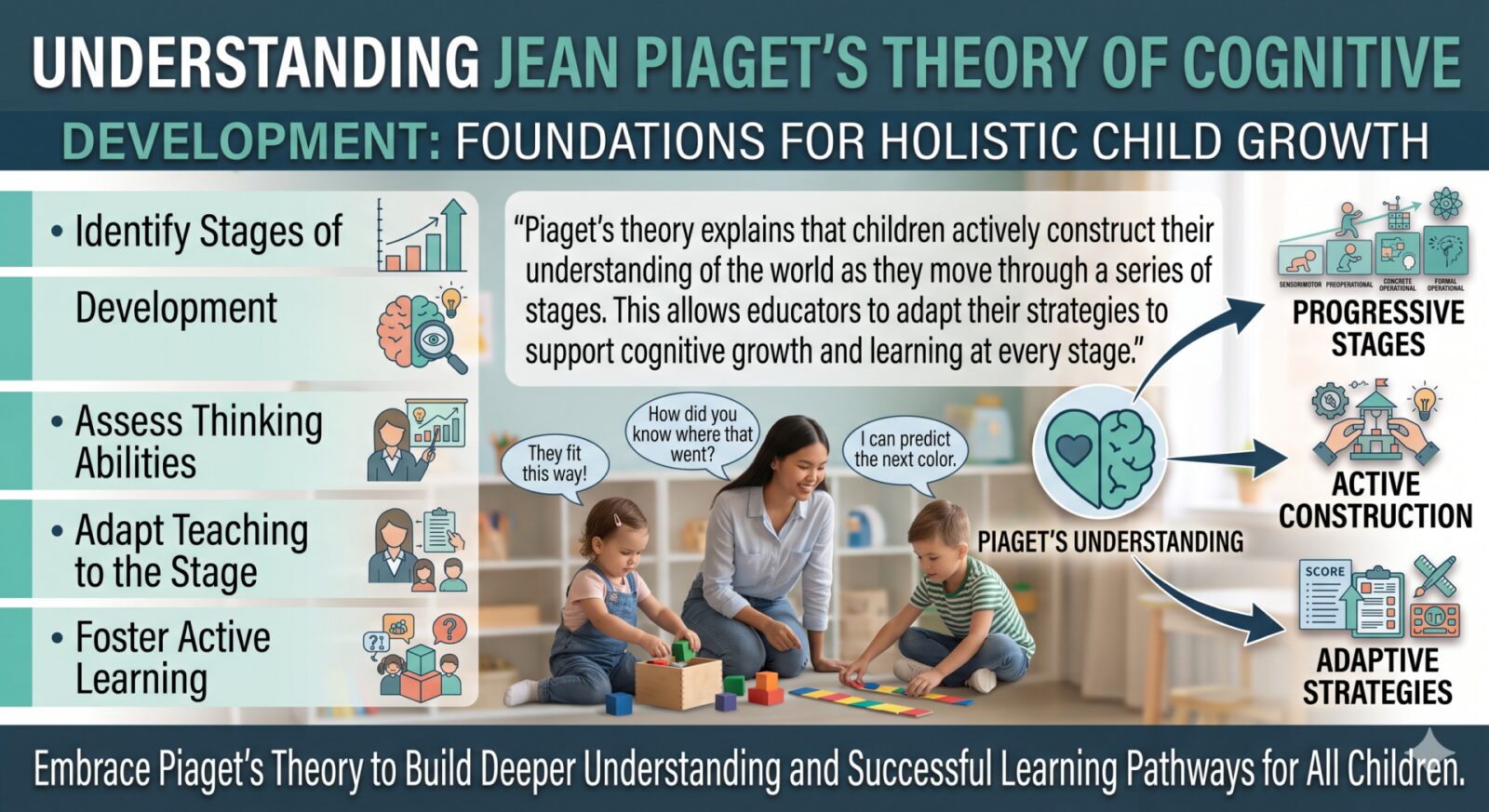
Piaget’s Cognitive Development Theory findings transformed modern pedagogy, laying the groundwork for student-centered learning and active discovery frameworks in early years and primary education.
- Differentiating for Individual Trajectories: Recognizing that children move through Piagetian stages at varying rates allows practitioners to tailor support appropriately across diverse primary classroom settings.
- Learning Through Exploration: Passive rote learning is replaced by active, hands-on activities. Providing physical manipulatives, water play, and exploratory science setups enables children to build schemas through direct experience.
- Respecting Developmental Readiness: Curriculum planning must align with a child’s current cognitive stage. Expecting a preoperational child to grasp abstract algebraic equations creates frustration, as their cognitive framework is not yet equipped for non-concrete operations.
- Facilitating Guided Discovery: Rather than directly giving answers, teachers act as facilitators, setting up problem-solving scenarios that prompt disequilibrium and encourage children to discover principles independently through trial and error.
Key Criticisms of Piaget’s Cognitive Development Theory
While Piaget’s Cognitive Development Theory remains fundamental to developmental psychology, modern researchers have highlighted notable limitations in his methodology and conclusions.
Kurt Fischer & Dynamic Skill Theory: Fischer argued against rigid, step-by-step developmental stages. His Dynamic Skill Theory suggests that cognitive development occurs in a non-linear, dynamic fashion, fluctuating based on emotional context, environmental support, and specific skill domains.
Lev Vygotsky & Social Constructivism: Vygotsky argued that Piaget viewed the child as an overly isolated learner. He emphasized that cognitive development is deeply shaped by cultural context, language, and social collaboration, introducing the Zone of Proximal Development (ZPD) to highlight how children achieve higher-level thinking when guided by more knowledgeable peers or adults.
Jerome Bruner & Instructional Scaffolding: Bruner posited that Piaget underestimated how structured guidance and language accelerate learning. Bruner proposed that any subject can be taught effectively to any child at any stage of development if content is presented appropriately through structured scaffolding.
Margaret Donaldson & Real-World Contexts: In her seminal work Children’s Minds, Donaldson demonstrated that Piaget’s laboratory tasks were often too abstract or artificially phrased. When experimental tasks were framed within meaningful, real-world contexts, children displayed advanced logical capabilities far earlier than Piaget predicted.
Bärbel Inhelder & Variability in Abstract Thought: Inhelder, a key collaborator of Piaget, noted that progression into the formal operational stage varies widely. Many adolescents and adults do not consistently reach abstract formal operations across all domains, often due to variations in formal education and specialized training.
Martin Hughes & Perspective-Taking: Hughes challenged Piaget’s conclusions on egocentrism. Using his “Policeman Doll Task,” Hughes proved that children as young as three could successfully understand another person’s spatial perspective when the task made practical sense to them.
Conclusion: Leveraging Piaget’s Insights in Modern Education
Jean Piaget’s Cognitive Development theory fundamentally changed how we view child development. By demonstrating that children are active participants in their own learning rather than passive recipients of information, Piaget provided educators, parents, and practitioners with a powerful framework for understanding how young minds grow.
While contemporary research highlights the vital role of social context and language—areas further expanded by theorists like Vygotsky and Bruner—Piaget’s core concepts remain highly relevant today. Recognizing the interplay between schemas, assimilation, and accommodation allows us to create learning environments that spark curiosity, respect developmental readiness, and encourage genuine discovery.
Ultimately, effective practice isn’t about rushing children through rigid age brackets. Instead, it’s about meeting children where they are cognitively, providing appropriate hands-on opportunities, and scaffolding their journey as they build a deeper understanding of the world around them.
Q1: What are the 4 stages of Piaget’s cognitive development theory?
Answer: The four stages are: (1) Sensorimotor (0–2 years), (2) Preoperational (2–7 years), (3) Concrete Operational (7–11 years), and (4) Formal Operational (11+ years).
Q2: What is the difference between assimilation and accommodation?
Answer: Assimilation occurs when a child fits new information into an existing schema (e.g., calling a new breed of dog a “dog”). Accommodation happens when a child alters an existing schema or creates a new one because the new information does not fit (e.g., realising a cat is not a dog).
Q3: How can teachers apply Piaget’s theory in the classroom?
Answer: Teachers can apply Piaget’s theory by offering hands-on, active learning opportunities, respecting developmental readiness, and encouraging trial-and-error discovery rather than forcing passive instruction.
Q4: What are the main criticisms of Jean Piaget’s theory?
Answer: Major critiques—notably from Lev Vygotsky and Jerome Bruner—argue that Piaget underestimated the role of social interaction, culture, and language, and that cognitive development is often more flexible than rigid age-bound stages suggest.