

Please Enter Your Email ID
Table of Contents
What is Self-Awareness in Social-Emotional Learning (SEL)?
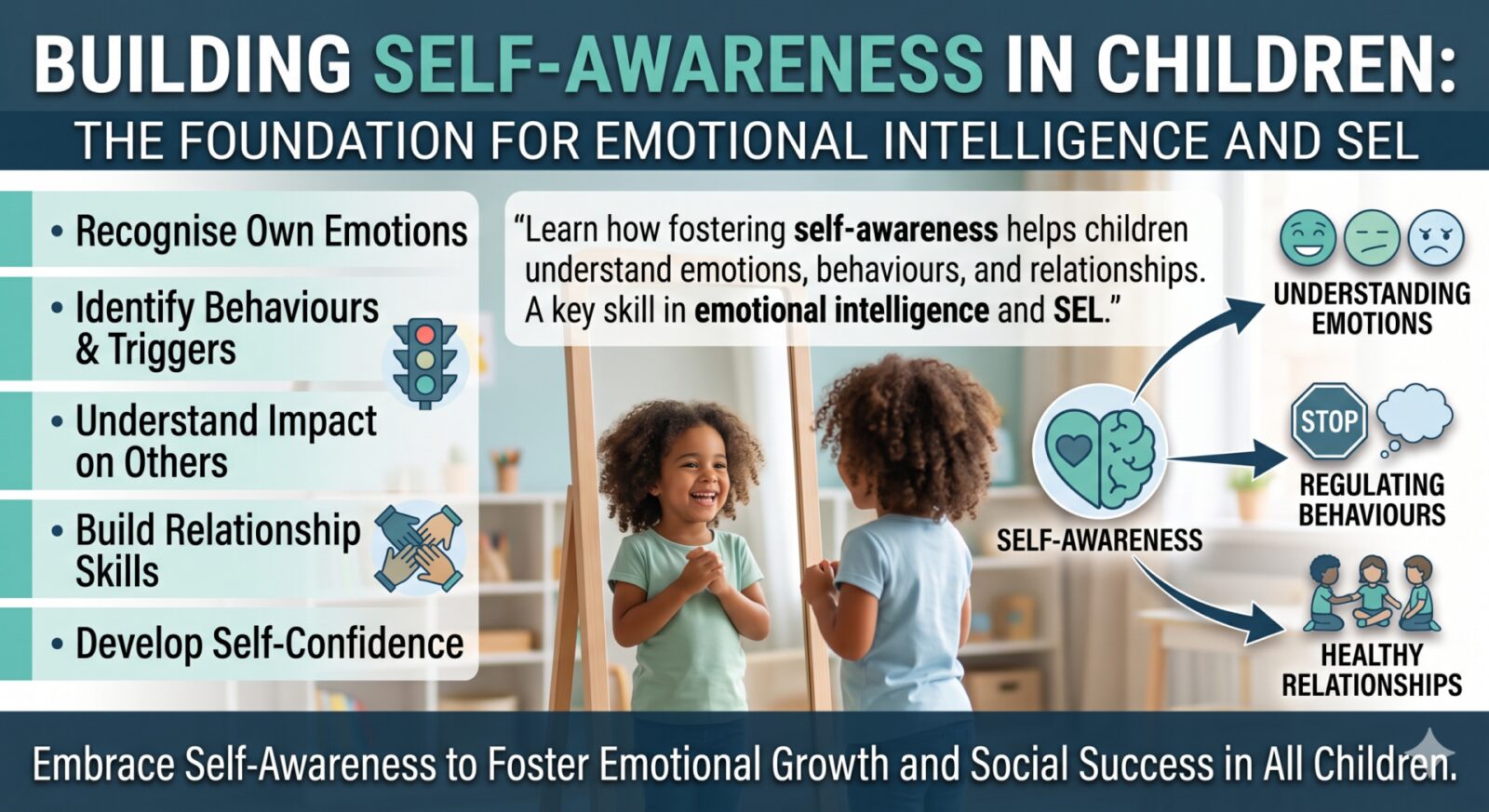
Self-awareness in children is the ability to recognise and understand their thoughts, emotions, and behaviours and how these influence their actions and impact on others. Self-awareness is a key component of emotional intelligence and one of the core competencies of social-emotional learning (SEL).
Children with the following essential skills will have higher levels of self-awareness:
- Can recognise and label their emotions.
- Can recognise physical sensations and link them to emotions.
- Ability to be self-reflective.
- Awareness of personal strengths and weaknesses.
- Awareness of personal values and beliefs.
- Awareness of situations or experiences that can be an emotional trigger.
- Have a growth mindset.
- Can see things from others’ perspectives.
Practical Strategies for Teaching Self-Awareness to Children
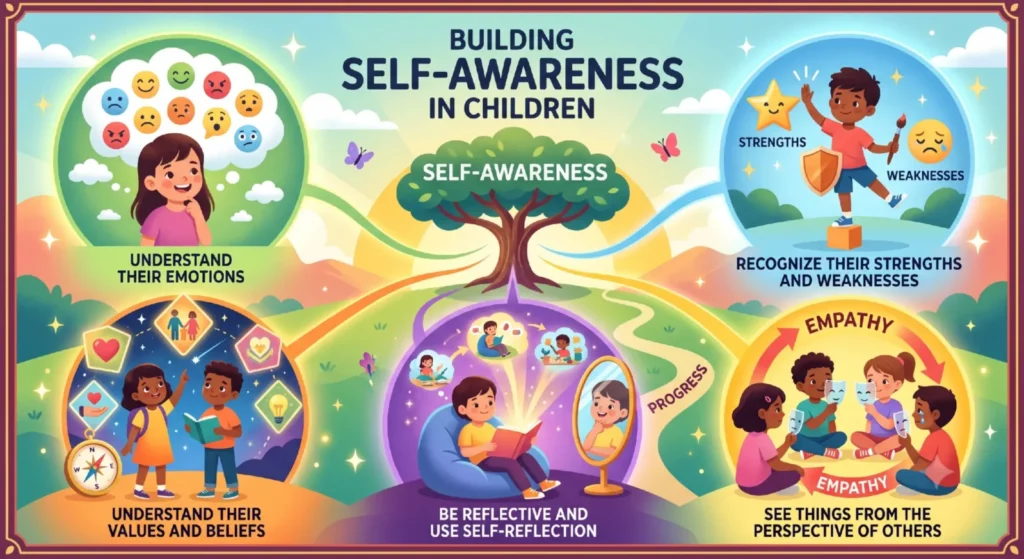
We can develop self-awareness in children by helping them to:
- Understand their emotions
- Recognise their strengths and weaknesses
- Understand their values and beliefs
- Be reflective and use self-reflection
- See things from the perspective of others
Developing these self-awareness skills will allow the children you are working with to understand and navigate their behaviours, self-regulate, make better decisions, and build positive and healthy relationships with others.
As an educator, your role in promoting self-awareness in children is crucial. If you are working with a child struggling with self-awareness, the following strategies will help.
Improving Emotional Literacy & Labeling Feelings
By teaching children to name or label their emotions and feelings, we can help build their emotional literacy, which is the ability to recognise, understand, and appropriately express their emotions. This skill is crucial for improving their ability to express themselves and is a key component of self-awareness.
Using tools such as emotion wheels or feeling charts to label emotions such as anger, sadness, anxiety, and fear, we can guide children in recognising and naming their feelings.
You can also take this further and link bodily sensations to their feelings.
Additional activities that can help children to identify emotions:
- Emotion cards
- Emotional charades
- Feelings thermometer
- “I Feel” statements
- Mood journaling
- Role-playing scenarios
- Feelings charts
- All about me activities
Developing Mindful Self-Regulation Techniques
You can use mindfulness activities to increase self-awareness in children, and the reason that this helps is because mindfulness helps children focus on the present moment.
Mindfulness activities can also help with emotion regulation and can be an excellent strategy for children who struggle with self-regulation. Some mindfulness activities that you can complete with children include:
- Deep breathing exercises
- Five senses exercise
- Mindful colouring
- Mind jar
- Gratitude practice
- Bubble breathing
- Teddy Bear tummy breathing
- Mindful walking
Interactive Tools to Promote Self-awareness in Children
Structuring a Daily Mood Journal for Children
Keeping a daily ‘mood journal’ where children write or draw about how they are feeling (and, just as importantly, what led to them feeling that way) is a great way to encourage them to talk about their feelings.
Journals can also be used as a reflective tool where children can reflect on their emotions, which will help them better understand how situations affect their moods.
Mood journaling not only promotes self-awareness in children but also promotes emotional expression and problem-solving and can help relieve stress, which can improve mental well-being.
You could use the following structure for a mood journal:
| Title | Description |
|---|---|
| Date | |
| Mood check | This could be a colour, face, emoji or other agreed identifier of current mood. |
| What happened (outside of my control) | Write about things that affected their mood that were outside their control. For example, they might have gotten mad because it rained. |
| What happened (inside of my control) | Write about things that affected their mood that were within their control. For example, X called me a name so I got angry and punched a wall. |
| Reflection | Write about how the situation was handled and whether it could anything have gone better |
| Gratitude or Affirmation | End the journal with something positive, such as a quote, affirmation or writing about something they are thankful for. |
Using Role-Playing and Storytelling to Model Reflection
You can use role-playing scenarios or storytelling to help children understand how they react in different situations. You can also use storytelling to create a scenario and ask questions like “What do you think will happen if X does this to Y?” The children can then give suggestions on what they think might happen next.
Just like role-playing, you can teach children about emotional regulation by modelling it in your day-to-day work. You can narrate your feelings and thought process to the children so they can observe how you handle challenging situations or obstacles.
Some additional ideas for scenarios that you can role-play include:
- Emotional scenarios such as being left out
- Mirror emotions such as role-playing a scene with just an angry face or a sad scene with a smile
- Role-switching, such as What would you do if you were the teacher
Implementing Regular Emotional Check-Ins
Emotions and feelings come and go, and with children who have not fully developed self-regulation skills, you will see emotions go up and down quite quickly throughout the day.
Regular check-ins not only help you understand the child’s emotional state but also make them feel cared for, understood, and less overwhelmed.
Some tools that can help with emotional check-ins include:
- Emotion charts and wheels
- Colour-coding feelings
- Thumbs-up/Thumbs-down
- Mood meter
- Check-in journal
- Feelings thermometer
Final Thoughts: Building Lifelong Emotional Literacy
Fostering self-awareness in children is not a one-time lesson; it is an ongoing process built through daily consistency, co-regulation, and compassionate guidance. By embedding practical SEL activities—such as mood journaling, emotional check-ins, and mindfulness—into regular routines, you give children the essential tools they need to understand their inner world.
When children learn to recognise, name, and navigate their emotions in a safe environment, they build the foundation for lifelong self-regulation, stronger relationships, and emotional resilience. Start small with one or two strategies that suit your setting, and give young people the space and confidence to find their own voice.
Frequently Asked Questions (FAQ)
Q1: Why is self-awareness important in social-emotional learning?
A: Self-awareness forms the foundation of social-emotional learning (SEL). It allows children to recognise their thoughts, emotions, and bodily sensations, helping them understand how their internal state drives external behaviour, decision-making, and interactions with others.
Q2: What are some simple self-awareness activities for children?
A: Effective activities include using feeling charts or emotion wheels, practicing daily mood journaling, engaging in simple mindfulness breathing exercises, and using role-playing scenarios to explore different perspectives and reactions safely.
Q3: How do emotional check-ins help develop self-awareness?
A: Regular emotional check-ins give children permission to reflect on their changing feelings throughout the day. By building a routine around identifying emotions early, children learn self-regulation strategies before feeling overwhelmed or dysregulated.
References
How Strong Is Your Emotional Literacy? – Verywell Mind
Can you teach empathy? As a psychotherapist I’d say yes – The Times
FRIENDS program – Wikipedia
Social Skills for ADHD – Verywell Mind
Emotional Regulation Skills Every Parent Should Teach Their Kids – Parents