

Please Enter Your Email ID
Table of Contents
SEMH Resources and Toolkits for Educational Settings
Navigating the sheer volume of frameworks, assessment matrices, and intervention guides available across local authorities and national bodies can be overwhelming. This curated directory brings together evidence-based SEMH resources and toolkits, assessment tools, and practical guidance to help you quickly access high-quality resources tailored to early years, primary, secondary, and specialist settings.
Social, Emotional, and Mental Health (SEMH) needs encompass a broad spectrum of child development challenges, ranging from social interaction difficulties and emotional regulation barriers to underlying mental health conditions. For educational practitioners, SENCOs, and school staff, identifying these underlying needs early is critical for fostering inclusive environments where every child can thrive.
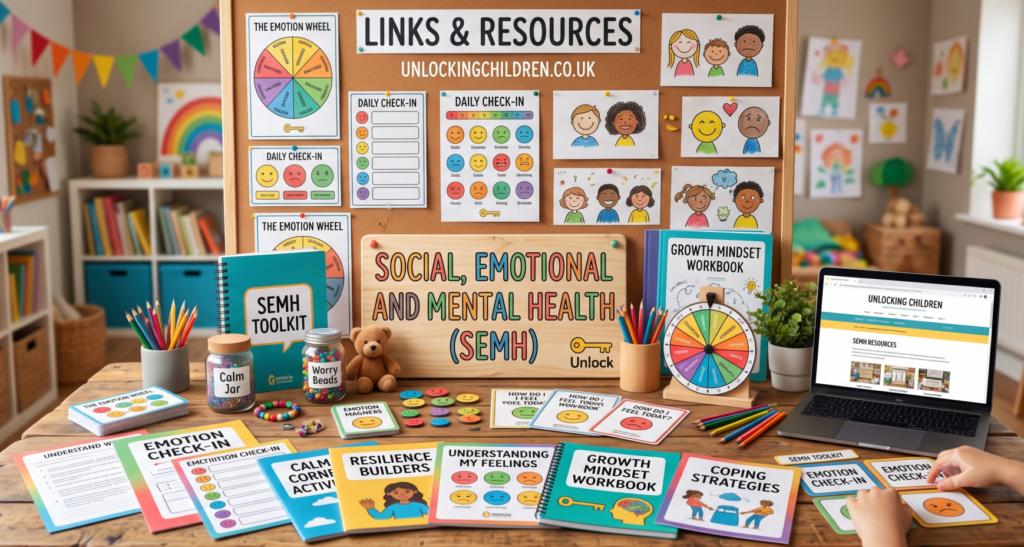
Social Emotional and Mental Health (SEMH) Toolkits
- SEMH resources and toolkits by KELSI – This toolkit has been created as a guide to support pupils with SEMH in the school setting, as well as help educational practitioners support pupils with SEMH to thrive in their mainstream setting socially, emotionally and academically.
- Early Years SEND toolkit – Social, emotional and mental health needs – Activities and resources to support children with social, emotional and mental health needs (SEMH).
- SEND toolkit – Our special educational needs and disabilities (SEND) toolkit has been co- written with schools, early years providers, post 16 education settings, parent carers and other professionals.
- Toolkit of evidence-based interventions to promote inclusion of children with SEMH needs – There is a substantial body of research evidence to suggest that young people’s social emotional and mental health (SEMH) needs have a significant impact on all aspects of their life including their learning and progress through the curriculum, behaviour in school and attendance, further training and employment and general life chances. Social media and new technology is also linked to increasing risks of poor SEMH.
- SEMH resources and toolkits – SEMH stands for social, emotional and mental health. Living autism describes SEMH needs as ‘a type of special educational need where a child communicates through behaviour in response to unmet social, emotional or mental health needs.
- Quick Checker – Social, Emotional and Mental Health (SEMH) – The Quick Checker can be used to support conversations between class teachers and parent carers at the initial concern stage. The Quick Checker is not a diagnostic tool but it is designed to identify barriers within the Social, Emotional and Mental Health (SEMH) area of need.
- Supporting Children and Young People with Social, Emotional and Mental Health Needs: A toolkit of strategies – This toolkit has been developed by members of the Inclusion Advisory Team in consultation with the SEN support workstream, parent carer forum and an independent behavioural specialist.
Social Emotional and Mental Health (SEMH) Resources
- SEMH resources and toolkits by Essex County Council – Tools and resources for working with children and young people with SEMH.
- SEMH Resources – This section provides key guidance and links to support social, emotional and mental health (SEMH) difficulties. For more practical resources, visit the SEMH Padlet (link below).
- EY: Social, Emotional and Mental Health (SEMH) – All young children take time to develop the ability to regulate their emotions, attention, and behaviours. In most cases, this is not a cause for concern or an indicator of needs relating to Social, Emotional or Mental Health needs.
- Social and emotional learning – Moderate impact for very low cost based on very limited evidence
Social Emotional and Mental Health (SEMH) Assessment Tools
- Supporting the social, emotional & development needs of all pupils by Boxall Profile – A comprehensive whole-school approach to assess and support the social, emotional, and development needs of all children and young people, to positively impact their learning, behaviour, attendance, and wellbeing.
- Tools to help identify SEMH needs – There is no single tool that will effectively screen for all social, emotional and mental health needs so it is important that all adults remain curious about behaviour and seek to understand any underlying needs. It is important to ensure that a holistic picture has been gathered and consideration has been given to potential trauma, attachments and family relationships, adverse experiences, deprivation, health needs, sensory needs as well as learning, language and literacy language needs.
- SEMH – assessment tools (KS2) – Identifying need requires careful planning and evaluation to ensure what is put in place brings about sustainable, positive change. Consider what assessment tools are used in your school
What are SEMH resources and toolkits, and how should schools use it?
An SEMH toolkit is a collection of structured assessments, intervention strategies, and practical frameworks designed to support children experiencing social, emotional, or mental health difficulties. Schools use these toolkits to assess baseline needs, track developmental progress, implement targeted classroom adaptations, and facilitate collaborative conversations between teachers, SENCOs, and parent-carers.
How do you assess SEMH needs in a classroom setting?
Assessing SEMH needs requires a holistic, child-centred approach rather than relying on a single screening tool. Practitioners typically combine standardised assessment frameworks (such as the Boxall Profile or local authority Quick Checkers) with structured classroom observations, discussions with parent-carers, and direct input from the child. It is essential to remain curious about underlying factors such as trauma, attachment dynamics, neurodivergence, or communication needs.
What is the difference between an SEMH assessment tool and a diagnostic tool?
SEMH assessment tools and quick checkers are observational frameworks used by educational professionals to identify functional barriers, social-emotional gaps, and classroom triggers. They do not provide medical or clinical diagnoses. Instead, they help schools put immediate, targeted support in place and gather robust evidence if a referral to external specialists (such as Educational Psychology or CAMHS) is required.