

Please Enter Your Email ID
Table of Contents
How Children Learn to Communicate Using Speech and Language?
Communication is a complex, progressive system of skills that serves as the cornerstone of all human interaction. Understanding how children learn to communicate with the world around them is fascinating. Everything from a baby’s first smile to complex debates in young adulthood, learning how children acquire speech and language helps parents, educators, and social care professionals better understand and support a child’s developmental journey.
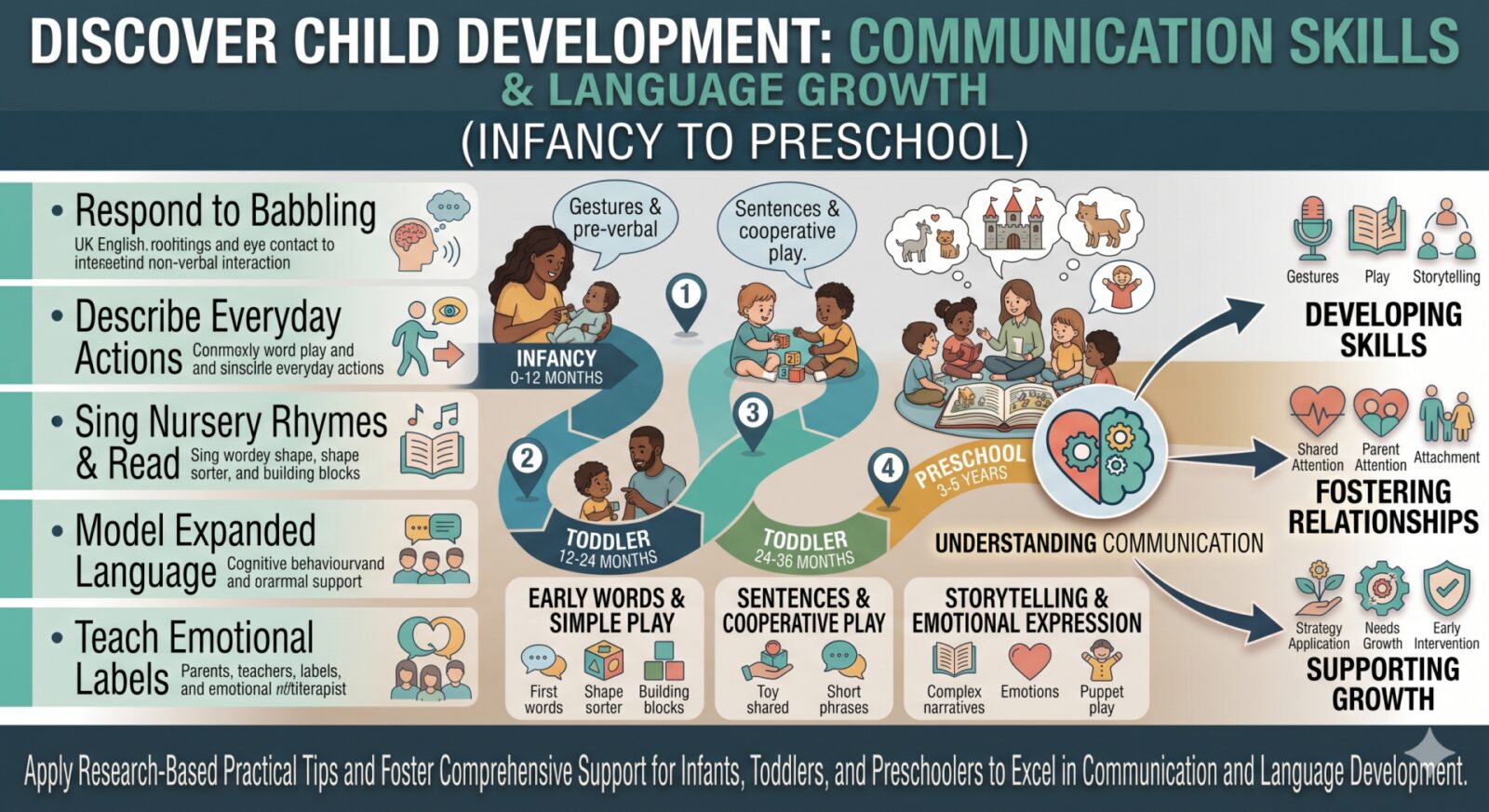
Language acquisition begins long before a child speaks their first word. While non-verbal communication—such as eye contact, facial expressions, and body language—lays the early foundation, speech development relies on two complementary forces:
Environmental Immersion & Caregiver Interaction (Nurture): The speed and depth at which children learn to communicate depends heavily on their environment. Responsive caregivers who engage in “serve-and-return” interactions (responding to babbles, gesturing, and reading aloud) provide the vital rich language input a child’s brain needs to thrive.
Innate Biological Readiness (Nature): Children are born with specialised neural networks wired for language processing. From birth, infants instinctively attune to human voices, facial expressions, and emotional tones.
Nature vs. Nurture in Child Language Acquisition
How children learn to communicate is driven by a dynamic interaction between innate biological readiness (nature) and environmental experiences (nurture).
Biological Readiness: Neural Networks & Language Processing
Specific regions of the human brain, including Broca’s and Wernicke’s areas, are dedicated to language processing and speech production. These intricate neural networks allow infants to decipher auditory patterns, assign meaning to words, and eventually produce spoken language.
Furthermore, humans possess an inherent evolutionary drive for connection. Studies on human cooperative behaviour show that infants instinctively attune to human faces, vocal tones, and facial expressions from birth, laying the foundation for early social communication.
The Role of Responsive Caregivers & Language Immersion
While biological wiring creates the capacity for speech, environmental nurturing determines also determines how children learn to communicate and how effectively those skills develop.
- Language Immersion: Exposing children to spoken language through daily conversation, storytelling, songs, and nursery rhymes expands their receptive vocabulary and comprehension.
- Responsive Caregiving: Engaging in “serve-and-return” interactions—such as mirroring babbling sounds, making eye contact, and responding to gestures—creates a supportive environment where language thrives.
- Therapeutic & Pretend Play: Imaginative play and role-playing act as gateways to language development, allowing children to practice negotiation, storytelling, and emotional expression.
Key Stages of How Children Learn to Communicate (0–5+ Years)
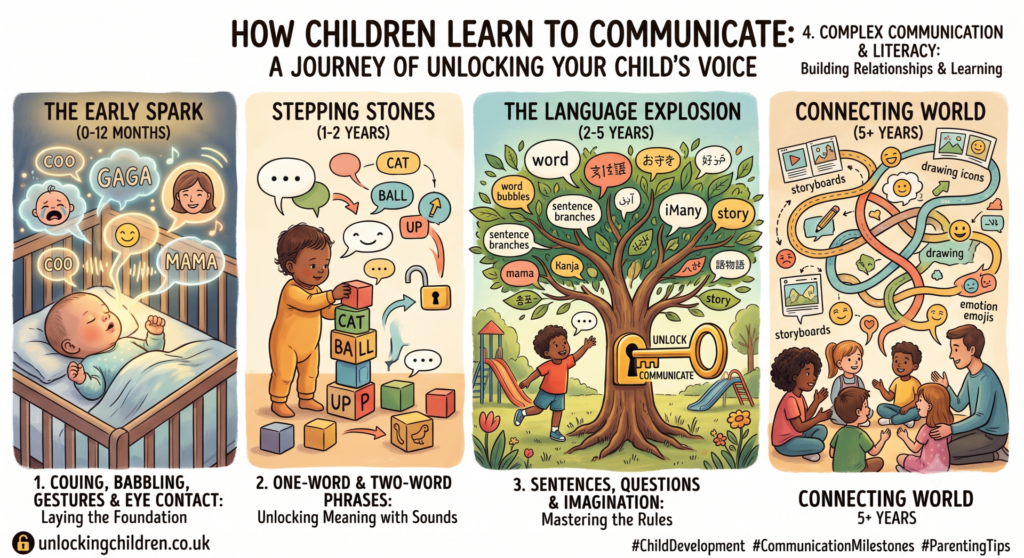
While every child develops at their own pace, language acquisition typically follows four distinct developmental milestones between birth and school age:
| Developmental Stage | Age Range | How Children Learn to Communicate at this Stage |
|---|---|---|
| Pre-linguistic | 0–12 Months | Non-verbal communication dominates. Infants express needs through cooing, crying, babbling, and gesturing while learning to respond to vocal cues. |
| Early Language | 12–24 Months | First words emerge (e.g., “Mummy”, “Teddy”). Two-word phrases develop toward age two (“want milk”), allowing children to communicate basic desires and follow simple instructions. |
| Developing Language | 2–5 Years | Rapid vocabulary explosion. Receptive vocabulary expands from ~1,000 words at age 3 to nearly 10,000 words by age 5. Children begin forming full sentences, creating narratives, and asking “why” questions. |
| School Age | 5+ Years | Advanced communication takes shape, including reading, writing, abstract reasoning, understanding humour/sarcasm, and adapting speech tone to different social contexts. |
Practical Strategies to Nurture Child Communication
Supporting language development is a shared responsibility among parents, caregivers, educators, and social care professionals.
- Engage in Meaningful Dialogue: Narrate daily activities (“We are putting on our coat to go to the park”), describe actions, and ask open-ended questions to encourage verbal expression.
- Practice Active Listening: Respond enthusiastically to every communication attempt—whether babbling, gestures, or words—to validate the child’s voice and build relational trust.
- Build a Literacy-Rich Environment: Surround children with books, read aloud daily, and visit local libraries to build foundational literacy and creative thinking skills.
- Balance Interactive Technology: While educational audiobooks and digital media offer value, they cannot replace the developmental impact of face-to-face human interaction, shared play, and conversational exchanges.
Conclusion
Nurturing a child’s language and communication skills begins at birth. From responding to early babbles to building a reading-rich home environment, consistent relational support gives children the confidence and tools they need to express themselves.
Remember that developmental rates vary naturally. If you have concerns regarding a child’s speech progression, consult a Health Visitor, GP, or Speech and Language Therapist for guidance.
Q: What are the main stages of communication development in children?
A: Children typically progress through four main stages: pre-linguistic (0–12 months, cooing and gestures), single words (12–18 months), two-word combinations (18–24 months), and complex sentence structure (3+ years).
Q: How do caregivers influence a child’s language development?
A: Caregivers play a critical role through “serve-and-return” interactions—responding to a baby’s babbles, maintaining eye contact, reading aloud, and modelling rich vocabulary during daily routines.
Q: What is the difference between speech and language in child development?
A: Speech refers to the physical production of sounds and words, whereas language refers to the broader cognitive system of understanding (receptive language) and expressing thoughts through words, symbols, or gestures (expressive language).
- Kuhl, P. K. (2004). Early language acquisition: Cracking the speech code. Nature Reviews Neuroscience, 5(11), 831-843.
- Hoff, E. (2006). How social contexts support and shape language development. Developmental Review, 26(1), 55-88.
- Tomasello, M. (2003). Constructing a language: A usage-based theory of language acquisition. Harvard University Press.
- Vygotsky, L. S. (1978). Mind in society: The development of higher psychological processes. Harvard University Press.
- Bruner, J. S. (1983). Child’s talk: Learning to use language. Norton.