

Please Enter Your Email ID
Table of Contents
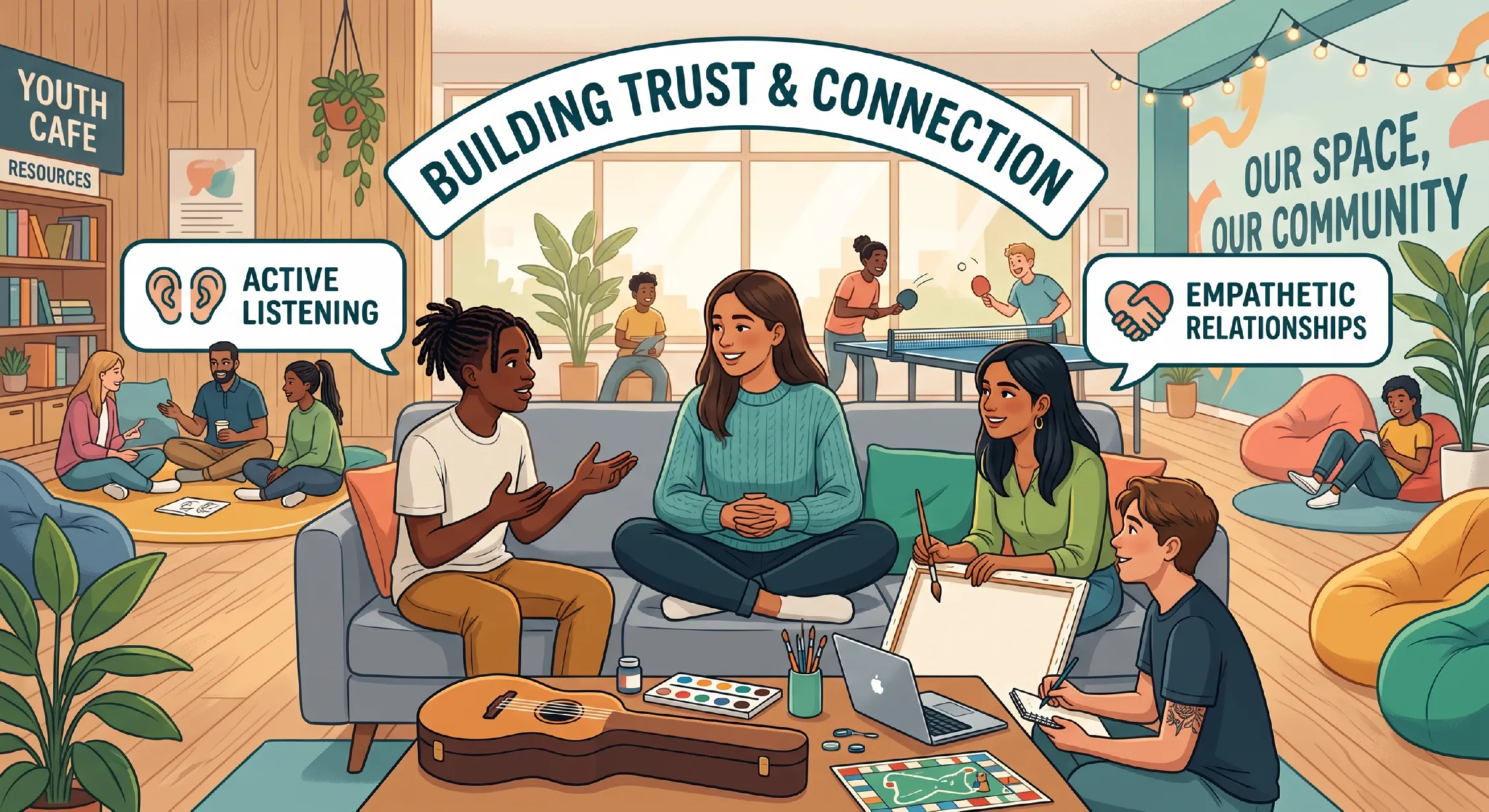
Youth work is fundamentally a relational practice. Unlike formal statutory environments or traditional classroom instruction where relationships are frequently governed by institutional hierarchies, compulsory attendance, and mandated curricula, youth work operates on the principle of voluntary engagement. Young people choose to walk through the door, choose to stay, and choose to share their lived experiences. Because participation is voluntary, the quality of interpersonal communication and the strength of the professional relationship are not merely supportive elements; they are the primary medium through which personal, social, and educational development occurs.
When communication falters, engagement breaks down. When relational trust is established with intentionality and ethical care, youth workers can support young people through personal crises, empower self-advocacy, and help navigate complex transitions into adulthood. This comprehensive guide examines the theoretical underpinnings, practical communication models, and boundary frameworks necessary to build transformative professional relationships with young people.
The Relational Foundation of Youth Work
At its core, youth work differs from other pedagogical disciplines through its commitment to association and informal education. As seminal youth work scholars Mark K. Smith and Tony Jeffs have long observed, informal education is driven by conversation and relationship-building in settings where young people feel a genuine sense of agency and ownership. The youth worker acts not as an authoritarian director, but as a facilitator of learning and self-discovery.
The Dynamics of Voluntary Participation
Voluntary engagement creates a distinct relational dynamic:
- Egalitarian Power Dynamics: While the practitioner retains statutory safeguarding duties and duty of care, the conversation is negotiated rather than dictated. Power must be continuously examined and shared.
- Unconditional Positive Regard: Grounded in humanistic psychology, the practitioner communicates genuine acceptance of the young person without condition, validating their worth irrespective of past behaviour.
- Privileged Witness Status: Because youth workers meet young people in community spaces, detached street settings, and informal clubs, they observe social ecologies that formal institutions rarely see. Operating as a respectful, non-judgemental witness requires elevated communication sensitivity.
Establishing rapport is rarely instantaneous. For young people who have experienced system fatigue, relational trauma, or exclusionary educational disciplinary measures, initial communication is often guarded. Practitioners must recognise hesitation not as resistance, but as an adaptive protective mechanism.
Core Communication Competencies for Youth Practitioners
Effective communication in youth work requires a sophisticated integration of verbal precision, non-verbal attunement, and conversational pacing.
Active and Empathetic Listening
Active listening goes beyond remaining quiet while a young person speaks; it demands intentional engagement with both spoken words and underlying emotional subtexts.
- Reflective Summarising: Paraphrase content without parroting words. Instead of saying, “So you are saying your teacher is unfair,” use: “It sounds like you felt completely dismissed when your side of the story was not heard in class.”
- Emotional Labelling: Help young people expand emotional literacy by gently reflecting observed feelings (“It sounds like that left you feeling drained and frustrated”).
- Tolerating Silence: In an informal setting, silences provide processing time. Rushing to fill a pause often interrupts emotional processing and shifts control back to the adult.
The Power of “Side-by-Side” Communication

One of the most effective techniques in informal youth work is communicating alongside an activity rather than across a table:
- Reduced Direct Eye Contact: Intensive, frontal eye contact across an interview desk can mimic interrogative or disciplinary settings.
- Shared Focus: Engaging in an activity—such as cooking, art, sports, board games, or project work—deflects intense scrutiny. The shared task acts as a conversational catalyst, allowing young people to raise vulnerable topics naturally when they feel ready.
Navigating Conflict, Defensiveness, and De-escalation
Disagreements and volatile interactions are inevitable when supporting young people facing acute systemic and personal pressures. Effective de-escalation hinges on relational safety rather than punitive control.
Non-Defensive De-escalation Techniques
When tensions rise, practitioners must regulate their own physiological responses before attempting to co-regulate the young person:
- Lower Tone, Pace, and Volume: Lowering vocal pitch and speaking at half-speed naturally encourages the other party to mirror your nervous system state.
- Open, Non-Threatening Posture: Keep hands visible, maintain an angled stance rather than squaring off chest-to-chest, and maintain comfortable physical distance.
- Validate the Emotion, Not the Harmful Behaviour: Disarm defensiveness by acknowledging the validity of the emotion before addressing the behaviour:“I hear how furious you are right now, and you have every right to feel angry about what was said. However, throwing chairs puts others at risk, and I need to keep everyone in this room safe. Let’s take a breath and figure out how to resolve this.”
Restorative Conversations
Following conflict, traditional punitive approaches often rupture relationships permanently. A restorative approach centres on accountability and relational repair by asking structured questions:
- What happened from your perspective?
- What were you thinking and feeling at the time?
- Who has been affected by what occurred, and in what way?
- What needs to happen to make things right and move forward together?
Professional Boundaries: The Container of Trust
A widespread misconception among novice practitioners is that building deep relationships requires becoming a young person’s “friend.” While youth work relationships are warm, friendly, and informal, they must remain rigorously professional.
| Element | Professional Youth Work Relationship | Friendship |
| Purpose | Centred entirely on the young person’s development and wellbeing. | Mutual emotional exchange and reciprocal support. |
| Power & Responsibility | Adult holds safeguarding accountability and duty of care. | Shared, egalitarian social dynamic without institutional accountability. |
| Self-Disclosure | Purposeful, minimal, and utilised solely to benefit the young person. | Regular, detailed sharing of personal dilemmas and life updates. |
| Longevity | Time-limited and bound by professional context and transitions. | Indefinite and sustained by mutual personal preference. |
Clear Communication on Safeguarding Limits
Confidentiality must be framed honestly from day one. Promising unconditional secrecy is unethical and endangers young people.
- The Transparency Script:“Everything we talk about here stays between us, with one crucial exception: if you share something that makes me concerned that you or someone else is at risk of significant harm, I cannot keep that secret. My job is to protect your safety, which means I will have to involve people who can help. But if that ever happens, my commitment is to be transparent with you and walk you through every step of the process.”
Clear boundaries do not inhibit closeness; they create the emotional safety container in which trust can safely grow.
Working with Neurodiversity, Trauma, and Diverse Cultural Backgrounds
Communication strategies must adapt to the intersectional identities and unique cognitive needs of each young person.
Trauma-Informed Relational Strategies
Young people who have experienced developmental trauma often process neutral interactions as potential threats:
- Predictability and Consistency: Inconsistency in adult behaviour triggers survival states. Keep your promises, be punctual, and clearly signal transitions between activities.
- Transparency of Intent: Avoid ambiguity. Always clarify why you are asking a question or why a particular operational rule exists.
Neuro-Inclusive Adaptations
Adapting communication for neurodivergent young people (including autistic individuals and those with ADHD) ensures equitable access:
- Direct and Unambiguous Language: Avoid idioms, metaphors, or heavy sarcasm that require complex social decoding.
- Multi-Modal Processing: Supplement verbal instructions with written agendas, visual timetables, or diagrammatic summaries.
- Sensory Considerations: Recognise that noisy, brightly lit environments impair auditory processing. Move complex or sensitive conversations to low-stimulus environments.
Reflective Practice: The Engine of Continuous Improvement
Supervision and critical reflection separate intuitive youth work from professional relational practice. Relational dynamics invariably evoke personal reactions, known in psychodynamic literature as transference and countertransference.
Practitioners should consistently audit their communication through guided reflective inquiry:
- Why did I react defensively to that young person’s comment?
- Am I working with this young person to meet their developmental needs, or to satisfy my own desire to be liked or helpful?
- Did my verbal pacing empower their voice, or did I dominate the conversational space?
Engaging in regular reflective supervision ensures that relationships remain purposeful, non-oppressive, and grounded in professional integrity.
Frequently Asked Questions (FAQ)
How can youth workers build trust with disengaged or guarded young people?
Building trust requires patience, consistency, and low-pressure engagement. Focus on showing up reliably over time, avoiding transactional conversations that immediately demand personal disclosures, and engaging in shared physical tasks or activities. Demonstrating transparent boundaries and reliably following through on minor commitments establishes safety.
What is the difference between being friendly and being a friend in youth work?
Being friendly describes an approachable, warm, and non-judgemental interpersonal manner. Being a friend involves mutual emotional reliance, reciprocal sharing of personal problems, and informal social contact outside professional settings. Youth workers must maintain clear professional boundaries so the relationship remains focused solely on the young person’s welfare and development.
How should a youth worker handle safeguarding disclosures during an informal conversation?
Do not panic or promise secrecy. Listen calmly without interrogating or asking leading questions. Reassure the young person that they did the right thing by speaking up, explain clearly who needs to be informed and why, and record the disclosure verbatim following statutory safeguarding reporting protocols immediately.
References
Benham-Clarke, S., Ewing, J., Barlow, A., & Newlove-Delgado, T. (2022). Learning how relationships work: a thematic analysis of young people and relationship professionals’ perspectives on relationships and relationship education. BMC Public Health, 22, 2289. https://doi.org/10.1186/s12889-022-14802-5
Davies, B. (2005). Youth work: A manifesto for our times. Youth and Policy, 88, 5–27.
Jeffs, T., & Smith, M. K. (Eds.). (2010). Youth work practice. Palgrave Macmillan.
National Youth Agency. (2020). The National Youth Work Curriculum. National Youth Agency.
Ruch, G., Turney, D., & Ward, A. (Eds.). (2018). Relationship-based social work: Getting to the heart of practice (2nd ed.). Jessica Kingsley Publishers.