

Please Enter Your Email ID
Table of Contents
Why Are Child Development Theories Important in Practice?
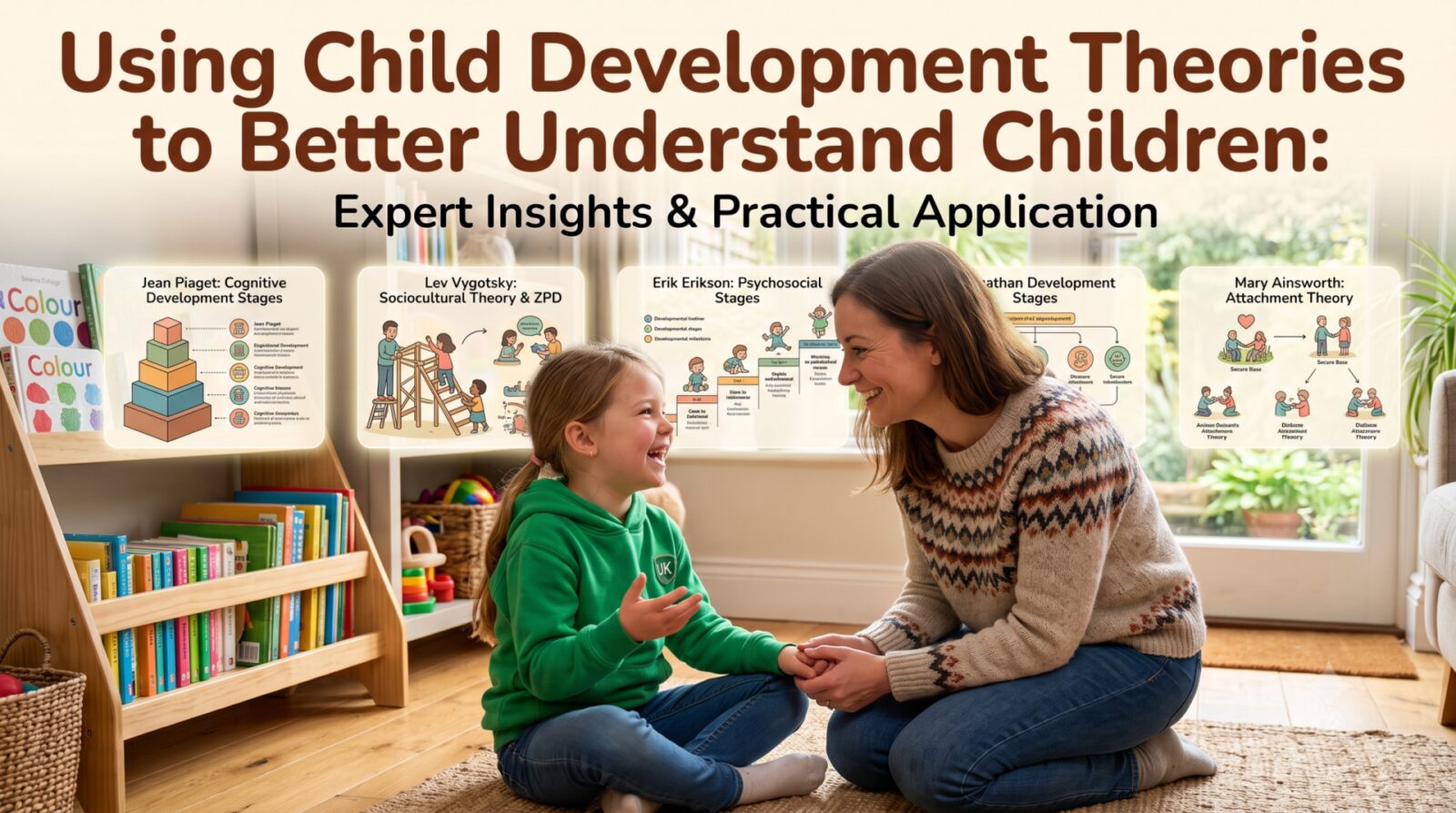
Child development theories provide professionals with frameworks that help us understand how children learn, grow and develop over time. These theories encompass cognitive, emotional, social and moral development.
Understanding child development is not just a theoretical exercise. It equips you with the knowledge to comprehend how children think, act, and behave. This understanding empowers you to better support and guide children’s learning and growth journey.
The theories below offer a comprehensive understanding of child development, highlighting the factors that influence how children grow and change over time. Each of the theories below provides a unique perspective on various aspects of development, including cognitive, emotional, and social growth.
Piaget’s Theory of Cognitive Development (4 Stages)
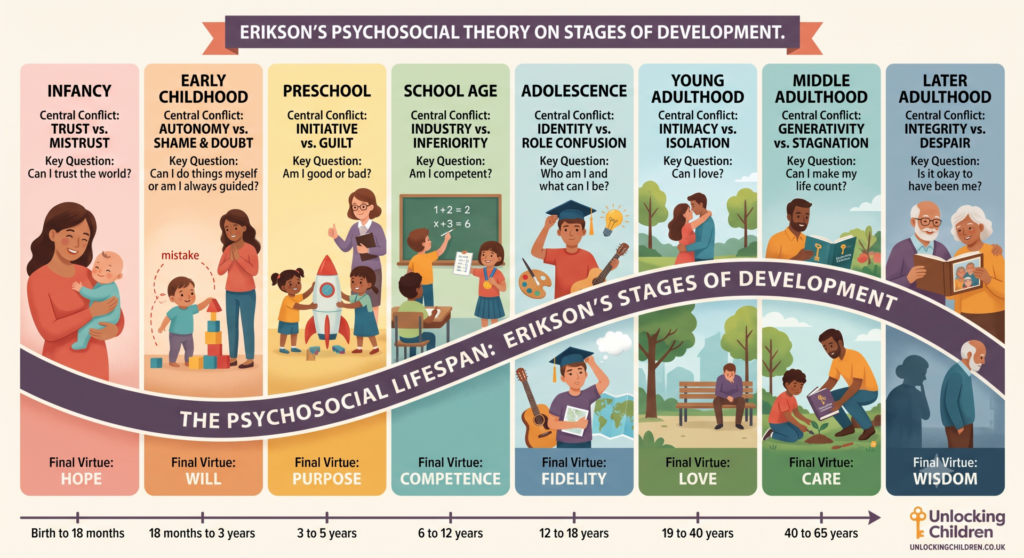
Jean Piaget (1896–1980) was a Swiss psychologist who proposed that children go through four stages of cognitive development before adulthood (Piaget, 1952). This theory shows how children’s thinking evolves as they gradually acquire the skills to think logically and abstractly.
| Stage | Age Range | Description |
|---|---|---|
| Sensorimotor | 0–2 years | Learn through senses and actions. Develop object permanence. |
| Preoperational | 2–7 years | Symbolic thinking, but still egocentric. |
| Concrete Operational | 7–11 years | Logical thinking, struggle with abstract ideas. |
| Formal Operational | 11+ years | Abstract and hypothetical reasoning. |
Vygotsky’s Sociocultural Theory & Scaffolding
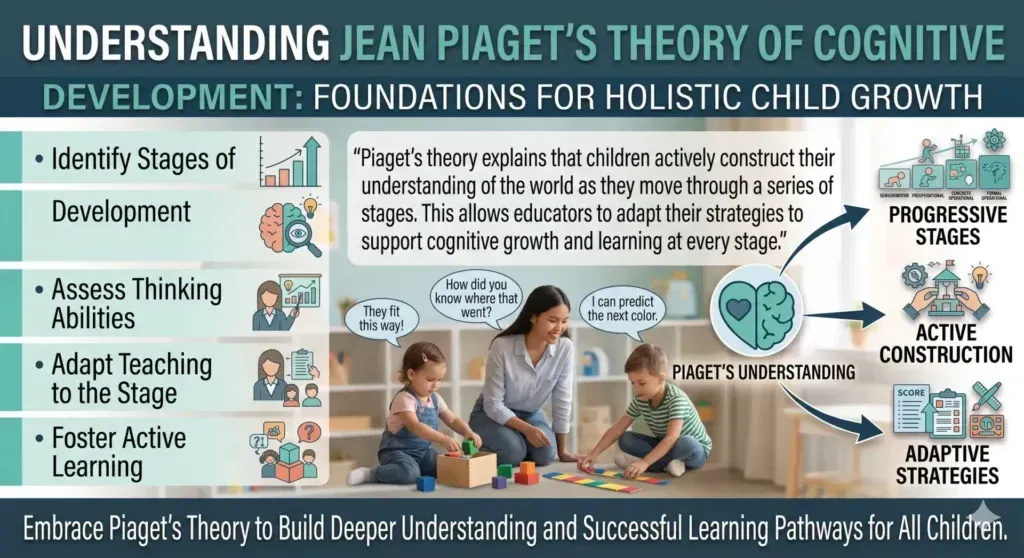
Lev Vygotsky (1896–1934) was a Russian psychologist who proposed that a child’s cognitive development is primarily influenced by their social interaction with more knowledgeable people (Vygotsky, 1978).
| Concept | Description |
|---|---|
| Zone of Proximal Development (ZPD) | Tasks children cannot complete alone but can with guidance from a more skilled person. Represents the potential for cognitive development. |
| Scaffolding | Support from a teacher, parent, or peer that helps the child perform tasks within their ZPD. |
| Cultural Tools | Language, symbols, and cultural artefacts passed down through generations that influence cognitive development. |
Erikson’s Stages of Psychosocial Development
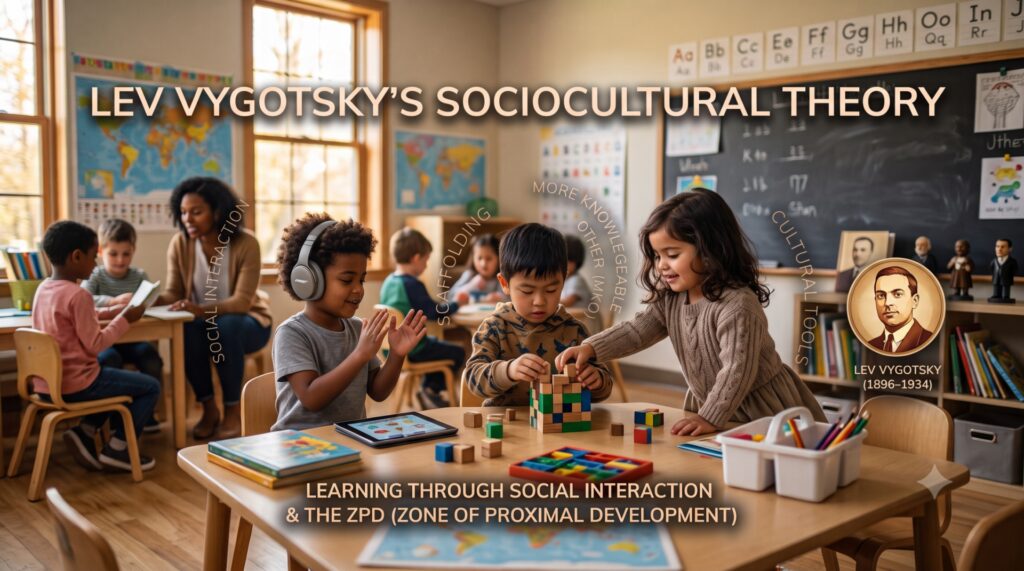
Erik Erikson (1902–1994) was a German-American developmental psychologist who proposed that a child’s personality develops through eight stages, each characterised by a specific psychosocial conflict that must be resolved. Success would produce a healthy trait; failure would create an unhealthy trait (Erikson, 1978).
| Concept | Age | Description |
|---|---|---|
| Trust vs. Mistrust | 0–1 year | Children develop trust or mistrust depending on caregiver reliability. |
| Autonomy vs. Shame and Doubt | 1–3 years | Children strive for independence; overcontrol can lead to shame. |
| Initiative vs. Guilt | 3–6 years | Children assert control or develop guilt if discouraged. |
| Industry vs. Inferiority | 6–12 years | Children develop competence or feel inferior if they fail to meet expectations. |
| Identity vs. Role Confusion | 12–18 years | Adolescents form identity or experience role confusion. |
The following three stages take place in adulthood:
- Intimacy vs. Isolation (Young Adulthood)
- Generativity vs. Stagnation (Middle Adulthood)
- Integrity vs. Despair (Late Adulthood)
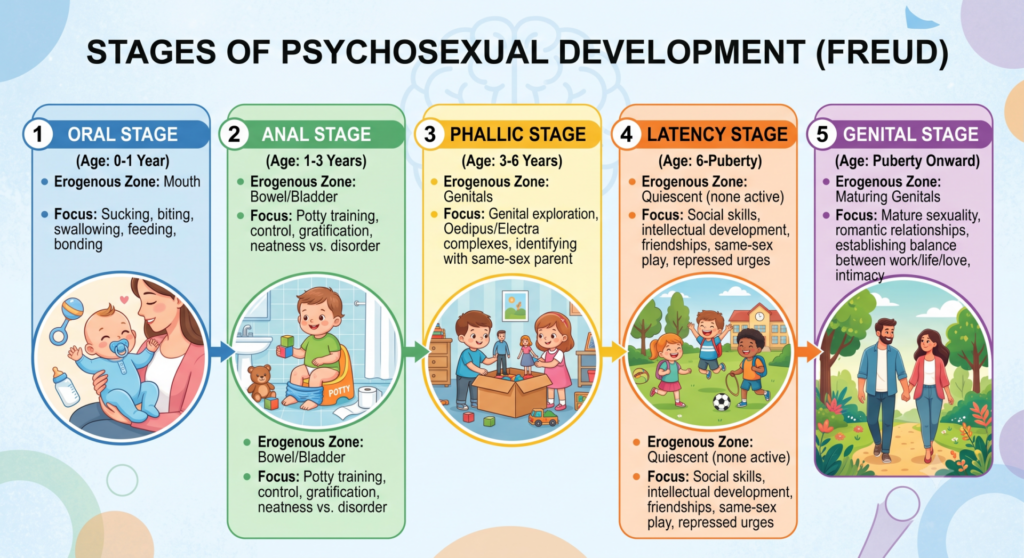
Freud’s Psychosexual Development Theory in Children
Sigmund Freud (1856–1939) proposed that early childhood experiences shape future personality. Development occurs through five stages (Freud, 1905).
| Stage | Age | Description |
|---|---|---|
| Oral Stage | 0–1 year | Weaning impacts oral fixations. |
| Anal Stage | 1–3 years | Toilet training influences personality traits. |
| Phallic Stage | 3–6 years | Develops awareness of gender, including the Oedipus/Electra complex. |
| Latency Stage | 6–puberty | Libido is dormant; focus on learning. |
| Genital Stage | Puberty onward | Healthy adult relationships depend on resolving earlier stages. |
Bandura’s Social Learning Theory & Observational Learning
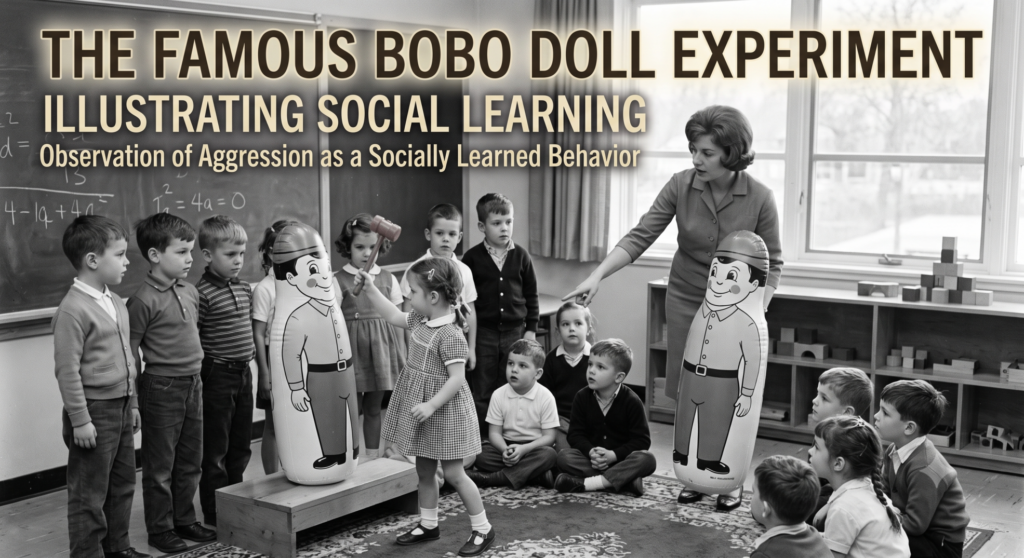
Albert Bandura (1925–2021) believed children learn through observation. His “Bobo Doll” experiment demonstrated observational learning (Bandura, 1977).
| Concept | Description |
|---|---|
| Modelling | Children imitate behaviours of others, especially role models. |
| Vicarious Reinforcement | Children learn consequences by observing others. |
| Reciprocal Determinism | Behaviour, personal factors, and environment all influence each other. |
Bronfenbrenner’s Ecological Systems Model
Urie Bronfenbrenner (1917–2005) suggested that child development is shaped by multiple environmental systems (Bronfenbrenner, 1979).
| System | Description |
|---|---|
| Microsystem | Immediate environment (family, peers, school). |
| Mesosystem | Interactions between microsystems (e.g., home and school). |
| Exosystem | Indirect environments (e.g., parent’s workplace). |
| Macrosystem | Culture, laws, societal norms. |
| Chronosystem | Time and life transitions affecting development. |
Bowlby’s Attachment Theory in Child Development
John Bowlby (1907–1990) believed secure caregiver bonds shape future relationships (Bowlby, 1969).
| Concept | Description |
|---|---|
| Attachment | An emotional bond with a caregiver promotes security. |
| Secure Attachment | Responsive caregiving fosters emotional health. |
| Insecure Attachment | Inconsistent caregiving leads to trust and relationship issues. |
Ainsworth’s 4 Attachment Styles Explained
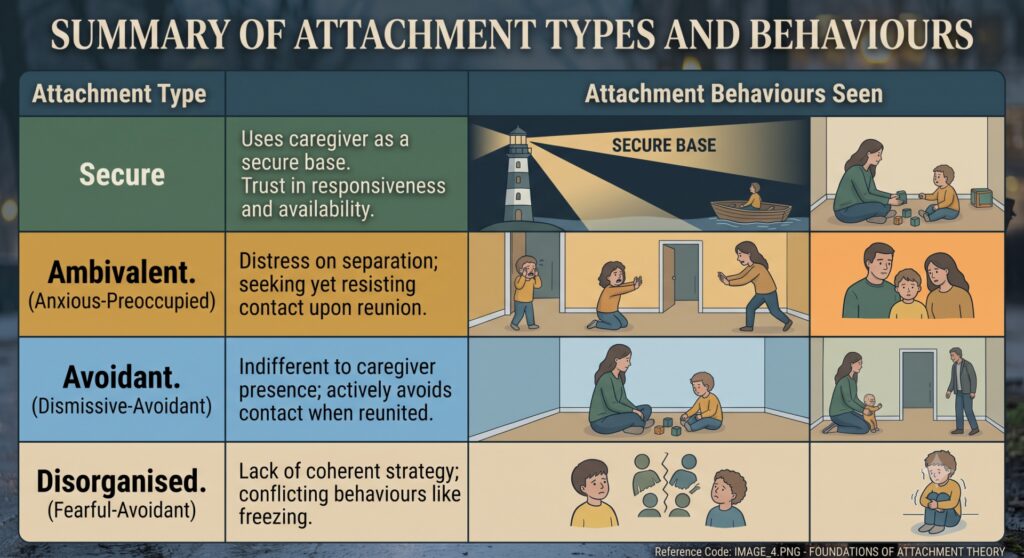
Mary Ainsworth (1913–1999) expanded Bowlby’s work through her “Strange Situation” study (Ainsworth, 1978).
| Attachment Style | Description |
|---|---|
| Secure Attachment | Distress when caregiver leaves, comforted upon return. |
| Insecure-Avoidant | Avoids or ignores caregiver; emotionally distant. |
| Insecure-Resistant | Clingy, distressed, not easily soothed. |
| Insecure-Disorganised | Contradictory behaviours; often linked to trauma or abuse. |
Frequently Asked Questions (FAQ)
Why are child development theories important for practitioners?
Child development theories provide structured frameworks that help teachers, social care workers, and parents understand how children learn, grow, and process emotions. They enable professionals to recognise milestone progressions, identify potential developmental delays early, and adapt practice to support individual needs.
What are the main theories of child development?
The primary theories of child development span cognitive, emotional, social, and psychological domains. Key frameworks include Piaget’s Cognitive Theory, Vygotsky’s Sociocultural Theory, Erikson’s Psychosocial Stages, Bandura’s Social Learning Theory, Bronfenbrenner’s Ecological Systems, and Bowlby and Ainsworth’s Attachment Theories.
How do Piaget and Vygotsky differ in their child development theories?
While Jean Piaget proposed that children learn independently through distinct cognitive stages of maturation, Lev Vygotsky emphasized that learning is fundamentally social. Vygotsky argued that children develop through social interaction, language, and culture within their Zone of Proximal Development (ZPD).
How does attachment theory apply to child development in educational settings?
Bowlby and Ainsworth’s attachment theories show that secure emotional bonds with primary caregivers foster a safe base for exploration and learning. In educational settings, understanding attachment styles helps practitioners build trusting adult-child relationships, reduce anxiety, and support emotional regulation.
References
- Berk, L. E. (2013). Child Development (9th ed.). Pearson Education. https://www.pearson.com/en-us/subject-catalog/p/child-development/P200000003058 (Publisher Entry)
- Piaget, J. (1952). The Origins of Intelligence in Children. International Universities Press. https://doi.org/10.1037/11494-000 (APA PsycNet / Official DOI)
- Vygotsky, L. S. (1978). Mind in Society: The Development of Higher Psychological Processes. Harvard University Press. https://www.hup.harvard.edu/books/9780674576292 (Harvard University Press)
- Erikson, E. H. (1963). Childhood and Society. W. W. Norton & Company. https://wwnorton.com/books/9780393310689 (Publisher Entry)
- Freud, S. (1905). Three Essays on the Theory of Sexuality. Basic Books. https://psycnet.apa.org/record/1926-10080-000 (APA PsycNet Record)
- Bandura, A. (1977). Social Learning Theory. Prentice-Hall. https://psycnet.apa.org/record/1977-28213-000 (APA PsycNet Record)
- Bronfenbrenner, U. (1979). The Ecology of Human Development: Experiments by Nature and Design. Harvard University Press. https://www.hup.harvard.edu/books/9780674224575 (Harvard University Press)
- Bowlby, J. (1969). Attachment and Loss: Vol. 1. Attachment. Basic Books. https://psycnet.apa.org/record/1969-16629-000 (APA PsycNet Record)
- Ainsworth, M. D. S., Blehar, M. C., Waters, E., & Wall, S. (1978). Patterns of Attachment: A Psychological Study of the Strange Situation. Lawrence Erlbaum Associates. https://doi.org/10.4324/9780203758045 (Official DOI Link)