

Please Enter Your Email ID
Table of Contents
Why Early Childhood Development Matters
While every developmental phase brings unique milestones, the first five years of life lay the foundation for a child’s lifelong trajectory. In educational and developmental research, this initial period is widely recognized as the most critical window in early childhood development (National Scientific Council on the Developing Child, 2007; Shonkoff et al., 2012).
During these formative years, a child’s environment, relationships, and experiences actively shape the physical architecture of their growing brain. Establishing a strong foundation between birth and age five promotes long-term resilience, educational attainment, and emotional wellbeing, whereas unaddressed early difficulties can create cumulative challenges in later life.
The Science of Rapid Brain Development in the First Five Years
The primary reason early childhood development is so vital comes down to neural plasticity—the brain’s extraordinary ability to grow and adapt in response to experiences. Between birth and age five, the human brain develops faster than at any other point in the lifespan, forming more than one million new neural connections every single second.
Both positive (nurturing) and negative (stressful or adverse) environments directly influence how these neural pathways are wired:
- Nurturing, Responsive Environments: Consistent, sensitive caregiving reinforces neural connections responsible for higher-order cognitive skills, language acquisition, executive functioning, and emotional self-regulation.
- Adverse or Neglectful Environments: Chronic stress or lack of responsive interaction can overload a child’s stress-response system, disrupting healthy brain architecture and impacting long-term physical and mental health.
Ultimately, the brain architecture established during early childhood serves as the biological foundation for all future learning, behavior, and physical health in adulthood.
How Early Experiences Shape Long-Term Outcomes
The trajectory of early childhood development plays a critical role in shaping adult mental health and social capability. John Bowlby’s seminal work on Attachment Theory (1969) highlights how early caregiving environments directly influence long-term psychological resilience.
When infants form secure attachments in their first year, they build a psychological safety net that fosters healthy emotional regulation across their lifespan. In contrast, early neglect or inconsistent caregiving can result in insecure attachment patterns, leading to persistent emotional and relational difficulties in adulthood.
5 Core Domains of Early Childhood Development
The first five years of life mark a period of extraordinary brain growth. During this urgent phase, a child’s brain forms the groundwork for lifelong learning, behaviour, and overall health.
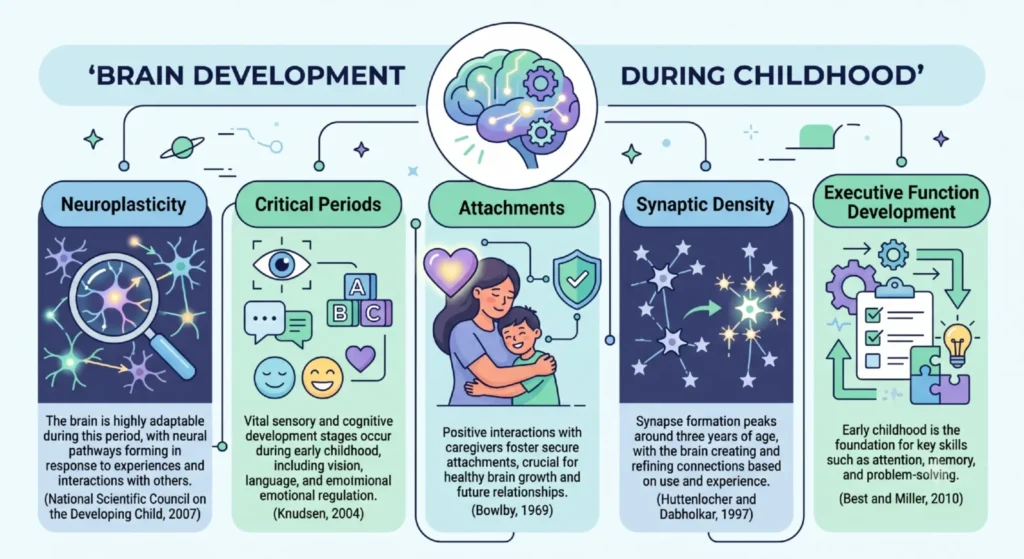
Early childhood development during this foundational period centers on five interconnected domains:
- Neuroplasticity: The brain is uniquely adaptable in early childhood. Neural pathways rapidly form and reconfigure in direct response to daily experiences and interpersonal interactions (National Scientific Council on the Developing Child, 2007).
- Critical Periods: Specific sensory and cognitive windows open during early childhood, setting the trajectory for vision, language processing, and emotional regulation (Knudsen, 2004).
- Attachment Security: Warm, responsive interactions with primary caregivers build secure attachments. These bonds directly support healthy brain architecture and future relationship stability (Bowlby, 1969).
- Synaptic Density: Synaptic connections reach peak density around age three, as the brain continually builds and refines neural pathways based on environmental usage (Huttenlocher & Dabholkar, 1997).
- Executive Function Development: Early experiences establish core cognitive control capabilities, including working memory, flexible thinking, and self-regulation (Best & Miller, 2010).
Key Takeaway: By age three, a child’s brain creates more than 1 million new neural connections every second. Because of this high adaptability, positive, nurturing environments are essential to safeguard development against the disruptive impacts of chronic stress or adversity.
Cognitive and Language Development in Early Childhood
Language acquisition represents a major milestone in early childhood development, marking a child’s first steps toward independence and self-expression. Communication skills evolve through distinct stages shaped by biological readiness and environmental stimulation:
| Stage | Typical Age | Key Language Milestones |
| Pre-Linguistic | Birth – 12 Months | Cooing, facial expressions, babbling, and repeated syllables (e.g., “mamamama”). First words emerge around 12 months (Stoel-Gammon, 2003). |
| First Words | 12 – 24 Months | Rapid vocabulary growth (~50 words by 18 months). Two-word phrases emerge (e.g., “want drink”). Receptive language exceeds expressive speech (Bloom, 1973). |
| Rapid Growth | 2 – 3 Years | Vocabulary expands to roughly 1,000 words. Children begin using simple adjectives, asking “why?”, and forming basic sentences (Kuhl, 2004). |
| Refinement | 3 – 4 Years | Speech clarity improves significantly. Children begin using plurals, past tense verbs, and structured sentences to retell simple events. |
| Advanced Language | 4 – 5 Years | Vocabulary surpasses 2,000 words. Children build complex sentences using conjunctions (“because”) to share ideas and solve problems (Dickinson & Tabors, 2001). |
Caregivers directly influence language acquisition. Creating language-rich environments through conversation, shared storytelling, and interactive reading strengthens early literacy and sets the stage for academic success (Weisleder & Fernald, 2013).
Social-Emotional Development and Attachment Security
Social-emotional growth during early childhood development centers on understanding emotions, managing reactions, and forming healthy relationships with others.
Key Milestones from Birth to Age 5
- Infancy (Birth – 12 Months): Building Secure Bonds – Infants establish primary attachments through eye contact, smiles, and cooing (Bowlby, 1969). By 6 to 9 months, social awareness deepens as babies participate in interactive games like peek-a-boo and mirror caregiver emotions.
- Toddlerhood (1 – 2 Years): Exploration and Self-Awareness – Securely attached toddlers use caregivers as a safe base from which to explore. Self-recognition emerges (e.g., identifying themselves in mirrors), alongside early expressions of empathy toward peers.
- Early Preschool (2 – 3 Years): Parallel Play & Emotional Naming – Children begin playing alongside peers (parallel play) while learning to label basic emotions (Rochat, 2003). Independence grows, alongside a need for caregiver guidance during emotional dysregulation.
- Preschool (3 – 4 Years): Cooperative Play & Negotiation – Children move into cooperative play, taking on roles in imaginative play setups and building early friendships (Dunn, 2006). They begin resolving minor conflicts and applying simple emotional regulation tools.
- Pre-K (4 – 5 Years): Emotional Maturity & Impulse Control – By age five, children demonstrate stronger impulse control, navigate group dynamics, and show a clearer understanding of social rules and behavioral boundaries (Saarni, 1999).
Physical and Motor Skill Milestones in Early Childhood Development
Physical progression in early childhood development splits into two core categories: gross motor skills (large muscle movements like running and jumping) and fine motor skills (precise movements like gripping a crayon or using scissors) (Gallahue et al., 2020).
- Infancy (0 – 12 Months): Movement evolves from tummy-time head lifts to rolling, sitting unsupported, crawling, and pulling to stand. The pincer grasp (picking up objects with thumb and forefinger) emerges near the end of the first year (Adolph & Berger, 2006).
- Toddlerhood (1 – 2 Years): Independent walking begins, followed by climbing and running attempts. Fine motor precision improves through stacking blocks, holding spoons, and scribbling.
- Early Preschool (2 – 3 Years): Gross motor control expands to jumping, kicking balls, and riding tricycles. Fine motor progress allows children to complete basic puzzles and control eating utensils more effectively.
- Preschool (3 – 4 Years): Children run with stability, hop on one foot, and catch large balls. Fine motor coordination develops enough for cutting along lines with safety scissors and drawing basic geometric shapes.
- Pre-K (4 – 5 Years): Advanced coordination allows skipping, riding bikes with training wheels, and precise ball skills. Fine motor control advances to forming legible letters, detailed drawing, and independent dressing (zippers, buttons).
Environmental Influences on Early Childhood Development
Although formal education typically begins at age five, the foundation laid during early childhood development plays a critical role in shaping a child’s academic outcomes and long-term school success.
Key Foundational Skills for School Readiness
Before entering a classroom, children benefit from developing core cognitive skills that support lifelong learning:
- Pre-Literacy Skills: Recognising letters, identifying sounds, and engaging with print are essential building blocks for early reading and writing (Whitehurst & Lonigan, 1998).
- Early Numeracy Skills: Counting, identifying numbers, and grasping basic spatial concepts like size and patterns set the stage for mathematical reasoning (Sarama & Clements, 2009).
How Caregivers Can Foster a Supportive Learning Environment
Caregivers play a vital role in guiding early childhood development through everyday interactions and intentional learning strategies:
- Build a Rich Vocabulary Library: Speak, read, and sing regularly with your child to expand their vocabulary and speech comprehension.
- Expose Children to Structured Settings: Encourage participation in preschool, playgroups, or community programs to help children adapt to routines and group dynamics.
- Encourage Purposeful Play: Utilize puzzles, building blocks, and imaginative role-play to build social skills, spatial awareness, and problem-solving abilities (Ginsburg et al., 2007).
- Establish Predictable Routines: Consistent mealtimes, sleep schedules, and activity blocks build emotional security and self-regulation.
- Ask Open-Ended Questions: Prompt critical thinking by asking questions that require more than a “yes” or “no” answer (e.g., “What do you think happens next?”).
- Promote Independence: Teach age-appropriate self-care tasks (dressing, tidying up) to foster confidence and resilience.
Key Insight: Prioritising these early development skills increases a child's likelihood of achieving academic success, building healthy relationships, and adapting to educational challenges later in life.
Protecting Early Childhood Development from Chronic Stress and Adverse Childhood Experiences (ACEs)
The foundational years of early childhood development are vital for establishing the bedrock of lifelong mental health, emotional regulation, and cognitive resilience (National Scientific Council on the Developing Child, 2015). During this sensitive window, children undergo rapid neural growth, form primary relationships, and build internal frameworks for processing emotion.
Key Developmental Benchmark: By age five, a child’s brain reaches approximately 90% of its adult size.
During these early years, the neural architecture responsible for stress response, self-regulation, and social interaction forms at an unprecedented pace. However, this high level of neuroplasticity also leaves the developing brain vulnerable to environmental disruption.
The Impact of Chronic Stress and Toxic Stress Responses
When a child experiences prolonged adversity—such as severe neglect, domestic instability, or chronic hardship—without supportive adult buffers, the body activates a toxic stress response. Unlike normal stress reactions, toxic stress leads to:
- Elevated Cortisol Levels: Sustained stress hormones disrupt the structural architecture of the prefrontal cortex and amygdala.
- Impaired Executive Functioning: Prolonged stress hinders the natural development of impulse control, working memory, and cognitive flexibility.
- Relationship Challenges: Insecure caregiving environments make it difficult for children to build secure attachments, affecting social interactions in later childhood and adulthood.
Safeguarding Early Growth Through Protective Buffers
Buffering children from the long-term impact of ACEs does not require a stress-free environment, but rather the presence of responsive, caring adults. Caregivers can protect early brain architecture through:
- Consistent, Nurturing Interactions: Providing predictable care and emotional availability to calm the child’s nervous system.
- Promoting Emotion Regulation Skills: Helping children name their feelings and teaching co-regulation strategies during distress.
- Early Intervention Services: Accessing community support, family counselling, or educational resources at the first sign of emotional or developmental disruption.
By prioritising nurturing environments, caregivers and educators can mitigate the risks associated with toxic stress, safeguarding early childhood development and fostering lifelong emotional health.
How Early Childhood Development Influences Long-Term Life Outcomes
Development during the first five years of life establishes the baseline for a child’s physical health, mental well-being, cognitive capability, and social competence.
While positive early experiences foster growth, developmental trajectories can be significantly altered by environmental adversity, including chronic stress, childhood trauma, abuse, neglect, and socio-economic deprivation (Felitti et al., 1998).
The Power of Positive Early Environments
Children raised in supportive, enriched environments with responsive caregivers consistently demonstrate stronger long-term outcomes across several core areas:
- Academic Success: Higher rates of school readiness, literacy, and educational attainment.
- Physical & Mental Health: Lower incidence of chronic health conditions and stronger emotional self-regulation in adulthood.
- Social Stability: Enhanced capacity for building healthy, fulfilling personal and professional relationships.
The Economic and Social Case for Early Intervention
Providing targeted support during these foundational years offers the highest return on investment for both the individual child and society as a whole.
Key Research Insight: Nobel laureate James Heckman (2017) demonstrated that quality early childhood development interventions for vulnerable children deliver up to a 13% annual return on investment through improved health, education, and economic outcomes.
Early intervention mitigates the long-term impacts of early adversity, helping to break generational cycles of disadvantage and shaping better futures for children, families, and communities.
Frequently Asked Questions (FAQ)
How does early childhood development affect long-term health?
Early experiences shape the physical architecture of the developing brain and nervous system. Positive environments promote healthy stress-response systems, whereas chronic early adversity can increase the long-term risk of cardiovascular issues, mental health struggles, and metabolic disorders in adulthood.
What is the economic benefit of early childhood intervention?
According to research by economist James Heckman, high-quality early childhood development programmes yield up to a 13% return on investment per year through reduced healthcare costs, lower spending on remedial education, and increased adult earning potential.
Can the negative impacts of early childhood adversity be mitigated?
Yes. While early adversity presents significant challenges, protective factors—such as supportive relationships with caring adults, targeted early interventions, and trauma-informed support—can help rebuild resilience and alter a child’s developmental trajectory.
How does chronic stress affect early brain development?
Chronic or “toxic” stress triggers a continuous release of stress hormones like cortisol. Without responsive caregivers to buffer the stress, these hormones can disrupt brain architecture, specifically impairing areas responsible for memory, learning, and emotional regulation.
References
Adolph, K. E., & Berger, S. E. (2006). Motor development. In W. Damon & R. M. Lerner (Eds.), Handbook of Child Psychology: Vol. 2. Cognition, Perception, and Language (6th ed., pp. 161–213). John Wiley & Sons. https://doi.org/10.1002/9780470147658.chpsy0204
Best, J. R., & Miller, P. H. (2010). A developmental perspective on executive function. Child Development, 81(6), 1641–1660. https://doi.org/10.1111/j.1467-8624.2010.01499.x
Bloom, L. (1973). One Word at a Time: The Use of Single Word Utterances Before Syntax. Mouton & Co. https://doi.org/10.1515/9783110867848
Bowlby, J. (1969). Attachment and Loss: Vol. 1. Attachment. Basic Books. https://books.google.com/books/about/Attachment_and_Loss.html?id=1h89j7-Oe5kC
Dickinson, D. K., & Tabors, P. O. (2001). Beginning Literacy with Language: Young Children Learning at Home and School. Paul H. Brookes Publishing Co. https://brookespublishing.com/product/beginning-literacy-with-language/
Dunn, J. (2006). Children’s relationships: Bridging the divide between cognitive and social development. Journal of Child Psychology and Psychiatry, 47(3‐4), 332–353. https://doi.org/10.1111/j.1469-7610.2006.01615.x
Felitti, V. J., Anda, R. F., Nordenberg, D., Williamson, D. F., Spitz, A. M., Edwards, V., Koss, M. P., & Marks, J. S. (1998). Relationship of childhood abuse and household dysfunction to many of the leading causes of death in adults: The Adverse Childhood Experiences (ACE) Study. American Journal of Preventive Medicine, 14(4), 245–258. https://doi.org/10.1016/s0749-3797(98)00017-8
Gallahue, D. L., Ozmun, J. C., & Goodway, J. D. (2020). Understanding Motor Development: Infants, Children, Adolescents, Adults (8th ed.). Jones & Bartlett Learning. https://www.jblearning.com/catalog/productdetails/9781284174946
Ginsburg, K. R., Committee on Communications, & Committee on Psychosocial Aspects of Child and Family Health. (2007). The importance of play in promoting healthy child development and maintaining strong parent-child bonds. Pediatrics, 119(1), 182–191. https://doi.org/10.1542/peds.2006-2697
Heckman, J. J. (2017). The Lifecycle Benefits of an Influential Early Childhood Program. The Heckman Equation. https://heckmanequation.org/resource/lifecycle-benefits-influential-early-childhood-program/
Huttenlocher, P. R., & Dabholkar, A. S. (1997). Regional differences in synaptogenesis in human cerebral cortex. The Journal of Comparative Neurology, 387(2), 167–178. https://doi.org/10.1002/(sici)1096-9861(19971020)387:2<167::aid-cne1>3.0.co;2-z
Knudsen, E. I. (2004). Sensitive periods in the development of the brain and behavior. Journal of Cognitive Neuroscience, 16(8), 1412–1425. https://doi.org/10.1162/0898929042304796
Kuhl, P. K. (2004). Early language acquisition: Cracking the speech code. Nature Reviews Neuroscience, 5(11), 831–843. https://doi.org/10.1038/nrn1533
National Scientific Council on the Developing Child. (2007). The Science of Early Childhood Development: Closing the Gap Between What We Know and What We Do. Center on the Developing Child at Harvard University. https://developingchild.harvard.edu/resources/report/the-science-of-early-childhood-development-closing-the-gap-between-what-we-know-and-what-we-do/
National Scientific Council on the Developing Child. (2015). Supportive Relationships and Active Skill-Building Strengthen the Foundations of Resilience: Working Paper No. 13. Center on the Developing Child at Harvard University. https://developingchild.harvard.edu/resources/supportive-relationships-and-active-skill-building-strengthen-the-foundations-of-resilience/
Rochat, P. (2003). Five levels of self-awareness as they unfold early in life. Consciousness and Cognition, 12(4), 717–731. https://doi.org/10.1016/s1053-8100(03)00081-3
Saarni, C. (1999). The Development of Emotional Competence. Guilford Press. https://www.guilford.com/books/The-Development-of-Emotional-Competence/Carolyn-Saarni/9781572304345
Sarama, J., & Clements, D. H. (2009). Early Childhood Mathematics Education Research: Learning Trajectories for Young Children. Routledge. https://doi.org/10.4324/9780203883785
Shonkoff, J. P., Garner, A. S., Committee on Psychosocial Aspects of Child and Family Health, Committee on Early Childhood, Adoption, and Dependent Care, & Section on Developmental and Behavioral Pediatrics. (2012). The lifelong effects of early childhood adversity and toxic stress. Pediatrics, 129(1), e232–e246. https://doi.org/10.1542/peds.2011-2663
Stoel-Gammon, C. (2003). Complexities of phonological development and disorders. Folia Phoniatrica et Logopaedica, 55(6), 283–288. https://doi.org/10.1159/000073250
Weisleder, A., & Fernald, A. (2013). Talking to children matters: Early language experience strengthens processing and builds vocabulary. Psychological Science, 24(11), 2143–2152. https://doi.org/10.1177/0956797613488145
Whitehurst, G. J., & Lonigan, C. J. (1998). Child development and emergent literacy. Child Development, 69(3), 848–872. https://doi.org/10.1111/j.1467-8624.1998.tb06247.x