

Please Enter Your Email ID
Table of Contents
Youth work occupies a vital, unique space in the broader landscape of social care, formal schooling, and community provision. While traditional educational institutions rely on structured curricula, standardised testing, and formal classroom hierarchies, the foundations of youth work approaches come from a distinct, person-centred perspective. It is rooted in voluntary engagement, informal education, and trusted relationships.
To understand its true value, one must explore the fundamental principles of youth work alongside established theories of child and adolescent development. When these domains interact, youth work serves not merely as a recreational activity, but as a critical catalyst for emotional, cognitive, social, and moral growth.
What are the Core Foundations of Youth Work?
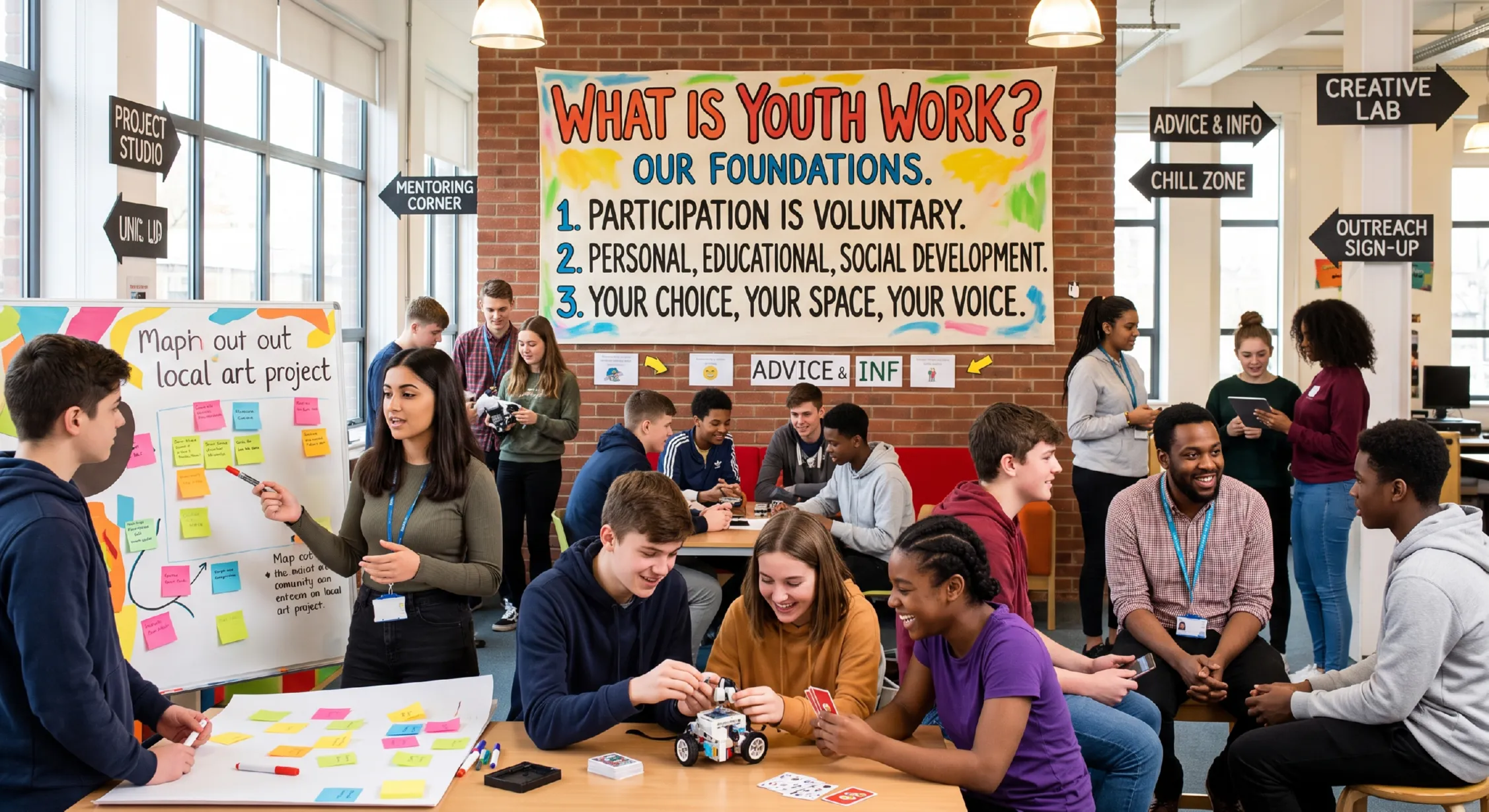
At its core, youth work comprises purposeful interventions designed to facilitate the personal, educational, and social development of young people aged roughly between 8 and 25. Unlike compulsory schooling, the defining hallmark of youth work is that participation is voluntary. A young person chooses to attend a youth provision, enrol in an outreach project, or converse with a detached youth worker.
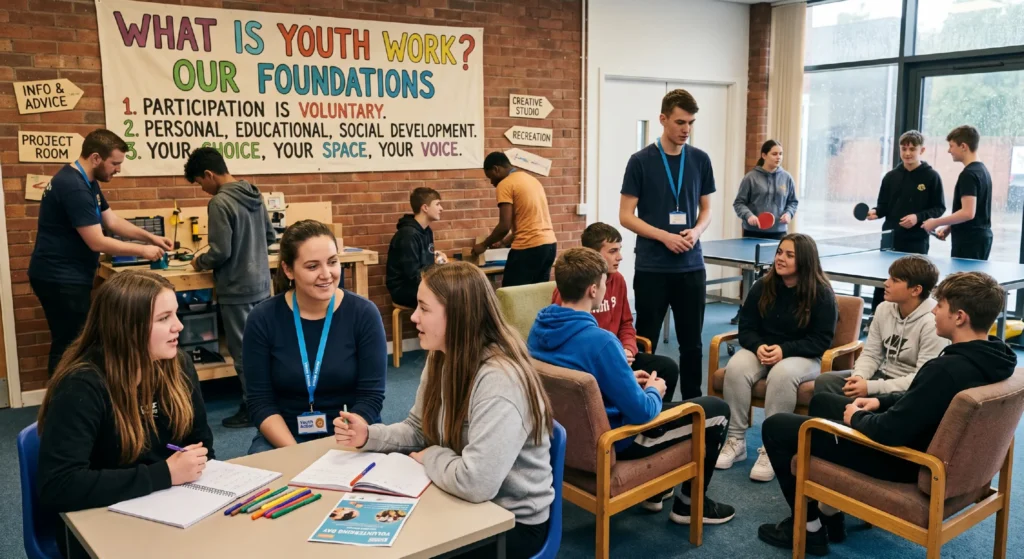
This dynamic alters the conventional power structure between adult and child, shifting the adult’s role from an authoritative instructor to a facilitator, mentor, and advocate.
1. Voluntary Engagement
Because young people enter youth work spaces willingly, engagement rests entirely on mutual respect and genuine interest. If a young person feels patronised, judged, or constrained, they can simply leave. This reality compels practitioners to build authentic relationships from the outset.
2. Informal and Non-Formal Education
While formal education operates on a fixed syllabus, informal education starts from where the young person is situated. Conversations around everyday challenges—such as peer conflict, managing stress, or setting goals—become natural learning opportunities. Informal learning is experiential: young people learn through action, reflection, dialogue, and collaborative problem-solving.
3. A Person-Centred, Asset-Based Approach
Traditional interventions often view young people through a “deficit model”—treating them as problems to be fixed, risks to be managed, or gaps to be filled. Youth work adopts an asset-based approach, viewing young people as resources with intrinsic agency, talents, and perspectives that can enrich their broader community.
4. Empowerment and Voice
Youth work seeks to shift power to young people. Whether organising a community event, managing a youth committee, or designing club activities, participants develop autonomy, civic responsibility, and a sense of ownership over their lives and spaces.
5. Equity, Diversity, and Social Justice
Youth work proactively dismantles barriers created by systemic discrimination, socioeconomic disadvantage, and inequality. It creates inclusive environments where young people from diverse backgrounds feel secure, valued, and heard.
The Intersection: Youth Work Meets Child and Adolescent Development
Child development encompasses biological, psychological, and emotional changes occurring between birth and the end of adolescence. While childhood lays down physical and foundational cognitive tracks, adolescence is marked by rapid neurological remodelling, identity exploration, and shifting social orientations.
During this transitional phase, the scaffolding provided by families and schools often experiences strain. Young people seek independence, push boundaries, and lean heavily into peer culture. Youth work bridges this critical transitional divide.
1. Cognitive Development and Constructivism
Jean Piaget: Active Experimentation
Jean Piaget posited that individuals construct knowledge through active interactions with their environment. In the later stages of cognitive growth—specifically the Formal Operational Stage (typically beginning around age 11–12)—young people develop the capacity for abstract thought, hypothetical reasoning, and systematic planning.
The Youth Work Application
Youth clubs and community projects offer natural testbeds for abstract thinking:
- Real-world planning: Organising a trip, budgeting for equipment, or creating a group project requires young people to plan, anticipate problems, and test hypothetical outcomes.
- Reflective practice: Youth workers guide young people to evaluate experiences: “What worked well? What would you do differently next time?” This turns practical actions into lasting cognitive insights.
Lev Vygotsky: The Zone of Proximal Development (ZPD) and Scaffolding
Lev Vygotsky argued that cognitive development occurs through social interactions. His concept of the Zone of Proximal Development (ZPD) defines the space between what a learner can achieve independently and what they can achieve with guidance from a More Knowledgeable Other (MKO).
The Youth Work Application
In youth work, the youth worker or a more experienced peer acts as the facilitator:
- Rather than providing ready-made answers, workers scaffold experiences. When a young person encounters an obstacle—such as resolving a team dispute or learning a new skill—the worker provides strategic prompts, emotional encouragement, and guidance until the individual can manage the task independently.
- Vygotsky’s emphasis on dialogue aligns directly with the conversational approach of informal education.
2. Psychosocial Development and Identity Formation
Erik Erikson: Identity vs. Role Confusion
Erik Erikson outlined eight stages of psychosocial development, with adolescence defined by the crisis of Identity vs. Role Confusion (Ages 12–18). During this period, young people ask fundamental questions: Who am I? Where do I belong? What do I stand for?
Failure to navigate this phase successfully can lead to role confusion, disengagement, and vulnerability to negative influences.
How Youth Work Supports Identity Exploration
- A Psychologically Safe Third Space: Sociologist Ray Oldenburg coined the concept of the “third place”—environments outside the home (first space) and school/work (second space). Youth clubs represent safe third spaces where young people can experiment with personal styles, artistic expressions, and social roles free from academic appraisal or domestic pressure.
- Constructive Failure: In a youth work setting, mistakes do not lead to bad marks or disciplinary sanctions. They are treated as natural learning curves, fostering resilience and healthy self-definition.
- Civic and Cultural Grounding: Youth work exposes individuals to civic action, volunteering, and diverse peer networks, helping them form an identity rooted in community and social contribution.
3. Attachment and Emotional Development
John Bowlby: Secure Bases Outside the Family
Attachment theory shows that infants form bonds with primary caregivers to feel safe and protected. However, as children grow into adolescence, the circle of attachment figures expands. Adolescents need secondary attachment figures who provide a secure base from which to explore the wider world.
The Role of the Youth Worker
- Reliable Consistency: For young people navigating unstable home environments or adverse childhood experiences, a youth worker can be one of the few predictable, non-judgmental adults in their lives.
- Unconditional Positive Regard: Drawn from Carl Rogers’ person-centred psychology, youth work offers acceptance without performance prerequisites. Unlike school, where positive reinforcement is often tied to academic performance or conformity, youth work values young people simply for who they are.
- Emotional Regulation: When crises occur, youth workers provide co-regulation, helping young people recognise emotional triggers, de-escalate tension, and build lasting coping strategies.
4. Social and Moral Development
Urie Bronfenbrenner’s Ecological Systems Theory
Bronfenbrenner viewed development as an interconnected ecosystem:
- Microsystem: Direct relationships (family, school, peer groups, youth clubs).
- Mesosystem: The interactions between microsystems (e.g., how youth workers communicate with parents or schools).
- Exosystem: External environments affecting the youth (community resources, social welfare policies).
- Macrosystem: Overarching cultural values, socioeconomic status, and systemic structures.
Adverse childhood environments and wider social conditions heavily shape developmental trajectories across these ecological layers (Lopez et al., 2021).
Youth Work as an Ecosystemic Bridge
Youth work operates across these ecological systems. It enriches the immediate microsystem by introducing positive peer networks and adult role models. Furthermore, it strengthens the mesosystem by liaising with schools, mental health services (such as Child and Adolescent Mental Health Services), and community centres to create a holistic network of support around vulnerable young people.
Core Domains of Child Development Supported by Youth Work
| Developmental Domain | Key Developmental Milestones | How Youth Work Intervenes |
| Physical & Motor | Pubertal growth, spatial awareness, physical health habits. | Sports leagues, outdoor education, dance, health and nutrition workshops. |
| Cognitive & Executive | Critical thinking, long-term planning, problem-solving, impulse control. | Youth councils, project budgeting, creative writing, social action initiatives. |
| Social & Relational | Navigating peer dynamics, collaboration, conflict management. | Group activities, peer mentoring, anti-bullying workshops, community forums. |
| Emotional & Identity | Self-esteem, emotional regulation, sense of purpose, agency. | Mentoring discussions, 1-to-1 key working, reflective arts, safe social spaces. |
| Moral & Ethical | Empathy, social justice awareness, civic responsibility. | Community volunteering, restorative justice circles, equality dialogues. |
Contemporary Challenges: Why the Foundations Matter Today
In modern society, young people navigate pressures that were unknown to previous generations:
- Digital Overload and Social Media: Rising rates of anxiety, screen addiction, cyberbullying, and unrealistic peer comparisons.
- Mental Health Crises: Increasing demand on statutory health and social care services, leading to long waiting lists.
- Erosion of Public Space: A systemic reduction in youth services, local authority funding, and safe spaces for young people to gather without commercial pressure.
The foundations of youth work provide direct solutions to these modern challenges. By focusing on connection, real-world community, and holistic wellbeing, youth work acts as a vital early-intervention strategy. It intercepts problems before they escalate into statutory crises, saving public resources while protecting vulnerable young lives.
Frequently Asked Questions (FAQ)
What are the main principles of youth work?
The core principles of youth work include voluntary participation, informal education, equal partnership between worker and young person, empowerment, and a focus on social justice and inclusion.
How does youth work differ from formal teaching?
While formal teaching follows a mandatory, structured national curriculum assessed via examinations, youth work is voluntary, person-centred, and focused on experiential, non-formal learning shaped by the young person’s immediate interests and life needs.
At what age does youth work begin?
Youth work generally focuses on young people aged 11 to 25, though many early-intervention community programmes work with children from age 8 onwards to support the transition from primary to secondary education.
How does youth work support emotional wellbeing?
Youth work provides safe environments, positive role models, and opportunities for open dialogue. By fostering self-esteem, active listening, and healthy peer networks, youth workers help individuals manage stress and build emotional resilience.
Why is voluntary participation so critical in youth work?
Voluntary participation ensures that the relationship between the youth worker and the young person is built on mutual consent, trust, and respect. It removes the power imbalances inherent in mandatory settings, giving the young person ownership over their learning and development.
References
- Bowlby, J. (1969). Attachment and loss: Vol. 1. Attachment. Basic Books.
- Bronfenbrenner, U. (1979). The ecology of human development: Experiments by nature and design. Harvard University Press.
- Erikson, E. H. (1968). Identity: Youth and crisis. W. W. Norton & Company.
- Piaget, J. (1952). The origins of intelligence in children (M. Piercy & D. E. Berlyne, Trans.). International Universities Press. https://doi.org/10.1037/11494-000
- Vygotsky, L. S. (1978). Mind in society: The development of higher psychological processes (M. Cole, V. John-Steiner, S. Scribner, & E. Souberman, Eds.). Harvard University Press.