

Please Enter Your Email ID
Table of Contents
Direct Work Resources for Social Workers Working with Children
Direct work refers to any activity where adults, particularly safeguarding professionals such as social workers or school safeguarding leads, engage with children in a purposeful, planned, and therapeutic manner. This interaction aims to understand the children’s needs, promote their well-being, and help them achieve positive outcomes.
These direct work resources for social workers and safeguarding professionals are designed to make it easier to understand the lived experiences of children and young people. Some examples of direct work include:
- Therapeutic sessions (individual or group-based)
- Social skills and emotional regulation training
- Life story work for children in care
- Targeted interventions around identified extra-familial or familial risk
The Purpose of Direct Work with Children
Direct work is a purposeful, child-centred practice that gives young people a voice while providing safeguarding professionals with the insights needed to make informed decisions. When social workers, Designated Safeguarding Leads (DSLs), and practitioners use direct work resources effectively, it delivers five fundamental benefits:
Understanding the Child’s Lived Experience: Gaining an authentic perspective allows you to see the world through the child’s eyes. Uncovering their thoughts, feelings, and daily reality is vital for identifying unmet needs and delivering timely, targeted support.
Building Relational Trust & Safety: Establishing a strong therapeutic rapport creates a non-judgemental space where children feel safe to open up. Relational trust is the cornerstone of effective direct work tools with children.
Facilitating Communication Beyond Words: Many children struggle to articulate complex emotions verbally. Utilising creative direct work resources—such as therapeutic play, drawing prompts, sand tray activities, and storytelling—allows children to express themselves at their own pace.
Developing Coping Skills & Resilience: Practical exercises help children build self-esteem, master emotional self-regulation, and learn healthy coping strategies to navigate challenging life situations with confidence.
Addressing Trauma & Major Transitions: Targeted interventions support children in processing developmental trauma, managing social, emotional, and mental health (SEMH) difficulties, and navigating critical life transitions (such as entering care, changing schools, or moving home).
Direct Work Resources for Social Workers & Safeguarding Professionals
Direct work requires a flexible toolkit to engage, understand, and support children at different developmental stages. Below are the primary direct work resources and frameworks used by social workers, Designated Safeguarding Leads (DSLs), and child protection practitioners.
1. Relationship-Building & Engagement Tools
Establishing rapport is the essential first step in any child-centred intervention, particularly when working with anxious or non-verbal children.
- Icebreaker Activities: Low-pressure games like “Would You Rather?” or “Two Truths and a Lie” help reduce anxiety during initial sessions and can be adapted for all age groups.
- Shared Creative Activities: Engaging in low-demand tasks—such as colouring, building blocks, or simple card games—creates a comfortable atmosphere that encourages spontaneous communication.
- Therapeutic Storytelling & Metaphors: Using age-appropriate books, social stories, or metaphors allows children to explore sensitive topics indirectly, normalizing complex emotions in a safe environment.
2. Evidence-Based Assessment Tools & Frameworks
Standardised screening tools enable practitioners to assess social, emotional, and mental health (SEMH) needs while gathering structured evidence for safeguarding reports.
- Strengths and Difficulties Questionnaire (SDQ): A validated behavioural screening tool for children aged 3–16, completed by young people, parents, or teachers to assess emotional symptoms, conduct, and peer relationships.
- The Boxall Profile: An evidence-based framework designed for educational settings to assess the social, emotional, and behavioural development of pupils aged 4–18, helping inform targeted pastoral support.
- Analysis of Children’s Artwork: Evaluating the content, symbolism, and spatial layout of a child’s drawings provides valuable qualitative insights into their inner thoughts, feelings, and lived experiences.
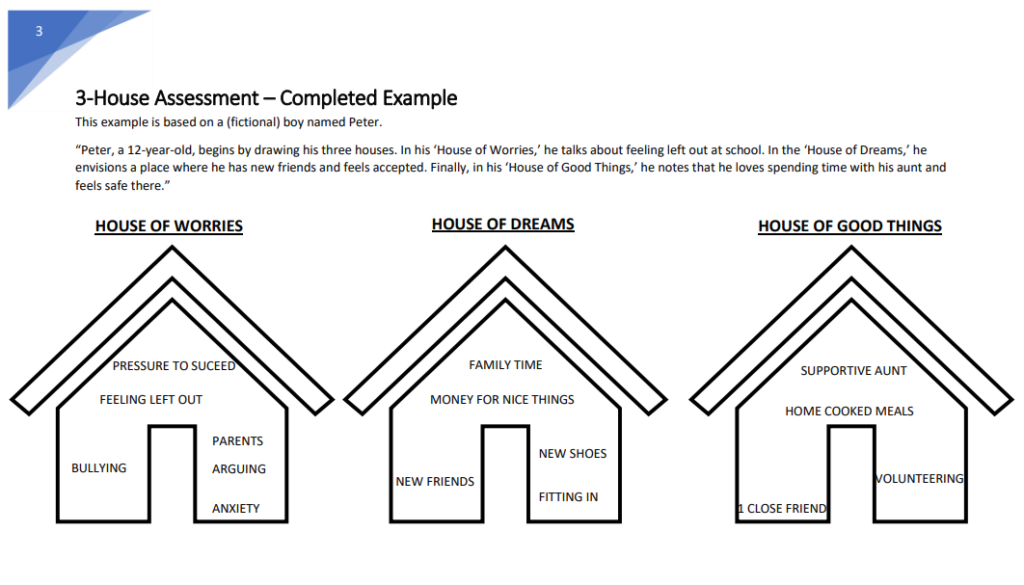
📥 Free Printable Resource: Download the 'Three Houses' Child Voice Assessment Worksheet (PDF)
A classic direct work tool designed to explore the House of Hopes, House of Worries, and House of Dreams to capture a child's perspective during statutory assessments.
3. Emotion Regulation & Resilience Resources
Practical tools help children identify complex feelings, develop emotional literacy, and build healthy coping mechanisms for stressful situations.
- Zones of Regulation Framework: A visual system that categorises feelings into four coloured zones (Blue, Green, Yellow, Red), helping children recognise their emotional state and select appropriate self-regulation strategies.
- Visual Emotion Tools: Visual aids such as emotion wheels, feelings charts, and games like “Feelings Bingo” help children identify, name, and communicate their emotional states accurately.
- Mindfulness & Grounding Exercises: Simple deep breathing techniques, body scans, and sensory grounding exercises teach children how to manage physiological stress and regain focus.
- Social Skills & Problem-Solving Scenarios: Structured role-playing and real-life scenarios teach essential communication, conflict resolution, and decision-making skills.
4. Specialist Therapeutic Interventions
When working with children who have experienced adverse childhood experiences (ACEs) or trauma, specialist direct work resources provide structured, therapeutic support.
- Creative Arts & Animal-Assisted Therapies: Utilising music, drama, art, or trained therapy animals helps lower stress, foster emotional expression, and support children who struggle with traditional verbal communication.
- Play & Sand Tray Therapy: Non-verbal therapeutic approaches using miniatures, toys, and sensory materials allow children to externalise trauma, process difficult experiences, and gain a sense of agency.
- Trauma-Focused Cognitive Behavioural Therapy (TF-CBT): An evidence-based approach combining cognitive, behavioural, and family therapy techniques to help children recover from traumatic events.
1. What is the main purpose of direct work in child protection and social care?
Direct work provides a structured, child-centred approach to building relational trust, understanding a child’s lived experience, and capturing their authentic wishes and feelings. It ensures that the child’s voice directly informs statutory assessments, safety planning, and multi-agency safeguarding decisions.
2. Which direct work tools work best for non-verbal or anxious children?
Non-verbal and sensory-based resources—such as sand tray therapy, creative drawing prompts, emotion wheels, and visual frameworks like the Three Houses Tool—allow children to externalise complex feelings without relying solely on spoken communication.
3. How should social workers and DSLs document direct work for safeguarding reports?
Direct work sessions should be documented using the child’s exact quotes whenever possible to preserve their unedited voice. Reports should also record objective observations of the child’s non-verbal cues, emotional state, and engagement level during the activity.
What is the difference between direct work and therapeutic interventions?
Direct work refers to practical, goal-oriented activities used by safeguarding practitioners (such as social workers or school staff) to assess needs, explore feelings, and support communication. Therapeutic interventions (like TF-CBT or formal play therapy) are specialised clinical treatments delivered by qualified therapists to treat specific psychological conditions or trauma.